


📽️ CRUCIAL VIEWING
René Clair’s I MARRIED A WITCH (US)
Chicago Film Society at the Siskel Film Center — Thursday, 6pm
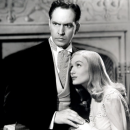
“‘Twill be sweet to plague the human race again,” is one of the first lines Veronica Lake’s Jennifer remarks in I MARRIED A WITCH, holding fast to her witch predilections. Jennifer is mischievous and otherworldly; she’s given life by Lake’s effervescent performance. Unbound by both reality and human behavior, she’s an unquestionably memorable and influential cinematic witch. The film is influential on the lighthearted depictions of housewife witches on film and television for decades to come. In revenge for being burned at the stake along with her father (Cecil Kellaway), Jennifer places a curse upon the perpetrator Jonathan Wooley and his entire line; every Wooley man will be fated to marry the exact wrong woman. In 1942, lightning strikes the tree under which father and daughter are buried; they return as magical smoke, though eventually taking human form. Determined to continue her tormenting, Jennifer finds the current descendent, the politician and soon to be married Wally (Fredric March, who plays all the Wooley men). Director René Clair and cinematographer Ted Telzlaff seamlessly fuse classic screwball moments with impressive fantasy and effects sequences; the scenes of Jennifer and father appearing as smoke by the tree are truly haunting, right out of an atmospheric horror film. The film’s fanciful nature doesn’t completely overpower the actuality of the situation and the darkness present at its start; this is perhaps most visibly seen through Jennifer’s distinct costume changes throughout the film, as they shift from white gowns to dark flowing garments and cloaks, more suited to a Hollywood witch. Even as the love story between Jennifer and Wally develops, her early impishness hangs over the film, commenting on the mystifying, and challenging, nature of love and relationships, even without the involvement of any magic at all. Preceded by Charles & Ray Eames’ 1957 short film DAY OF THE DEAD (15 min, 35mm). (1942, 77 min, 35mm) [Megan Fariello]
Warren Beatty's DICK TRACY (US)
Music Box Theatre — Monday, 7pm
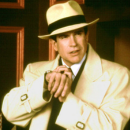
It suffices to say they don’t make them like they used to—the modern comic adaptation is less an homage to its source as it is a vehicle used to exploit its audience’s thirst for more, more, more, of anything and everything, such desires having been bred by the studios themselves. It’s with this in mind that I’d consider DICK TRACY a remarkable achievement, if not a masterpiece, for more than just its distinctive aesthetic; it knows its place, so to speak, both in regards to sincerity and drollery, qualities instilled by its undersung auteur. It’s not a personal project inasmuch as it was serendipity that brought Warren Beatty to it—Steven Spielberg, John Landis, Walter Hill, and even Alain Resnais were all tapped to direct at some point before Beatty, himself a fan of the comic and having wanted to make a Dick Tracy film since the ‘70s, optioned the rights and came on as director, producer, and leading man. The film’s plot, devised by Jim Cash and Jack Epps, Jr., with Beatty and collaborator Bo Goldman significantly rewriting the dialogue, and recalling the comic strip’s pulpy origins, is simple enough, even with ten plus villains: Yellow-clad detective Dick Tracy relentlessly pursues “Big Boy” Caprice (Al Pacino in what might honestly be one of his best performances) and his rogues gallery all whilst being torn between his personal life (long-suffering girlfriend Tess Trueheart and The Kid, an orphan who’d witnessed Big Boy’s germinal onslaught) and his work (aforementioned rogues and Madonna’s Breathless Mahoney, a lounge singer who falls hard for Tracy’s noble character). The canonical nature of its plot is in arrant contrast to the overburdened storylines of contemporary comic adaptations. Good and evil are just that, and archetypes are valuable for their insular purity; anyone who disagrees should try to synopsize any recent comic adaptation in so many lines. Pacino and Madonna are especially revelatory, though Beatty—whose performance wasn’t so well-received but I’d defend as demonstrating necessary restraint—and Glenne Headly as Tess are guilelessly amiable in what amounts to not-very-interesting characterizations. The film is also noted for its superior (almost to a fault) production design, its palette reportedly limited to just seven colors, the vivid costumes and gorgeous painted matte backdrops ironically reflecting the limited scope of comic art. Many critics accused the film of being too two-dimensional, but what’s the harm in that? What is DICK TRACY if not an exercise—or perhaps even a verdure exaltation—of Camp? To again quote Sontag, “Camp is a certain mode of aestheticism. It is one way of seeing the world as an aesthetic phenomenon. That way, the way of Camp, is not in terms of beauty, but in terms of the degree of artifice, of stylization.” Beatty’s visualization is just that—a veritable aesthetic phenomenon, a triumph of artistry not in spite of but because of its alleged failures. "Camp taste is, above all, a mode of enjoyment, of appreciation—not judgment,” Sontag asserted. “Camp is generous. It wants to enjoy… Camp taste doesn't propose that it is in bad taste to be serious; it doesn't sneer at someone who succeeds in being seriously dramatic. What it does is to find the success in certain passionate failures." It should say something about this film that the last point I’ll make in its favor is still far and above that of most other films—I’m referring to its soundtrack, with a score from Danny Elfman and five original songs by Stephen Sondheim. Beatty’s commitment to detail, which has proven to be an issue of contention between himself and those financing his films, from his allegiance to the source or inspiration, to various complementary elements, ranging from costumes to music, is the root of his auteurism. Born in a shadow cast by Tim Burton’s BATMAN the year prior, a lot of money, both on the production and marketing sides, went into making DICK TRACY the singular misadventure it’s remembered as today. Though part of its singularity likely stems from its patent declension (we cinephiles love a good underdog) and the doomed fate of a fabled sequel, one wonders how things might have been had the fortunes been reversed, if the overblown artistry of DICK TRACY had eclipsed the menacing excess heralded in by BATMAN. A girl can dream. Introduced by Grelley Duvall, with a preshow Madonna DJ set by Gaudy God starting at 6:30pm. (1990, 105 min, 35mm) [Kat Sachs]
Alfred Hitchcock x2
Music Box Theatre — See below for showtimes
Alfred Hitchcock's PSYCHO (US)
Sunday, 11:30am; Tuesday, 4pm; and Thursday, 9:45pm
So much ink has been spilled over PSYCHO that it might have been best if nothing had been written about it at all. More than any other Hitchcock film it deserves a fresh pair of eyes (perhaps the kind we'd find in a kid with hands that barely reach the ticket window and then cling to the armrest as he loses the main character less than half way in, as a lucky few recount). Even if the infamous shower scene has lost its surprise and shock value (but watch it closely anyway), there's still a great deal to enjoy: a black and white pallet fine-tuned down to Vera Miles' bra; Hitchcock's bizarre infatuation with the Oedipus Complex; Bernard Herrmann's superb score. From the outside it's a film we've become accustomed to, but in a dark theater it becomes hauntingly unfamiliar again. (1960, 109 min, 35mm) [Julian Antos]
---
Alfred Hitchcock's ROPE (US)
Monday, 9:45pm
While maybe not Hitchcock's best film, ROPE is certainly one of his most curious. Based on an English play entitled Rope's End in which two elitist university students murder an acquaintance and hold a cocktail party over his hidden corpse, Hitchcock's 1948 film sanitizes it for American audiences. The play, ostensibly about the infamous Leopold and Loeb case, purports a homosexual relationship between the two male leads, and a supposed affair with their former professor—the inspiration for the murder—who also sniffs out the crime at the party. Hitchcock's film, by removing the offending gay cues and suggestive Britishisms—"my boy!"—leaves us mostly with elephants in the room. According to screenwriter Arthur Laurents, Warner Bros. purportedly never used the word homosexuality or its variants, preferring to use "it," and never acknowledged its basis on Leopold and Loeb. It is only fitting that Hitchcock's ROPE, often described as an experiment, would strike such tension with Hollywood filmmaking: dialogue-driven, single location, long takes, etc. Even its unique editing construction—long shots that attempt to hide cuts by disguise through clever camera movements—is interesting considering the Hollywood style of "invisible" editing. ROPE isn't exactly subversive, but it doesn't play by the rules either—a distinctive feature for much of Hitchcock's work. (1948, 80 min, 35mm) [Brian Welesko]
---
Both screening as part of the Fond of Mother: Queer-Coded Hitchcock series.
Howard Hawks' THE CRIMINAL CODE (US/Silent)
Doc Films (at the University of Chicago) — Thursday, 8pm
Howard Hawks directed the pre-Code Hollywood crime film THE CRIMINAL CODE as his tenth feature. It was the director's first assignment for Columbia Studios; before this, he had made his mark in the silent era with comedies and dramas over at Fox. Made at the start of the 1930s, an era of class consciousness and unity that hasn't been replicated since, THE CRIMINAL CODE is a critique of the prison system that remains entertaining and never too theoretical for a wide audience. The film opens with Robert (Philips Holmes) receiving the maximum sentence of ten years after murdering a man in defense of his lover. The story then jumps six years into Robert’s prison term, where the harsh, cramped conditions have taken their toll on him. Living behind bars may wither the individual, but it strengthens the bonds between criminals. Boris Karloff gives a magnetic performance as a cellmate looking to seek revenge on the officer who has wronged him; he would go on to star as Frankenstein’s Monster the next year. THE CRIMINAL CODE depicts prisoners in a sympathetic light, asking the audience to imagine how they would feel if they were cramped in a space with strangers for years on end. Prior to this film, Hollywood regularly depicted prisoners as two-dimensional caricatures. A master storyteller, Hawks gave his actors the room to give compelling performances, whether it’s Holmes with his humanity or Karloff with his gripping realization of a character seeking vengeance. The performances carry the film even when the plot slows down. The pre-Code era, a new studio, and the introduction of sound provided the conditions for Hawks to expand his repertoire. Pushing the soundtrack to new realms of possibility, the speedy dialogue anticipates some of the classics Hawks would direct later in his career, namely the screwball comedies BRINGING UP BABY (1938) and HIS GIRL FRIDAY (1940) and the hard-boiled mystery THE BIG SLEEP (1946). Screening as part of the Howard Hawks’ Pre-War Years series. (1930, 97 min, 35mm) [Ray Ebarb]
📽️ ALSO RECOMMENDED
First Peek Members Week
Music Box Theatre — See Venue website for for showtimes [Free Admission for Music Box members only]
Vincente Minnelli's AN AMERICAN IN PARIS (US)
John Sayles's LIMBO has nothing on this ending: a magnificent seventeen-minute ballet, and then suddenly The End. What will happen between Gene Kelley and Leslie Caron? Perhaps Vincente Minnelli's wisest insight was knowing that we wouldn't really care. Seen today it's the details that grab your attention: It's: the artfully faux-Paris, artificial settings executed with such skill even the bottles behind the bar in a café become a study in early '50s MGM production design. It's the Gershwin, of course (there are at least eleven of his tunes on the soundtrack). And, more than anything, it's Oscar Levant, stealing every scene he's in—a particularly memorable dream sequence finds him conducting an orchestra of his own doppelgangers. And who can deny that the real sparks fly between Levant and Kelley, not Kelley and Caron? It's irrelevant whether or not you actually buy Kelley as a painter—the Technicolor is such an eyeful and the score so tuneful that it's enough to sit in a darkened theatre and drink it in. (1951, 113 min, DCP Digital) [Rob Christopher]
---
Marcel Camus' BLACK ORPHEUS (Brazil)
Adapted for the screen from Vinicius de Moraes Orfeu da Conseição, which itself is an adaptation of the tragedy of Orpheus and Eurydice from Greek mythology, BLACK ORPHEUS is a vibrant film teeming with palpable energy. Set in Rio de Janeiro during Carnaval, Eurydice (Marpessa Dawn) comes to the city to stay with her cousin and to get away from a man wanting to kill her. She meets Orfeu (Breno Mello in a phenomenal role as a first time actor) who instantly takes a liking to her despite being engaged. As the celebration of Carnaval commences, Eurydice’s worst fear is realized as her pursuer, a man dressed as Death in a skeleton costume, has followed her to Rio. Orfeu must now juggle his jealous fiancée with protecting Eurydice. What makes Marcel Camus’ film so intoxicating is its combination of memorable music, lavish costumes, and gorgeous Technicolor. It is a film that succeeds at transporting its viewers into the luscious setting so that it becomes practically tactile. It’s hard not to want to dance along to the film’s near-constant, upbeat samba/bossa nova music. The wonderful chaos that unfolds onscreen juxtaposes well against the film’s more somber, mythological roots. The clever modernization of elements such as Orfeu descending a darkened spiral staircase to symbolize Orpheus’ travels into the Underworld or the more straightforward takes on Hermes and Cerberus help to bring the classic story to a wider audience. BLACK ORPHEUS is a feast for all senses and a film that’s hard to forget. (1959, 107 min, DCP Digital) [Kyle Cubr]
---
Also screening are Rosa von Praunheim’s 1979 film TALLY BROWN, NEW YORK (97 min, DCP Digital) on Saturday at 9:30pm and Sunday at 7pm and Jonathan Dayton and Valerie Faris’ 2006 film LITTLE MISS SUNSHINE (101 min, DCP Digital); see Venue website for showtimes of the latter. With this series, Music Box Members are getting the first peek at their brand-new third screen.
Boots Riley's SORRY TO BOTHER YOU (US)
Music Box Theatre — Tuesday, 7pm
Boots Riley’s debut feature about a Black man who can only become a success in America by using a white voice at his bottom-feeder telemarketing gig is a trenchant, by turns hilarious and horrifying take on the state of our country. Cassius “Cash” Green (Lakeith Stanfield) can’t make headway interrupting people’s lives on the phone until an older coworker (Danny Glover) shows him how to use a white man’s voice to project confidence and trust, enabling him to become the star of the office. But his newfound talent and riches come at the cost of losing his girlfriend and friends, who are all battling an economic system that is literally turning citizens into chattel. Riley uses conspiracy theories and surreal horror to illustrate the very real situation many Americans, but especially African-Americans find themselves in—trapped in a cutthroat system which values profit over basic human decency at every turn. While Armie Hammer’s evil mogul may be an ugly caricature, he will not be unfamiliar to any halfway-informed resident of 2018 United States of America. His company, Worry Free, which offers food and shelter in exchange for freedom, is like a funhouse mirror version of gig economy juggernauts like Uber or AirBnB. They offer a cheerful illusion of independence as they’re robbing their customer/workers of basic rights. By the time the horse-people appeared, I was ready to accept anything Riley threw in front of me because his feel for setting and tone is so assured that even the most out-there moments fit the overall premise. He has created a parallel world not unlike the ones found in the work of Gogol, Kafka, or Paul Beatty’s great 2015 novel, The Sellout, where people are turned into monsters and do outrageous and reprehensible things and no one bats an eye. Much of what he shows has already come to pass and the rest will as well unless we fight like hell against it. Screening as part of IN/DEX, with Riley in person for a post-screening Q&A and an after party in the Lounge & Garden from 8:30pm - 10pm. (2018, 105 min, DCP Digital) [Dmitry Samarov]
Brian De Palma's BODY DOUBLE (US)
Alamo Drafthouse — Saturday, 9:45pm; Monday, 10pm; and Wednesday, 11:30am
The '80s were a heady time: Apple released the Macintosh, Eli Lilly brought you Prozac, and Brian De Palma was constantly inventing new and exciting ways to fail the Bechdel test. BODY DOUBLE (1984) had the unenviable task of following up the director's DRESSED TO KILL (1980), BLOW OUT (1981), and SCARFACE (1983). Say what you will about those films—I think the horse is still breathing—but in the waning days of New Hollywood they occupied a certain place in its pantheon. Caine, Travolta, Pacino. Add to that mononymous list: Wasson. "Nobody's perfect" is the De Palma mantra though, and BODY DOUBLE manages to transcend its flaws en route to realizing its unique vision of Reagan-era Los Angeles. Craig Wasson plays Jake Scully, underemployed actor and amateur claustrophobic. When we meet Scully he's just suffered a series of unfortunate setbacks: he has a fit on the job, he catches his wife cheating on him, and is thus booted from their home. Temporarily adrift, an acting acquaintance offers him a plush housesitting gig high, high in the Hollywood Hills. From this lofty vantage point Scully makes a habit of spying on exhibitionist neighbor, Gloria, and under the flimsy pretense of chivalry the practice eventually evolves into outright stalking. No points for catching the Hitchcock nods; De Palma's allusions to (or outright theft of) works like REAR WINDOW and VERTIGO are so overt as to signal jumping off points rather than ends in themselves. In a surreal segue toward the end of the film, a lip-synching Holly Johnson of the band Frankie Goes to Hollywood leads Scully, suddenly decked out in thick-rimmed glasses and argyle, onto a porno set to the tune of "Relax." The sequence functions as a movie-within-a-movie; it's De Palma's "Broadway Melody Ballet," if you will, except Gene Kelly didn't find Cyd Charisse behind a door labeled 'SLUTS.' The "Relax" scene marks a tonal crossroads in BODY DOUBLE. Soon after, the proceedings begin to accelerate at an almost nightmarish rate and the tightly plotted thriller De Palma fashioned in the film's first half starts to unravel as the limits of internal plausibility are pushed to the extreme. If you're on De Palma's wavelength though it's a worthy tradeoff, as tension gives way to near mania. When the film was released, Roger Ebert characterized BODY DOUBLE as having De Palma's "most airtight plot" yet—an assertion it's hard to imagine Ebert leveling without cracking a slight smile. The virtue and, dare I say, greatness of BODY DOUBLE come not from bulletproof narrative or even rudimentary character development, but instead from a messier place. De Palma synthesizes a multitude of disparate references into a scathing critique of nice-guy chauvinism, critical Puritanism, and countless other -isms, all under the guise of mindless genre fare. (1984, 114 min, DCP Digital) [James Stroble]
Paul Mazursky’s BOB & CAROL & TED & ALICE (US)
Alamo Drafthouse — Saturday, 12pm
Bob and Carol arrive at a California mountain retreat geared toward helping people discover spiritual enlightenment within themselves, almost certainly at a generous asking price. They take part in group activities that look more like acid trips than counseling sessions. All of it begins prickly at first, but eventually the couple finds something of value in the rituals. Discovering that they have a renewed view of physicality, honesty, and love within their relationship, they cannot wait to return to their upper middle class lifestyle and tell their friends Ted and Alice about it over cocktails. Good, healthy, and purifying ideas about honesty begin to get turned on their heads as Bob and Carol, coming down from the exhilaration of their experience at the new age resort, misdirect their newfound philosophy into trivial matters with their waiter. Ted and Alice don’t seem quite sure what to make of their friends’ new outlook on life. Director Paul Mazursky frames Bob and Carol’s excitement as youthful and invigorating, yet, at this point in the narrative, it is uncertain how much they’ve really understood. The two Boomer couples become caught up in the Free Love movement of the time, foreshadowing the radical notions of sex and love that are most susceptible to distortion, both mildly and monstrously (the latter not depicted here), as love for one another devolved into the impenetrable narcissisms of the “Me” generation. The conflation of the ego pops up most innocently when Carol asks their Dominican waiter how he feels about waiting on their table, even up to the moment she goes to apologize to him in the kitchen—a moment that certainly helps draw the comparison made between Mazursky and Jean Renoir (the former remade the latter’s BOUDOU SAVED FROM DROWNING as DOWN AND OUT IN BEVERLY HILLS). Eventually Bob and Carol rope Ted and Alice into their new takes on sex and love, which results in a both tender and hilarious dissection of emotional honesty. Beyond the biting human comedy, this film is wrapped up in the end of an era, as the ‘60s gave way to the ‘70s, and those approaching middle age tried to make sense of the changing times. The awakening Bob and Carol experience at the beginning of the movie gives way to raw moments of ridiculousness; it is this contrast that makes the film so deeply humane and teeming with an unexpected positivity despite all its satire. The lengths these two couples will go to to grapple with their own selves while still maintaining a marriage, are imbued with so much embarrassment and warmth, the main ingredients constituting real feelings, that it’s a shame that it hasn’t received wider acclaim (beyond it being notable as a “trad comedy of Boomer orgies,” which it is most certainly not). It’s not hard to view it cynically when simply looking at its poster image of four forty-somethings sitting naked in a bed together, but beyond that it is closer in spirit to the films of Albert Brooks or John Cassavetes, albeit his lighter works like MINNIE AND MOSKOWITZ. Woody Allen’s films are often compared to Mazursky, but in the comparison Mazursky’s films reveal just how overly self-interested and intellectually-inflated a filmmaker like Allen can be. Not unlike the film’s title characters, Allen’s work can be intensely self-serious with its modernity in a way that doesn’t feel fully formed or understood. What Allen lacks as a filmmaker, Mazursky nails, in effect placing the work of Allen neatly inside this film’s very critique of a certain generation, with Mazursky displaying an honesty and humility Allen could only begin to hint at. It isn’t too important to situate Allen’s work alongside Mazursky’s, but it shows which of them understood themselves better as an artist and human being, an understanding key to making works as transcendent as this is. Presented as part of Alamo’s Olivia Wilde Guest Selects for her new film, THE INVITE. (1969, 105 min, DCP Digital) [John Dickson]
Lilian T. Mehrel’s HONEYJOON (US/Portugal)
Siskel Film Center — See Venue website for showtimes
There’s a fascinating technical note that unlocks something deeper in Lilian T. Mehrel’s debut feature: Mehrel and director of photography Inés Gowland used three cameras to weave together her personal cinematic snapshot of exhumed grief. First, the film is primarily filmed on the ARRI ALEXA 35, a standard contemporary camera that acts as our baseline visual marker to follow June (Ayden Mayeri) and her mother Lela (Amira Casar) on their trip to the Azores off the coast of Portugal. They’re here on the first anniversary of the death of the family patriarch, exploring an island paradise that previously brought him calm and peace before his untimely death. We’re treated to vibrant imagery of winding roads, lush greenery, and endless waters, where Lela and June approach the act of memorial through vastly separate lenses of distraction. Lela’s fixation on the civil rights abuses being perpetrated in Iran are at odds with June’s attempts at focusing on her irrepressible libido. Second, Mehrel slips in frequent iPhone footage to capture June and Lela’s personal cataloguing of their trip, the world they wish to present to the rest of the world via the clean sheen of social media. That Mehrel is able to interweave her memory play with both genuine emotional potency and laugh-out-loud humor is tremendously skillful, our attention oscillating between belly laughs and deep cathartic release without any sense of whiplash. Finally, Mehrel uses Super 8 to reflect back the memory of Azores, and of June’s father’s trip there years ago, the fragments of memory bookending the film to present a blip in time, and an attempt at grasping at someone ever so elusive. June and Lela, trapped at a vacation destination otherwise filled with honeymooning loved ones, ultimately find common ground to venture upon, their memories and experiences coalescing into a trip that’s romantic in the grander sense, uniting a mother and daughter in shared appreciation for the vivacity of moving forward together. Q&A with Mehrel following the 7pm showtime on Saturday. (2025, 80 min, DCP Digital) [Ben Kaye]
Phil Alden Robinson’s FIELD OF DREAMS (US)
Alamo Drafthouse — Tuesday, 7pm
Imagine a Chicago Friday night in April. The Cubs beat the Mets 8–4, a new Kevin Costner baseball movie has just opened, and everything feels right with the world. Then you leave the theater trying to hide the fact that you've been crying for two hours. Years before Tom Hanks declared, “There’s no crying in baseball,” audiences discovered otherwise with FIELD OF DREAMS. Coming just one year after Costner played Crash Davis in BULL DURHAM, Phil Alden Robinson’s film surprised viewers by using baseball as a vehicle for grief, forgiveness, and reconciliation. Robinson, who began his career making training films for the U.S. Air Force before moving into television and screenwriting, adapts W.P. Kinsella’s novel into something both nostalgic and deeply personal. When Iowa farmer Ray Kinsella (Costner) hears a mysterious voice in his cornfield, he follows its instruction and builds a baseball diamond despite the financial risk to his family. The field soon attracts the ghosts of Shoeless Joe Jackson (Ray Liotta) and other long-departed ballplayers, sending Ray on a cross-country search for answers. Along the way, he meets reclusive writer Terence Mann (James Earl Jones) and learns of former ballplayer Archie Graham (Frank Whaley), whose dreams were never fulfilled. As memory, fantasy, and reality blur together, Ray realizes his journey is ultimately about confronting the pain of his estranged relationship with his late father. Filmed during an Iowa drought, the production faced challenges that mirrored Ray’s own leap of faith. Crew members had to secure extra water to grow the corn taller than Costner, while grass planted for the diamond died and had to be painted until replacement turf arrived. Against the odds, the field was completed and still stands today as a destination for thousands of visitors. Where the novel lamented the corruption of baseball by modern industry, Robinson preserves that sentiment while making the story more intimate. A farmer building his own ballpark and inviting baseball legends to play is a dream that would be dismissed at every turn. The irony is that nearly forty years later, corporate sponsors like Netflix have turned the dream field into a corporate entity. Costner once called FIELD OF DREAMS “our generation’s IT’S A WONDERFUL LIFE,” and the comparison makes sense. Early critics dismissed it as a “male weepie,” a label that says more about cultural discomfort with male vulnerability than the film itself. Ray Kinsella is an everyman figure haunted by the distance between himself and his father. In the film, because of the Christian structure of Noah’s calling, it’s easy to forget that Ray may have lost his mind. But at least he gets to hang out with his father as a young man and maybe through a game of catch they can repair the past. Dwier Brown, who plays Ray’s father, once observed that even healthy father-son relationships often leave feelings of love, pride, and gratitude unspoken. FIELD OF DREAMS resonates because it speaks directly to that absence. Robinson also subverts the sports-movie formula. There is no championship to win. The goal is understanding the past in order to move forward. Amy Madigan as Annie may not be the most well-drawn female character, but there is never a moment of disapproval or disbelief with Ray’s plan. They support each other. Robinson subverts expectation by understanding that a true partnership sometimes means going crazy together. FIELD OF DREAMS has cemented itself into pop culture, as a misheard quote became shorthand for personal wealth through free enterprise, but it was never, “Build it and they will come.” It was always “he,” what Ray needed most. Not a capitalist slogan, but a present father. Having lost my own stoic father, maybe watching this on his birthday wasn’t the best idea, but there’s nothing wrong with being a “male weepie.” The short documentary HIS OWN WAY: THE EDDIE RUSSELL STORY will also be screening. A Free Victory screening. (1989, 107 min, Digital Projection) [Shaun Huhn]
Steven Spielberg's JAWS (US)
Music Box Theatre — Wednesday, 7pm
If PSYCHO forever changed bathroom behavior, then JAWS no doubt gave us pause before diving head first into the ocean; but like the best horror movies, the film's staying power comes not from its superficial subject matter, in this case a mammoth, man-eating shark and the ominous abyss of the deep blue sea, but from the polysemic potential and wealth of latent meanings that these enduring symbols possess. JAWS marks a watershed moment in cinema culture for a variety of reasons, not excluding the way it singlehandedly altered the Hollywood business model by becoming the then highest grossing film of all time. A byproduct of such attention has been the sustained output of scholarly criticism over the years. At the time of its release, JAWS was interpreted as a thinly veiled metaphor for the Watergate scandal (an event that was slightly more conspicuous in the book), but since then a variety of readings have emerged, including socioeconomic and feminist analyses; however, Marxist theorist Fredric Jameson may provide the most intriguing interpretation by connecting the shark to the tradition of scapegoating. Like Moby Dick or Hitchcock's titular birds, the shark functions as a sacrificial animal onto which we project our own social or historical anxieties (e.g., bioterrorism, AIDS, Mitt Romney). It allows us to rationalize evil and then fool ourselves into thinking we've vanquished it. But by turning man-made problems into natural ones we forget that human nature itself is corrupt, exemplified here by Mayor Vaughn who places the entire population of Amity Island in peril by denying the existence of the shark. Jameson's reading is in keeping with the way in which Spielberg rarely displays the shark itself (the result of constant mechanical malfunctions); as opposed to terrifying close-ups, we get point of view shots that create an abstract feeling of fear, thus evoking an applicable horror film trope: the idea is much more frightening than the image. JAWS is a timeless cautionary tale because it appeals to the deep-rooted fears of any generation. Programmed and presented by the Shedd Aquarium. Featuring a pre-show chat with Dr. Steve Kessel, the aquarium’s director of marine research. (1975, 124 min, DCP Digital) [Harrison Sherrod]
Douglas Sirk’s IMITATION OF LIFE (US)
Alamo Drafthouse — Saturday, 3pm
Douglas Sirk’s IMITATION OF LIFE occupies a paradoxical position, with its initial critical drubbing as a straightforward "shameless tear-jerker" (and continued appeal as such to philistines) on one hand, and on the other its delayed procession of revisionist interpretations (following Sirk's English-language outing as a disingenuous semiotic savant in Jon Halliday's 1971 book Sirk on Sirk) by poststructuralist/feminist film-studies academics and their camp-loving, reflexivity-obsessed students. Thus, the film can be read as alternately reinforcing and criticizing ideologies of capitalism, race, and patriarchy, through the progressively prominent role of the African-American housekeeper (Juanita Moore) of the successful, widowed white actress (Lana Turner), and the increasingly radical aspiration to the latter's status by the housekeeper's fair-skinned daughter (Susan Kohner). For R.W. Fassbinder (who saw IMITATION in Munich in 1971), "you can understand both of them, and both of them are right, and no one will ever be able to help either of them. Unless of course, we change the world.” Presented as part of the Alamo’s John Early Guest Selects for his new film, MADDIE'S SECRET. (1959, 125 min, DCP Digital) [Michael Castelle]
Gregory Jacobs' MAGIC MIKE XXL (US)
The Davis Theater — Thursday, 9pm
Of Steven Soderbergh's outstanding two features of 2012, HAYWIRE and MAGIC MIKE, both films about the transgressive, violently beautiful movements that exceptional bodies can make and the perils those bodies bring with them to those with whom—and against whom—they collide, the former struck me as decidedly the more daring and original and dangerous, a strange, minimally comprehensible work of narrative elision and visual timing that was so satisfying and successful in part because of its self-assured, question-answering nature, a film that was the working-out of many of the central aesthetic problems of Soderbergh's recent career. But Soderbergh is contemporary Hollywood's resident chameleon, his major consistency being the mutability of his work, the inconstancy of his themes, the marvelous self-reinvention his work performs with nearly every project, and that plasticity is in full force here in this remarkable collaborative sequel, for which he served as cinematographer and editor (and, as indicated in some interviews, unofficial co-director with credited filmmaker Gregory Jacobs, Soderbergh's longtime producing partner). Perhaps because of the freedom afforded by being able to concentrate his efforts purely on camerawork and montage, Soderbergh's work here is nothing less than revolutionary. Every shot seems glazed in a golden mist; every human form is shown to be in its own way an opportunity to gaze upon a world of untapped, unacknowledged reservoirs of grace and bliss. Chairs glow. Lights float through dancing bodies. Pectorals glisten as though specked with diamonds, as though sculpted out of opal. One obvious way to approach the sequel to the first film, which depended so much on setting up oppositions between squalor and desire, between inarticulate conversation and hyper-expressive dancing, would have been to build on those tensions, to ramp up the disparities and miscommunications. Instead, MAGIC MIKE XXL dispenses with the darkness underlying the surfaces of its predecessor, giving us a film that, perversely, resembles nothing so much as what would have happened had the mid-career Powell and Pressburger of BLACK NARCISSUS and A CANTURBURY TALE started directing male physique films for Bob Mizer. The paradisiacal realm glimpsed through the screen is one that a lesser film would corrupt with cynicism, would dwell on as kitsch, would denigrate as built on self-delusion and economic desperation and sexual exploitation. MAGIC MIKE XXL shows us a world of sincerity and pleasure and loveliness that while unattainable to mere mortals like ourselves is still a dream tantalizingly close, frustratingly near to our reach. As the strippers gyrate and pulse and thrust and swirl across their stages, through convenience stores, down beaches, and amidst crowds of grinning, joyous women, Soderbergh's images tease us with their carnal lushness, engorged with light and color and flesh, always unabashed before our gaze, always proudly superhuman both in physical form and in willingness thereof to display. A huge, quantum leap over MAGIC MIKE on every level. There's also a lot of really hot guys and some glossed-over nonsense about a male stripper convention. Screening as part of the Not Quite Midnight series. (2015, 115 min, DCP Digital) [Kian Bergstrom]
John Hughes' FERRIS BUELLER'S DAY OFF (US)
Music Box Theatre — Thursday, 7pm
John Hughes' FERRIS BUELLER'S DAY OFF is a picaresque tale about a confident young man doing what he can to postpone adulthood. In a performance that made him a bona fide leading man at the age of 23, Matthew Broderick creates a character so clever and charming that you can't help but root for him. Beginning with a little white lie about a serious illness to get a final day off before going to college, Ferris schemes to cheer up his best friend Cameron with a VIP tour of the city. Wrigley Field, the Art Institute, Michigan Avenue, and the Sears Tower ("I think I see my dad") are the backdrop for the greatest senior ditch day ever put on film. Its enduring appeal lies in the subplot, however, in which the evil dean of students, Edward Rooney (Jeffery Jones), vows to catch Ferris in the act and force him to repeat his senior year. In the film that not only taught countless youngsters how to properly play sick, but also showcased our city as the playground for Broderick's under-stimulated Northshore slacker, there are moments of cinematic greatness. Featuring a post-screening Q&A with First Assistant Director James R. Giovannetti Jr. (1986, 103 min, DCP Digital) [Jason Halprin]
---
This event is part of Filmscape Week, a celebration of Chicago and the production community leading up to Filmscape Chicago 2026. View more information on the conference here
Simón Mesa Soto’s A POET (Colombia)
FACETS — Saturday, 2:30pm and Sunday, 1pm
At first and second glance, Oscar Restrepo (Ubeimar Rios) is a loser. Middle-aged, estranged from his wife and daughter, and freeloading off his pensioner mother when he’s not collapsing on the sidewalk after a drunken late-night rant, he’s unable to hold a job or even profit from the legacy of a poetry career fading into obscurity. But he also claims to thrive in such a condition, alluding to a fellow Oscar—Wilde—when he shares with a room of other poets the quote “Where there is suffering, there is sacred soil.” He then immediately confesses that poets constantly exaggerate their suffering. Situating itself within a squirrelly vérité-style visual idiom, A POET grapples sardonically with age-old notions about the lot of the “tortured artist” while remaining attuned to contemporary socioeconomic realities. When Oscar finally finds employment teaching at the local poetry school, he takes under his wing a fledgling young poet named Yurlady (Rebeca Andrade) from an impoverished family. New ethical and social questions emerge from this relationship. To what extent is Oscar using his charge as a personal or career project to accomplish? What boundaries is he crossing by seeing her outside of school? And where can poetry, or any art-making, fit in the lives of the materially precarious? Needless to say, A POET does not have a romantic view of the working artist, nor of the institutional contexts in which their work is funded and circulated. As if matching the perturbed, ramshackle comportment of Rios’s remarkable performance as Oscar, Mesa Soto uses handheld 16mm cinematography with deliberately exposed film rebate, leaving every shot framed by jagged black edges. It’s a striking, appropriately scrappy look for a film flailing at the margins. Impressively, A POET avoids making Oscar into a grotesque or pitiable character; he may still be a loser, but his resilience and fundamental good-heartedness prove he’s no failure. Screening as part of the Must-Watch Indies series. (2025, 124 min, DCP Digital) [Jonathan Leithold-Patt]
John Waters' FEMALE TROUBLE (US)
Alamo Drafthouse — Friday, 9:45pm
FEMALE TROUBLE stands out as the high point of John Waters' '70s cycle, and a pivot point in his artistic trajectory. He had already established his proficiency as a tasteless provocateur, but this is the film where his equally irrepressible tastefulness as a filmmaker (evidenced in his tight screenwriting and potent cultural criticism, which only get sharper as his career continues) becomes obvious. Instead of trying to top the shit-eating gimmicks of PINK FLAMINGOS, here he takes a turn for the operatic, creating a trashy, tragic, hilarious meditation on glamour, crime, filth, and celebrity that invokes several artists from his pantheon—the Kuchar brothers, Douglas Sirk, Andy Warhol—and does justice to each of them. It's also his most fully realized collaboration with Divine, whose unforgettable Dawn Davenport brilliantly transforms from a rebellious teen to a degenerate art star to a blissfully deluded death row inmate over the course of the film's three acts—a narrative arc that feels epic in spite of its modest run time. Divine even breaks out of drag (his most famous talent, but certainly not his only one) for a few scenes, to co-star opposite himself as the man who deflowers Dawn and becomes the deadbeat father to her petulant child. But while FEMALE TROUBLE is unquestionably Divine's movie, Waters' entire cast of Dreamlanders provides amazing support. Chief among them is Edith Massey, as the sordid, sultry, straight-hating Ida, decked out in a strappy vinyl suit that can barely contain her abundant flesh. Massey manages to steal almost every scene she's in and has the honor of delivering the film's best line—an astute observation that could very well stand as the thesis of Waters' entire oeuvre: "The world of heterosexuals is a sick and boring life." Presented as part of the Alamo’s John Early Guest Selects for his new film, MADDIE'S SECRET. (1974, 89 min, DCP Digital) [Darnell Witt]
Raoul Peck's I AM NOT YOUR NEGRO (International/Documentary)
Alamo Drafthouse — Friday, 4:30pm
If the role of the public intellectual is to speak truth to power, then James Baldwin was one of the greatest America ever produced. A searing and compassionate social critic, he was equally penetrating when he turned his novelist's gaze toward film, as this galvanizing, heartbreaking essay/documentary by Raoul Peck demonstrates. Its voiceover is in Baldwin's own words, the beautiful music of his language measured out by Samuel L. Jackson in an intimate spoken-word performance. In televised interviews and debates from the 1960s, Baldwin is pensive and incendiary, and the film cuts between his embattled times and our own. Baldwin investigated the mystery of the fathomless hatred of white Americans for blacks, and while his analysis was economic, it also involved a kind of psychoanalysis of the American psyche. This film's jumping-off point is Remember This House, his unfinished manuscript about the intertwining lives, and violent deaths, of his friends/foils Malcolm X, Martin Luther King Jr. and Medgar Evers. Soon it turns to The Devil Finds Work, his earthy, shattering essay about growing up a child of the movies. Baldwin understood cinema as "the American looking glass," and he wrote with such lucidity, and such painful honesty, about what he saw reflected there, about himself, race, and his country. "To encounter oneself is to encounter the other," he wrote, "and this is love. If I know that my soul trembles, I know that yours does, too: and, if I can respect this, both of us can live." Viewer identification is complex: as a youngster whose heroes were white, who rooted for Gary Cooper, it came as a huge shock for him to realize "the Indians were you"—and these heroes aimed to kill you off, too. Peck has called his film an essay on images, a "musical and visual kaleidoscope" of fiery blues, lobotomized mass media, classic Hollywood, TV news, reality TV, and advertisements. He causes a government propaganda film from 1960 about U.S. life, all baseball games and amusement parks, to collide with the Watts uprising; a Doris Day movie meets lynched bodies. The point is not even that one is reality and the other is not. It's that these two realities were never forced to confront each other—and they must, because one comes at the other's expense. When Baldwin speaks of the "death of the heart," of our privileged apathy, of an infantile America, an unthinking and cruel place, he could be speaking of the Trump era. He feared for the future of a country increasingly unable to distinguish between illusion, dream, and reality. "Neither of us, truly, can live without the other," he wrote. "For, I have seen the devil...[I]t is that moment when no other human being is real for you, nor are you real for yourself." Let this movie inspire today's young dissenters, and let James Baldwin be our model of oppositional, critical thinking as we raise our angry voices against Donald Trump and everything he stands for. (2016, 95 min, DCP Digital) [Scott Pfeiffer]
Charlotte Wells' AFTERSUN (UK/US)
Alamo Drafthouse — Sunday, 12pm
There’s something about the quality of DV home-movie footage that feels particularly, singularly fragile. Maybe it’s the tendency of the image to pixelate at relatively slight movements, or the fact that the format now exists in hindsight as a consumer video relic that experienced only the briefest of heydays before being usurped by HD and smartphones. Whatever the case, writer-director Charlotte Wells employs DV to poignant effect in her debut feature. The film opens in the low-resolution format, presented as video taken by 11-year-old Sophie (Frankie Corio) of her father Calum (Paul Mescal). The pair, whom we soon learn are sharing a motel room near a resort in Turkey, are spending one last summer vacation together before Sophie heads back to live with her divorced mother in Scotland. Wells will return to the girl’s video diaries throughout, although it takes one a while to situate them in time: are they sweet documents of the present or fragmented representations of the past? What’s the difference? Such temporal indeterminacy gradually reveals itself to be central to the meaning and effects of the film, which regards memory as always a hazy refraction of the then, now, and never-quite-was, an equation that, as it so happens, finds expression in the ontology of moving images. Not unlike the work of Wells’s compatriot Lynne Ramsay, AFTERSUN comes at its characters and events from oblique angles that delay or preclude our apprehension. In visual terms, this sometimes manifests as a darkness in which figures are barely or fleetingly perceptible; at other moments, Wells composes shots using various reflective surfaces, such as when we see Sophie’s live video playing on a tube television in front of a mirror, the source of the action never glimpsed directly, just as Calum’s unspoken inner turmoil remains elusive to Sophie. Based on Wells’ relationship with her own father, who passed away when she was an adolescent, AFTERSUN both diegetically depicts the splintered, wistful process of remembrance and evokes it through a nonlinear, diaphanous formal construction. During the climax, an outsize emotional crescendo set to “Under Pressure,” the film snaps into focus as a kind of spiritual bridge from daughter to father, through which their “last dance” leaves a perpetually echoing afterimage. (2022, 101 min, DCP Digital) [Jonathan Leithold-Patt]
Steven Spielberg's RAIDERS OF THE LOST ARK (US)
Alamo Drafthouse — Sunday, 2:45pm; Monday, 4pm; and Tuesday, 1:30pm
A monument in the Cold War's conservative cinema of reassurance, RAIDERS OF THE LOST ARK is today undeniably a fairy tale about the origin of the atomic bomb. While in reality, nuclear weapons were the intentional outcome of a race between America and Germany's large-scale militarization of the physical sciences, here they are represented not as a technological invention of bureaucratic rationalism but as an archaeological re-discovery, of the Old Testament's famously powerful Ark of the Covenant. Mild-mannered, crushworthy, U of C-educated anthropology professor Jones—teaching at a time when one was morally obligated to kill as many Nazis as possible in the course of one's fieldwork—teams up with his former advisor's daughter (now a hard-drinking expat Nepalese barmaid) to engage in battles of dubious detective-work and elaborately staged, violent fisticuffs with rival archaeologist Belloq, a variety of expendable German soldiers, and the seemingly re-indentured residents of Egypt. At stake is the primary fetish object of the Books of Joshua and Samuel, certainly the closest material embodiment of God in the Bible; however, like GHOSTBUSTERS—which also treated the Abrahamic religions as a mere historical elaboration on occult Mesopotamian ritual—RAIDERS romanticizes the agnostic and empirical logic of its hard-nosed protagonist, who eventually realizes that the only way to escape The Lord's wrath is to close one's eyes to His power. This reassurance returns conclusively in the coda, which seems to say: oh, the wrath of God, we'll never use that again; we're just filing it away with the fruits of America's other positivist projects in some Library of Babel-sized warehouse. (1981, 115 min, DCP Digital) [Michael Castelle]
Nicholas Ray's JOHNNY GUITAR (US)
Alamo Drafthouse — Monday, 7pm and Tuesday, 4:30pm
The western is an odd beast, a genre bound only by location, easily shaped into something as desolate or as crowded, as stark or vivid, as is required. They come more varied than science fiction films, expanding the West into something more complex than outer space, and creating dozens of different landscapes out of the same mold—Anthony Mann's West, John Ford's West, Budd Boetticher's West. Nicholas Ray's West, at least as created in JOHNNY GUITAR, is one of the most bizarrely beautiful. From Peggy Lee's desperate title song and Victor Young's score, hanging over the film like a sympathetic vulture, to the unearthly two-strip Trucolor, which seems to bind the film's characters into their environment as if they're bleeding into one another, it's Ray's most aesthetic film. But it's every bit as personal as IN A LONELY PLACE or WE CAN'T GO HOME AGAIN. Joan Crawford and Sterling Hayden don't seem fit for the west, and the same could be said of their gender roles, but it's their complete discomfort that gives the film its tense and uneasy beauty. Ray has a knack for finding poetry where others would surely fumble, and here he's at his most poetic. Screening as part of the Queer Film Theory 101 series. (1954, 110 min, DCP Digital) [Julian Antos]
Park Chan-wook's THE HANDMAIDEN (South Korea)
The Davis Theater — Wednesday, 7pm
Widely known for his Revenge Trilogy, which includes the seminal OLDBOY, Park Chan-wook's films have frequently employed the use of retribution. His latest work, although less violent than some of his previous outings, finds the Korean director swimming in familiar waters. In THE HANDMAIDEN, a swindler is hired by a Japanese heiress (set to inherit an exorbitant amount of priceless books) to be her handmaiden; but she is secretly planning to steal her employer’s fortune by having the heiress committed to an insane asylum through the help of her partner, who plans to marry her. The film is divided into three parts, with each part building upon the previous as new twists and wrinkles are exposed through perspective shifts. The resulting web is complex and mischievous. The love story is equal parts passionate and perverted. Love of all kinds is explored and Park does not shy away from sensual moments. From gorgeous cherry blossom trees to rolling fog over a river, the cinematography captures everything in a large depth of field. This added clarity helps to show off what's at stake (such as the heiress's gigantic estate) as well as to provide the audience with more screen real estate in which to catch clues. THE HANDMAIDEN finds Park in peak creative form thanks to its captivating source material, dynamic cast, and beautiful undertones. Screening as part of the Big Screen Classics series. (2016, 144 min, DCP Digital) [Kyle Cubr]
Meredith Alloway’s FORBIDDEN FRUITS (US)
FACETS — Saturday, 5pm and Sunday, 3:30pm
"'60s by way of '90s by way of now." Meredith Alloway's pre-production mantra was realized by a devoted cast and crew. Cinematographer Karim Hussain (POSSESSOR, INFINITY POOL) referenced Mario Bava’s BLOOD AND BLACK LACE when first approached. The Sherway Gardens mall, previously used for MEAN GIRLS, stands in for Highland Place Mall. Alloway was able to adapt Lily Houghton’s stage play by pitching it as “MEAN GIRLS but a slasher.” Houghton, with Alloway, updated her play, "Of the woman came the beginning of sin, and through her we all die," to reflect the present day. FORBIDDEN FRUITS wears its references openly: HEATHERS (1989) by way of PRACTICAL MAGIC (1998); a Gen-Z CLUELESS; THE CRAFT (1994) with JAWBREAKER (1998) sensibilities. Yet Alloway's debut remains singular, a work brewed from past formulas. True sisterhood forms through the retail seasons of a boutique clothing store. Set in a hyper-capitalist universe where Nordstrom and American Eagle coexist with parody brands like Free Eden, Sister Salt, and Yeast Garden, this mall culture feels familiar yet absurd. At Free Eden —not Free People—a tablecloth display can easily become a $400 beach accessory. The store profits while employees sleep in their cars. The mall setting, a landmark of Reaganism, has been reduced to liminal spaces, ransacked storefronts, and ghost-town food courts in most areas. Alloway shows both the boom of shoppers and the emptiness after closing time. The structure itself eventually becomes a weapon against the women who work there. Apple (Lily Reinhart) is the leader of the Free Eden sales team, dubbed the fruits: Cherry (Victoria Pedretti), Fig (Alexandra Shipp), and new employee Pumpkin (Lola Tung). Alloway encouraged the cast to build their characters' identities. Reinhart worked with a movement coach to capture Apple's unwavering confidence and chose a bowler-cut manicure, for obvious reasons. Apple, the alpha femme sales associate, also runs an afterhours coven with her fruits. Pumpkin's arrival, like Sarah’s in THE CRAFT, completes a quartet representing fiscal quarters rather than classical elements. This coven dominates profit margins while dismantling the patriarchy. Female empowerment, sisterhood, and confessing sins to martyred feminist icon Marilyn Monroe in a changing room define their closing shifts. As wants change, can their paradise sustain itself? "Goat's milk, thigh gaps, rose petals, bone cast, truffle oil, bitch slap, blood clots, juice prep," the group chants while inducting Pumpkin. When the fruits wring out their underwear into a bedazzled boot, one audience member at my screening gagged and left; perhaps he realized he'd have to listen to layered female characters speaking to one another, with names, desires, goals, and no need for men. He wasn't welcome anyway. The shopping mall is a fallen paradise, a cement block where these women try to build a garden but are seduced by power dynamics and terrified of abandonment. As coven dynamics break down, secrets surface and a snake must be punished. The blood-soaked final act provides ample gore and shock to solidify its place as a horror comedy destined for midnight programming. FORBIDDEN FRUITS is a lovingly handmade mix-tape of '90s witchcraft films, giallo aesthetics, feminist energy, Gen-Z parlance, and an uncanny recollection of vanished mall culture that feels fresh and nostalgic all at once. Screening as part of the Must-Watch Indies series. (2026, 103 min, DCP Digital) [Shaun Huhn]
📽️ ALSO SCREENING
⚫ Alamo Drafthouse
Ruben Östlund’s 2014 film FORCE MAJEURE (125 min, Digital Projection) screens Friday, 6:30pm, as part of Alamo’s Olivia Wilde Guest Selects for her new film, THE INVITE.
Joe D'Amato's 1980 film ANTHROPOPHAGOUS (90 min, Digital Projection) screens Tuesday, 9:30pm, as part of the Terror Tuesday series.
Otis Gibbs's 2026 documentary A LOVE LETTER TO HANDSOME JOHN (Digital Projection) Wednesday at 7pm.
Sander Maran’s 2025 film CHAINSAWS WERE SINGING (99 min, Digital Projection) screens Wednesday, 9:30pm, as part of the Weird Wednesday series. More info on all screenings here.
⚫ Chicago Film Archives
A Celebration, a large-scale video installation by experimental filmmaker and Chicago Film Archives curatorial assistant Colin Mason, is on view through Saturday, July 4, in the lobby of 150 N. Riverside Plaza (enter via Randolph Street); free and open to the public Monday–Friday 4–7pm and Saturdays 11am–5pm. The installation is part of the 150 Media Stream arts program, curated by Chicago video artist Yuge Zhou, and was produced in partnership with Chicago Film Archives. More info on all screenings and events here.
⚫ Chicago Public Library
The Chicago Public Library's Community Cinema program presents free film and TV screenings at dozens of neighborhood branches throughout the week. See the full schedule here.
⚫ Cinema/Chicago
Mariana Arriaga and Santiago Arriaga's 2023 film UPON OPEN SKY (117 min, Digital Projection) screens Wednesday, 6:30pm, at the Chicago Cultural Center (78 E. Washington St.), as part of Cinema/Chicago's Free Summer Screenings series, co-presented by the Consulate General of Mexico. Note: free online tickets are sold out; a standby line opens one hour before showtime. More info here.
⚫ FACETS
Nadav Lapid's 2025 film YES (152 min, DCP Digital) screens Saturday at 7:30pm and Sunday at 6pm as part of the Must-Watch Indies series.
Sweet Void Cinema presents its Industry Hobnob in the FACETS Studio on Sunday from 5pm to 8pm. Their screenwriting workshop takes place Wednesday from 6pm to 9pm. Both are free to attend. More info on all screenings and events here.
⚫ Goethe-Institut Chicago (150 N. Michigan Ave.)
Lateral Entrant, a site-specific exhibition by Chicago-based interdisciplinary artist Maya Nguyen incorporating video, photography, and performance, exploring migrant strategies of camouflage and adaptation across languages and visual cultures connecting Vietnam, Germany, and the United States, is on view through July 31. Public viewing hours are available by advance registration on Eventbrite, and a state- or federally-issued photo ID is required for building check-in. More info here.
⚫ Music Box Theatre
Adrian Chiarella's 2026 film LEVITICUS (88 min, DCP Digital) begins screening. See Venue website for showtimes.
Peter Jackson’s LORD OF THE RINGS trilogy screens this weekend, with all three films presented in their original theatrical versions. THE LORD OF THE RINGS: THE FELLOWSHIP OF THE RING (2001, 179 min, 35mm) screens Saturday at 11:30am and Sunday at 5:45pm; THE LORD OF THE RINGS: THE TWO TOWERS (2002, 179 min, 35mm) screens Saturday at 3:15pm and Sunday at 2:15pm; and THE LORD OF THE RINGS: THE RETURN OF THE KING (2003, 201 min, 35mm) screens Saturday at 7pm and Sunday at 5:45pm.
Jim Sharman’s 1975 film THE ROCKY HORROR PICTURE SHOW (100 min, 35mm) screens Saturday at midnight.
Animation Adventures presents a Secret Screening on 16mm (78 min) on Monday at 5pm. More info on all screenings here.
⚫ Siskel Film Center
Sara Dosa’s 2026 film TIME AND WATER (93 min, DCP Digital) and a new 4K DCP digital restoration of Michael Arias’ 2006 animated film TEKKONKINKREET (111 min) screen this week. See Venue website for showtimes.
Bong Joon-ho’s 2000 film BARKING DOGS NEVER BITE (110 min, 35mm) screens four times this week. See Venue website for showtimes.
Alejandro González Iñáritu’s 2000 film AMORES PERROS (153 min, New 4K DCP Digital Restoration) screens Saturday at 8pm and Tuesday at 8:30pm.
Summer Sneaks: Brought to You by IN/DEX presents six sneak previews of upcoming indie films between Sunday and Tuesday. Nick Davis’ 2025 documentary YOU HAD TO BE THERE (95 min, DCP Digital) screens Sunday at 6pm; Piotr Winiewicz’s 2024 film ABOUT A HERO (84 min, DCP Digital) screens Sunday at 6:15pm; Mischa Richter’s 2025 documentary SUMMER TOUR (80 min, DCP Digital) screens Monday at 9am; Virgilio Villoresi’s 2025 film ORFEO screens Monday at 9:15am; Adam Meeks’ 2026 film UNION COUNTY (97 min, DCP Digital) screens Monday at 11am; and Paula González-Nasser’s 2026 film THE SCOUT (89 min, DCP Digital) screens Monday at 11:15am. More info on all screenings here.
CINE-LIST: June 19 - June 25, 2026
MANAGING EDITORS // Ben and Kat Sachs
CONTRIBUTORS // Julian Antos, Kian Bergstrom, Michael Castelle, Rob Christopher, Kyle Cubr, John Dickson, Ray Ebarb, Megan Fariello, Jason Halprin, Shaun Huhn, Ben Kaye, Jonathan Leithold-Patt, Scott Pfeiffer, Dmitry Samarov, Harrison Sherrod, James Stroble, Brian Welesko, Darnell Witt