




📽️ CRUCIAL VIEWING
Mitchell Leisen's REMEMBER THE NIGHT (US)
Music Box Theatre – Saturday and Sunday, 11:30am
Lee Leander has just experienced a terrible epiphany. She now realizes that her mother is still a cold, unforgiving woman who's not about to make amends just because it's the holidays. And then Lee realizes something worse: she now has nowhere to spend Christmas. As she steps off the porch, away from the dark, tomb-like house, she looks over at John, utterly helpless. With deliberate casualness, he asks her if she'd like to stay with him and his family over Christmas. Her eyes tear up, she collapses into his arms, and says only, "Gee!" What happens next is proof positive that Leisen and writer Preston Sturges were geniuses: there is an abrupt dissolve to a painting of John's cross-eyed grandfather. Coming immediately after such a tender, vulnerable scene, the wacky painting is like a splash of cold water on your face; the threat of heavy-handed sentimentality is wonderfully waved away. Comedy as tool; and, more interestingly, comedy as sobriety. In its careful pacing (it's barely an hour and a half!) and layering of moods, REMEMBER THE NIGHT is surely one of the all-time great Christmas movies. Screening as part of the Working Girl: The Films of Barbara Stanwyck series. (1940, 94 min, 35mm) [Rob Christopher]
Billy Wilder's DOUBLE INDEMNITY (US)
Music Box Theatre – Thursday, 11:30am
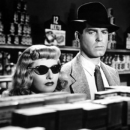
Raymond Chandler shepherds his procedural style to the screen in Billy Wilder's quintessential noir, DOUBLE INDEMNITY, helping to bring the genre to a boil. Ironic, given that its placement in the canon of Hollywood cinema is attributable to a chilly murder plot by two frozen-souled conspirators. Told in flashback from his desk and in a bloody suit, insurance salesman Walter Neff (Fred MacMurray) narrates how, while an on a routine sales visit, he falls for Mrs. Dietrichson (Barbara Stanwyck), a femme fatale housewife plotting her husband's demise. Fully seduced, Neff uses his knowledge of his industry to foil investigators and kill Mrs. Dietrichson's husband "accidentally"—invoking a clause in the policy that pays double. Mrs. Dietrichson's dark past crops up to break the spell on Neff—who even then stays in it too long—as Keyes (Edward G. Robinson), fellow insurance agent and confidant, sniffs out their scheme. With so many imitators, DOUBLE INDEMNITY shines with wonderful idiosyncrasies: Neff on crutches imitating a broken-legged Mr. Dietrichson, the unabashed sexiness of Mrs. Dietrichson, the authentic bare bulb dialogue, and so many venetian blinds. Without them, the murder and investigation might become overly flat. But through its methodical telling, Wilder's film allows us to contemplate the significance of what is essentially a fatalist's cynicism—after all, we know the ending the whole time—"killed him for money, and for a woman. I didn't get the money, and I didn't get the woman." Screening as part of the Working Girl: The Films of Barbara Stanwyck series. (1944, 107 min, 35mm) [Brian Welesko]
Park Chan-wook’s NO OTHER CHOICE (South Korea)
Music Box Theatre – See Venue website for showtimes
Neon, the distribution company handling the US release of NO OTHER CHOICE, put out an exquisite piece of PR: “On behalf of Director Park Chan-wook's new film, we are cordially inviting all Fortune 500 CEOs to a special screening of NO OTHER CHOICE. This is truly a film that speaks to our gracious executive leaders and the culture they have cultivated.” Whether any CEO accepted the invitation is beside the point—the provocation lands cleanly. NO OTHER CHOICE looks directly at the class that treats labor as an abstraction and asks them to sit with the human residue left behind. Audiences have embraced the film for its sharp wit and plainspoken clarity, recognizing themselves in its vision as the world lurches each day closer toward economic collapse. The film follows Man-su (Lee Byung-hun), a veteran paper-industry professional whose stable life implodes after an abrupt layoff during corporate restructuring. What unfolds is a slow erosion marked by repetitive job interviews leading nowhere, mounting debts, and quiet domestic compromises. Months stretch into a year. Man-su’s sense of dignity becomes increasingly bound to professional reinstatement, and his family home, formerly a symbol of personal history and stability, becomes a pressure cooker. Park shapes Man-su’s moral descent with procedural discipline. Routine governs the rhythm. Each decision emerges through deliberation, framed as practical problem-solving rather than impulse. Park’s labyrinthine tales of vengeance like LADY VENGEANCE (2005) are traded here for a straightforward logic. The tension at each moral quandary comes from recognition. Every step makes sense. And morality becomes another variable to manage. This framework traces back to Donald E. Westlake’s 1997 novel The Ax, a corporate satire that charts violence as career strategy. Park retains the architecture while reshaping the emotional terrain. Man-su is no longer alone inside his reasoning like the novel’s protagonist Burke Devore. The film places him within a family whose survival depends on shared silence and mutual implication. Responsibility spreads outward. Consequences echo inward. Glimpses of other laid-off workers provide a mirror for Man-su: men who have given up, workers who have been spit out and forgotten. Within Park’s body of work, NO OTHER CHOICE occupies a transitional space. His precision remains unmistakable: calibrated compositions, ironic musical cues, an enduring fascination with self-justifying ethics. Yet the film abandons the operatic violence of his other films like OLDBOY (2003), THIRST (2009), and THE HANDMAIDEN (2016). Violence here feels laborious and draining. Murder aligns with job hunting, interviews, and evaluations. It becomes another task to complete, another box to check. Dark humor, awkward missteps, and poorly executed plans brush against slapstick, an unexpected lightness that keeps Man-su recognizably human. By shifting focus away from revenge and obsession toward systemic design, NO OTHER CHOICE emerges as Park Chan-wook’s most direct examination of work as ideology. Employment defines dignity. Automation signals erasure. Survival demands compromise. The film offers no relief, only a clear-eyed portrait of a system accelerating toward collapse, guided by those insulated from its costs. Build identity around labor, strip it away, demand adaptation, and call it opportunity. Eventually, resistance becomes inevitable. There is no other choice. Unless, of course, a few CEOs attended the premiere and decided to reduce profits and expand their workforce. Cinema inspires miracles all the time; maybe that’s why the film was released on Christmas day. (2025, 139 min, 35mm) [Shaun Huhn]
Kleber Mendonça Filho’s THE SECRET AGENT (Brazil)
The Davis Theater and the Music Box Theatre – See Venue websites for showtimes
The films of Kleber Mendonça Filho unfold like novels, immersing viewers in the specificities of location while gradually revealing aspects of the principal characters that aren’t immediately apparent. They also abound in digressions and supporting characters, neither of which advance the plot so much as expand on it until the world of the movie seems as rich as the one we inhabit. The richness of THE SECRET AGENT has a lot to do with how the film engages with Brazilian history. Mendonça Filho doesn’t confront the legacy of his nation’s military dictatorship head-on, but rather obliquely and circuitously, dramatizing how citizens lived under the terror of the period until that terror enters the foreground of the action. The story takes place mainly in 1977, at the height of the dictatorship; per a title card that comes near the beginning, this is a time of “great mischief,” one of several euphemisms for state-sponsored violence that arise during the film. Wagner Moura stars as a technical analyst who returns to his hometown of Recife after an unspecified time away. He wants to reconnect with his young son, who’s currently living with his maternal grandparents, but circumstances (also unspecified) keep the two from residing together. Mendonça Filho evokes a climate of fear and secrecy through his presentation of the intricate community networks that Moura’s character must navigate to stay safe in Recife. The writer-director also sometimes jumps forward a few decades to consider some young women in the present who are researching the character’s life, suggesting that Brazil is far from done with its culture of surveillance. These flash-forwards aren’t the only curveballs in THE SECRET AGENT, which also features a fascinating subplot about a human leg found in the body of a shark that’s washed up on the Recife coast (an event that coincides with the local popularity of JAWS) as well as a thorough depiction of how Recife’s police department functioned under dictatorship. The sheer volume of narrative detail recalls the films of Arnaud Desplechin, and Mendonça Filho adds to the complexity with his inspired direction, employing innovative widescreen compositions, unpredictable montage, and daring shifts in tone. Indeed, the film’s technical brilliance is so astonishing as to almost distract from the story, which is another way of saying that this towering achievement likely requires multiple viewings to reveal all it has to offer. (2025, 160 min, DCP Digital) [Ben Sachs]
Francis Ford Coppola's MEGALOPOLIS (US)
Alamo Drafthouse – Thursday, 12pm and 10:30pm
Francis Ford Coppola’s MEGALOPOLIS at times suggests a $100 million-plus version of Léos Carax's recent persona essay film IT’S NOT ME. But unlike Carax, Coppola doesn’t interweave his contemporary and historical concerns. Rather, the film takes place in a strange amalgam of ancient Rome and present-day New York—a grand, metaphorical way of saying that contemporary America looks a lot like the Roman Empire just before its fall. Coppola’s “New Rome” is mired in decadence, extreme income inequality, and widespread public distrust of government, and numerous characters speculate that the general order could be upturned at any time. The situation may be dire, yet MEGALOPOLIS is hardly a dour film. In fact, it’s often quite funny (especially when Aubrey Plaza or Jon Voight is on screen), and Coppola’s imagery can be breathtaking. Taking inspiration from Lang’s METROPOLIS (1927), Coppola and his team imagine a giant city of the imagination, a platform on which people can realize their grandest dreams for civilization. And per the architect (and Coppola stand-in) played by Adam Driver, this is what cities are supposed to be. Driver’s character spends the movie trying to construct a new urban center that will be so glorious that it restores the citizenry’s faith in their city-state/nation/empire. (The character’s messianic ambition, coupled with the brazenly sexual atmosphere, suggests that Coppola had spent a lot of time studying King Vidor’s film of THE FOUNTAINHEAD [1949] before he made this.) His mission is comparable to Carax’s goal of recapturing the vision of the gods—in each case, a passionate artist wants to return a sense of awe to our despiritualized world. Perhaps the most inspiring thing about MEGALOPOLIS is that Coppola clearly still finds awe in the process of filmmaking; the digressions into weird humor, classical quotations, and garish eroticism create the impression the director was finding the movie as he went along, throwing anything into the work that reflects his deep love of cinema. Featuring a pre-recorded Q&A with filmmaker Francis Ford Coppola. (2024, 138 min, DCP Digital) [Ben Sachs]
📽️ ALSO RECOMMENDED
Kahlil Joseph’s BLKNWS: TERMS & CONDITIONS (US)
Siskel Film Center – Sunday, 12pm
“I know what you’re thinking… But this is not a documentary.” With this bit of cheeky onscreen text—hilariously presented with accompanying memes of a smiling Denzel Washington and a relieved Vivica A. Fox—Kahlil Joseph interrupts himself practically mid-sentence to extend an olive branch to his audience, letting us know that we are not, in fact, about to be subjected to two hours of droll, academic analysis. There are still hints of that sprinkled throughout Joseph’s expansive and purposely uncategorizable BLKNWS: TERMS & CONDITIONS, a film that dares to live and luxuriate in what acclaimed art curator Okwui Enwezor called "the space between the spectator and the work of art." Joseph’s imagery and artistry has been viewed by millions around the world, even if they don’t know his name, as he's collaborated on music videos and visual albums with the likes of Beyoncé, Travis Scott, and Kendrick Lamar, cementing his bona fides as an artist in direct conversation with some of the most influential Black performers of the day. Here, Joseph’s interests have led him to a grander project, using the Africana Encyclopedia—a massive text birthed from the ambitions of W.E.B. DuBois—as a jumping off point to interrogate Black history in four dimensions. Past, present, future, and even alternate realities are extrapolated and interrogated, “BLKNWS” itself popping up as a fictional in-universe news source and Tumblr page, an artistic corrective to re-center and reclaim Black and African culture in the larger diaspora. Joseph intentionally blurs and remixes the lines between reality and fiction, even evoking a charming quotation from Agnes Varda, “What is bad for cinema is the categories; this is real fiction, fake fiction, real documentary, fake documentary. This is a film.” Varda’s not alone as inspiration here, as Joseph’s work, with its intense montage spanning millennia and onscreen text both supporting and contrasting the images presented—recalls Chris Marker’s SANS SOLEIL (1983) and especially the late-career essay films of Jean-Luc Godard, all filtered through an unabashed contemporary Black lens, ancient artifacts and sculptures and cinema positioned alongside memes and TikToks and reality television. The barrage of montage is interspersed with fictional reenactments of the lives of DuBois and Marcus Garvey, alongside beautifully textured explorations of the Nautica, an epic, futuristic ocean vessel looking to retrace the Transatlantic Slave Route but in reverse (a homecoming-turned-luxury liner). Here, a young journalist explores the onboard TransAtlantic Biennale, a place for Black art to be reimagined and recontextualized, perhaps a direct reference to Joseph’s own presence in the art gallery space, where BLKNWS was seen in its early forms. There is certainly something of a museum quality to Joseph’s work; the film warrants intense dissection and analysis, but it could also be easily consumed in short bites by wandering travelers, something to be both memed and studied. This bold attempt at reconfiguring cinematic language and form positions Joseph as a talent to reckon with and watch; his eye for our current moment and what may come next makes him as exciting as any filmmaker out there. (2025, 113 min, DCP Digital) [Ben Kaye]
Bi Gan's RESURRECTION (China/France/US)
Siskel Film Center – See Venue website for showtimes
Bi Gan’s latest film unfolds as a cosmology disguised as cinema. In its world, humanity has discovered the secret to eternal life: stop dreaming. A person who no longer dreams becomes like a candle that does not burn. It can exist forever, but it produces no light, no heat, no risk. Within this brutal logic, dreaming becomes sabotage. Those who persist are branded “Deliriants,” figures whose dreams introduce pain and instability into reality. Cinema, Bi Gan suggests, is the oldest and most dangerous Deliriant of all. RESURRECTION opens inside a movie theater, with cinema confronting its own origin. Film stock burns as the audience recoils. An intertitle announces the governing law: immortality requires the abolition of dreams. Yet cinema survives precisely because it refuses this command. It retreats into opium dens, nested dollhouses, silent-era distortions, and German Expressionist sets. The assassin assigned to eliminate Deliriants can see through illusion, yet must adopt the gentlest of forms to destroy them. This contradiction structures the film. Each chapter inhabits a distinct cinematic mode, less homage than lived environment. At the center is a nameless Deliriant whose world appears as a tinted silent film. He eats flowers and would rather die than stop dreaming. When the assassin brings him home, she discovers an empty projector cavity in his back and threads it with film. When the projector runs, they are transported into a field. Cinema quite literally animates him. A poet before he was a filmmaker, Bi Gan has always treated cinema as a tool for excavating memory rather than advancing plot. From KAILI BLUES to LONG DAY’S JOURNEY INTO NIGHT, he dissolves past, present, and future into a single perceptual state through long takes, nonprofessional actors, and Buddhist philosophy. RESURRECTION extends this project outward. Cinema itself becomes both subject and setting, staging a century of film history as a dream that has begun to forget why it once mattered. THE ARRIVAL OF A TRAIN (1896) mutates into film noir, complete with an unsolved murder, false accusations, and a suitcase serving as a MacGuffin. Jagged shadows stripe alleyways like jailhouse bars before a hall-of-mirrors shootout closes the chapter. The relay continues through winter wastelands, monasteries, and apocalyptic cities. Across time, the Deliriant appears as monk, con artist, and lover, facing detectives, deities, thieves, and vampires. Each episode marks a cinematic era and a philosophical shift. In the monastery, bitterness becomes a literal spirit summoned after a tooth is pulled. In the con-artist chapter, supernatural power reveals itself as performance: timing, gesture, confidence. Bi Gan also punctures his own seriousness when needed. One episode asks a riddle: what can never be recovered once lost? After prolonged insistence, the answer lands. A fart. The film’s most ambitious chapter is a monumental long take set on New Year’s Eve, 1999, cinema’s collective nervous breakdown. Biker gangs roam as the camera glides through docks, alleys, stairwells, and karaoke clubs without blinking in the rain. When a character addresses the camera directly, it responds. It has a name. Cinema becomes sentient, implicated, unable to feign neutrality. By dawn, as lovers race for the 7am boat, RESURRECTION has compressed cinema’s history into lived duration. Two hours pass for the assassin. A hundred years pass for the Deliriant. Cinema ages differently than people. It accumulates suffering, desire, and memory at a higher speed. It dies young and ancient at once. RESURRECTION argues that cinema persists not because it grants immortality, but because it insists on burning anyway. Immortality without art is just another name for death. (2025, 160 min, DCP Digital) [Shaun Huhn]
Charles Laughton's THE NIGHT OF THE HUNTER (US)
Alamo Drafthouse – Sunday, 12pm
Though now considered a classic, at the time of THE NIGHT OF THE HUNTER's release in 1955 the American critics and public rejected it; Laughton's wife Elsa Lanchester later remembered, "It just broke his heart." In 1954, the great author and film critic James Agee adapted Davis Grubb's bestselling novel The Night of the Hunter, which is loosely based on a series of actual crimes in rural West Virginia during the Great Depression. In Laughton's Southern Gothic film, the dangerous Reverend Harry Powell (Robert Mitchum) meets a condemned man named Ben Harper in prison, who accidentally reveals that he hid $10,000 in stolen money somewhere in his home. After he gets out of jail, the preacher seeks out Ben's widow Willa (Shelley Winters) and her children John (Billy Chapin) and Pearl (Sally Jane Bruce); he even seduces Willa into marrying him. But Powell shifts his attention to John and Pearl when he suspects they know the money's location, and the children in turn flee in fear from their home. As Laughton crafted his story and its imagery, the work of the American cinematic pioneer D. W. Griffith primarily influenced him. For this new filmmaker, Griffith mastered a heightened, poetic melodrama, and Laughton aspired to recapture the power of his silent cinema. At the same time, Laughton and cinematographer Stanley Cortez also applied the techniques of German Expressionism to render this strange fairy tale of the Deep South. In his review of THE NIGHT OF THE HUNTER in the Chicago Reader, critic Dave Kehr specified, "Laughton's direction has Germanic overtones—not only in the expressionism that occasionally grips the image, but also in a pervasive, brooding romanticism that suggests the Erl-King of Goethe and Schubert. But ultimately the source of its style and power is mysterious—it is a film without precedent and without any real equals." (1955, 93 min, DCP Digital) [Candace Wirt]
Todd Haynes' SAFE (US)
Alamo Drafthouse – Saturday, 2:45pm
Director Todd Haynes has restless eyes and ears that never linger in one aesthetic or time-period for longer than a film. And despite his continual shifts, it's the aesthetic that tends to star in his films, but this is never a shallow engagement. If Haynes can be said to have a formula, it is to find a pristine surface and scratch until we can see the uneasy construction underneath. His first (banned) public experiment was SUPERSTAR: THE KAREN CARPENTER STORY, in which he used Barbie doll whittling as an inspired, literal representation of Karen Carpenter's struggle with her eating disorder. FAR FROM HEAVEN honored and interrogated the world of Douglas Sirk. In I'M NOT THERE, he chipped away at the impenetrable image of Bob Dylan, all the while pointing at the impossibility of his project with a graphic mix of sympathy and irony. SAFE takes a break from public images to get intimate with a housewife's health. Shot and lit with the peachy haloes of a douche commercial, SAFE's blurry suburban Los Angeles is an unlikely venue for horror. We follow Carol White on her errands, to her exercise classes, with her friendly acquaintances; no one seems to mean her any harm. But it's precisely this vagueness—of purpose, of symptoms, of identity—that begins to gnaw at Carol until she is reduced to her flintiest self-preservation impulse. She suffers from both the controversial Multiple Chemical Sensitivity and the middle-class affliction of Unlimited Healing Budget, and either condition could prove fatal. Haynes takes care not to fix any problems or to answer stupid questions; the ending lingers in one's mind like an unresolved chord. Screening as part of the Alamo Time Capsule 1995 series. (1995, 119 min, DCP Digital) [Josephine Ferorelli]
Zach Cregger’s WEAPONS (US)
Siskel Film Center – See Venue website for showtimes
Following the breakout success of his “don’t go in the basement” horror flick BARBARIAN (2022), sketch comedian-turned-filmmaker Zach Cregger hurled himself further into the deep end of mainstream genre filmmaking, using this newfound industry carte blanche to to solidify his bona fides as a craftsman. By ambition alone, WEAPONS excels, building upon Cregger’s structural obsessions with nesting narratives, shifting perspectives, and withheld information (tools well-honed in the sketch comedy world) to investigate our capacity for finding understanding and sanity in the face of overwhelming grief. In interviews leading up to the film’s release, Cregger frequently cited Paul Thomas Anderson’s MAGNOLIA (1999) as a major influence on this sophomore outing, a comparison both foolhardy and entirely apt; like MAGNOLIA, WEAPONS thrusts a large ensemble of disparate, lost souls together to reckon with tragedy and culminates in an act of seemingly random magical realism. But this doesn’t give Cregger enough credit for the intricacies and playfulness at hand, his thematically thorny tale beginning with an enticing enough log line: at 2:17am, seventeen children from the third-grade classroom of Ms. Justine Gandy (Julia Garner), all run out of their homes, without explanation, never to return. The ensuing mystery and hunt for the children causes panic and disarray, the ripple effects of tragedy infecting every member of the community; in the film’s chaptered narrative, each section highlights a different character’s perspective of the events at hand. Cregger ever so slightly shifts the visual language of each chapter to underscore each character’s emotional and narrative status: Justine’s constant anxiety and paranoia is contrasted with the thudding, apocalyptic walking nightmare of one of the missing children's parents (Josh Brolin) and even further contrasted with the frantic, rat-a-tat comic ramblings of the homeless drug addict (a comically essential Austin Abrams) inexplicably dropped into the conspiracies at the center of the narrative. The sprawling web comes into focus in the final chapter focused on Alex (Cary Christopher), the only child in Ms. Gandy’s class who didn’t go missing that fateful day, and whose story, filled with leaps of narrative faith, genuine dread, and a showstopping villainous performance by Amy Madigan, brings things to a truly unforgettable finish. The answers to WEAPONS’ great central mystery won’t be satisfying to everyone, but perhaps Cregger doesn’t believe tragedies like these can ever have satisfying answers. Maybe all we have is a little bit of faith in each other to survive together as long as we can before the world rips us apart piece by piece. (2025, 128 mins, DCP Digital) [Ben Kaye]
Billy Wilder's THE APARTMENT (US)
Alamo Drafthouse – Wednesday, 12pm
For many—including Wilder himself—this was the director's finest hour, the film in which all the elements converged with grace, sass, and a tinge of tragic inevitability. It was inspired by a line that Wilder wrote in his notebook sometime in the 1940s and couldn't forget: "Movie about the guy who climbs into the warm bed left by two lovers." By the time the film was made (during the so-called "New Permissiveness" of the early 60s), the two lovers had multiplied into several men and countless mistresses and the warmth of the bed had turned musty. The guy, however, retained all the bittersweet sympathy of that initial premise. As incarnated by Jack Lemmon (in the most tolerable performance of his career), C.C. Baxter is the ultimate schlemiel, a resigned bachelor who lends his apartment to his insurance company superiors because he can't imagine any alternative to advancing in a job that kills him. Shirley MacLaine plays the disabused mistress who turns out to be the girl of his dreams, one of the great creations of the movies: her Fran Kubelik is a woman who seems ideal even in her faults—youthful, spontaneous, naive, sexy, resilient: exactly the type who could humanize an office drone like Baxter. The romance between them is so affecting (to say nothing of the dialogue, which pops as only Wilder and I.A.L. Diamond's writing can) that it's easy to overlook what a superior piece of filmmaking THE APARTMENT is. Wilder remains underrated as a visual artist; and here, working in sparkling black-and-white 'Scope, he creates some remarkable effects, such as the unforgettable loneliness of the apartment itself and the modernist nightmare of the insurance company office (an image borrowed from King Vidor's THE CROWD), where rows of desks seem to extend into infinity. Wilder also employs small objects with an imaginative economy worthy of Hitchcock. As he explained in Cameron Crowe's book-length interview Conversations with Wilder: "When Baxter sees himself in [Fran's broken compact] mirror, he adds up two and two. He gave it to the president of the insurance company [Fred MacMurray], the big shot at the office, now he knows what we know. And we see it in his face in the broken mirror. That was a very elegant way of pointing it out. Better than a third person telling him about the affair—that we did not want to do. This was better. This gave us everything, in one shot." (1960, 125 min, DCP Digital) [Ben Sachs]
Paul Thomas Anderson's PHANTOM THREAD (US/UK)
Alamo Drafthouse – Monday, 12pm
More often than not, modern movies are endlessly clogged with flimsy, cardboard cutouts of the “classic love story,” a trend hopefully being seared away entirely, given that they seem more offensive in a cavernous last year of cynicism and bitterness. The genre has been in desperate need of a refurbishing to allow for a better understanding of what’s embedded inside its own fragile construction. Paul Thomas Anderson’s latest and possibly greatest achievement isn’t without a mind of its own; it is a wonderfully conceived cinematic dream, wrapped in the lush, evergreen imagination of an artist working closely within the inner representation of his creations, much like Daniel Day-Lewis’ dress-making main character, Reynolds Woodcock. Anderson achieves something much closer to the actual emotions and feelings that echo throughout a relationship between two people, avoiding many of the stale and dry trends found in the modern romance movie. These lifeless morality lessons, usually soaked in a pale blue sadness, seem too bitter and lazy to have much real purpose and functionality, allowing Anderson to spin a delightedly deceptive chamber piece instead. Given the film’s advertising, championing PHANTOM THREAD as a brooding sure-fire contender in the race for awards-season gold, you might be surprised to discover a strange rom-com hiding in the lining of its framework. The plot involves a dressmaker (Daniel Day-Lewis) and his closely-curated daily home and work life, right as another of his romantic relationships is beginning to dim out. As another unfulfilled and lifeless relationship goes, Woodcock decides to retreat to one of his favorite restaurants (it is here I’d like to heavily underline the film’s ideas about taste and hunger, given new literal and metaphorical life in a way that is shockingly unpretentious). It is at this place of dining that he meets Alma, played by newcomer Vicky Krieps, that leads to an intimate portrayal of love’s inherent mystery, built inside an almost hermetic world of imagination that conjures up visions of the classical Hollywood era, while simultaneously managing to subvert the work of “tradition,” straddling the lines of the modern and classical film structure/form with the skill of a master operating at the height of their creative abilities. Despite taking place in Great Britain, this is far from the British-ness on display in BBC dramas and endless droves of Oscar bait. Beginning with its suggestive point-of-view, then unwinding between not two points of view, but a shared point of view, the personal nature of this film for Anderson is evident, with Anderson not only writing the script, but also shooting nearly every frame of film himself (though he goes uncredited in that role). The everyday gestures, glances, embraces, arguments, and alluring atmosphere between two people seeps through every frame, delivering unexpected surprises carefully yet unabashedly. This is one of the few films in recent years that is really essential to witness in 70mm. The projection’s colors and light are captured in spellbinding luminosity, the sounds and images pushing forth the relationship of one woman and one fragile male ego, across a tapestry of sensual pleasures with hardly a hint of on-screen sex in sight. The results trace the lines around eroticism, rather than circling it directly, letting them blossom into a rare achievement in recent American cinema, a precious gift inside the fabric of its own design; one to keep close through the next several years. (2018, 130 min, DCP Digital) [John Dickson]
Paul Thomas Anderson's ONE BATTLE AFTER ANOTHER (US)
Siskel Film Center – See Venue website for showtimes
A motif of flooded landscapes recurs in Thomas Pynchon’s novels about the midcentury American counterculture. In Vineland (1990), radical filmmaker turned counterinsurgent Frenesi Gates confesses a recurring vision of disappeared beaches she calls the Dream of the Gentle Flood, set to a siren song promising the return of “whatever has been taken… whatever has been lost….” Pynchon renders this uncommonly emotional scene with a blue-green melancholy, a generational lament for stolen futures and failed alternatives employing the same haunted imagery that Inherent Vice (2009) conjures in one of P.I. Doc Sportello’s aborted reveries, analogizing the broken promise of the hippie decade to the excavation of a mythical underwater continent: “some undrowned Lemuria, risen and redeemed, where the American fate, mercifully, failed to transpire…” Said American fate is the subject of Paul Thomas Anderson’s new film ONE BATTLE AFTER ANOTHER, a loose Vineland adaptation that strips one of the book’s central plots—a government spook returns to hunt an ex-radical’s teenage daughter, living in hiding with her burnout papa sixteen years after the destruction of their revolutionary cell—out of the Reagan ‘80s and plants it in an apocalyptic present tense recent-past-near-future so up-to-the-minute it could have wrapped production this week. (Anderson isn’t a prophet, he’s just paying attention.) In the Californian hamlet of Bakhtan Cross, forcibly retired explosives expert Bob “Ghetto Pat” Ferguson (Leonardo DiCaprio) tries to keep daughter Willa (newcomer Chase Infiniti) alive by sending her to self-defense classes with Sensei Sergio (Benicio Del Toro) and policing her use of technology, but can’t protect her from the arrival of a federal dragnet led by Col. Steven J. Lockjaw (Sean Penn), whose past entanglement with Willa’s mother Perfidia (Teyana Taylor)—and possible fathering of a mixed-race daughter—threatens his initiation into the inner sanctum of a white supremacist cabal. So the thugs surge into town, an old ally (Regina Hall) spirits Willa away, and Bob teams with Sergio to rendezvous with what remains of his network before Steven can smoke them out. Anderson’s treatment of this scenario—angry, funny, frantic—distills the experience of our 21st-century late-capitalist crack-up at a moment when the potential for organized mass resistance has slowed to an ebb tide. The diluvial theme in Pynchon resonates with Hunter S. Thompson’s oft-mythologized monologue in Fear and Loathing in Las Vegas, which describes California at the end of the 1960s as “that place where the wave finally broke and rolled back.” The Fitzgeraldian, Lost Generation lilt of Thompson’s prose typifies the rueful sentiment of much post-’60s literature (including Pynchon’s), and Anderson’s reliably knotty, suggestive character work here locates failures aplenty in Bob’s scattered movement: chiefly, the equation of Bob and Steven as parallel father figures with mutual responsibility for the shrunken future offered to Willa, and whose fetishization-slash-idolatry of Perfidia shares Anderson’s roving authorial eye. Bob has another parallel in Sergio, whose work speeding a hidden community of undocumented migrants to safety serves as a quiet contrast to the revolutionaries fixated upon code words and armed resistance. Sergio knows when to lie low and when to run for the high ground, as do the skateboarders they meet whose blissed-out ride for freedom amidst a militarized crackdown sums up this movie’s command of motion and message in a single feather-light shot. If Anderson ultimately wills some optimism into his vision of a shaky generational truce, ONE BATTLE AFTER ANOTHER also acknowledges that an ungentle flood is here, and the tides are climbing high. The American fate may not be to recover what was lost but to move with the rising waters—as in the final chase that sees Willa hurtling through an undulating desert road, mastering its crests and troughs, surfin’ U.S.A. (2025, 161 min, DCP Digital) [Brendan Boyle]
📽️ ALSO SCREENING
⚫ Siskel Film Center
Amy Berg’s 2025 documentary IT’S NEVER OVER, JEFF BUCKLEY (106 min, DCP Digital) screens Friday at 6pm and Saturday at 5pm.
Robert Redford’s 1994 film QUIZ SHOW (133 min, DCP Digital) screens Saturday, noon, and Wednesday, 6pm; David Lowery’s 2018 film THE OLD MAN & THE GUN (93 min, DCP Digital) screens Saturday, 2:45pm, and Tuesday, 6pm; and Phil Alden Robinson’s 1992 film SNEAKERS (126 min, DCP Digital) screens Sunday, 2:30pm, all as part of the Golden Boy: A Robert Redford Retrospective.
Off Center: Kuchar Xmas (1988 - 2007, 60 min, Digital Projection), featuring MECCA OF THE FRIGID, CAT HOUSE, and DINGLEBERRY JINGLES, screens Monday at 6pm. More info on all screenings here.
⚫ VDB TV (Virtual)
oliverio rodriguez and Victoria Stob's 2018 short film LYNDALE (24 min) and Sandi DuBowski's 1993 short film TOMBOYCHIK (15 min) stream for free on VDB-TV. Programmed by Cine-File contributor Elise Schierbeek. More info here.
CINE-LIST: December 26, 2025 - January 1, 2026
MANAGING EDITORS // Ben and Kat Sachs
CONTRIBUTORS // Brendan Boyle, Rob Christopher, John Dickson, Megan Fariello, Josephine Ferorelli, Shaun Huhn, Ben Kaye, Brian Welesko, Candace Wirt
