
Kat Sachs/Cine-File: You've written that SUICIDE NOTE was unusual among your films in that the title preceded the imagery, rather than the other way around. How did beginning with such a specific, emotionally charged concept affect your approach to making the film?
Fred Camper: That's actually a good question, because I've been thinking about how to talk about it when I introduce it, which tends to be more analytical, using my skills as a critic.
To give you an example, I have five earlier films that Chicago Film Society also restored. One began when I was sitting in my chair reading late in the day. I had a light on, and the sky was kind of blue. I looked outside the window, and there was this big tree near where I lived. I had rented a fancy camera with a long zoom for some other project, and suddenly, from that scene, I got the idea of a short film in which I zoomed in on the tree and then focused on it, because it would have been out of focus when I started the zoom. The second-longest of those films was called BATHROOM, and it was definitely inspired by sitting on the toilet looking at the walls. It wasn't my bathroom. It was in a rooming house, so the paint was peeling. It wasn't incredibly filthy, but there was detail. And a film came out of that.
With SUICIDE NOTE, what imagery was there? If there had been footage of him jumping, I don't think I would have used it. It was more a feeling. When I got the idea for the title, suddenly it seemed that the feeling of not being fully present could somehow be expressed partly by using Super 8. Working in 16mm, with a decent camera and sharp film, you can really create a sense of the presence of what you're filming. Super 8 Kodachrome, with a sharp lens and in the right situation, can look very present with a fancy projector, but it typically doesn't.
I came to understand one kind of suicide, because there are many, as arising from the feeling that the individual doesn't belong in the world. It's a failure of the self, which is a phrase I keep using. That's based on an actual suicide note somebody left. It was an envelope on the floor of a garage where a carbon monoxide suicide had taken place. The envelope said, "To be opened in the event of my death," but it was unsealed and empty. That really got to me. He couldn't write a suicide note. The idea is based on this failure of the self, a person who feels they aren't fully present in the world. I've had that sometimes in moments of depression, and I know other people have. One friend once said, "I shouldn't even have been born." How do you convey that in film?
I'm not exactly sure. Jean-Luc Godard famously said that writing an essay and making a film were the same process for him, and I would say no, absolutely not. If you can give words to it, I'm a little bit suspicious.
I've been making art involving still photographs, too, and I found that it took me a few months after I'd finished a group of works before I could write an artist statement. I took that as confirmation, not that the work was good, but as a good sign that the process was authentic. For a more poetic strain in the arts, you don't want to know what you're doing and be able to articulate it.
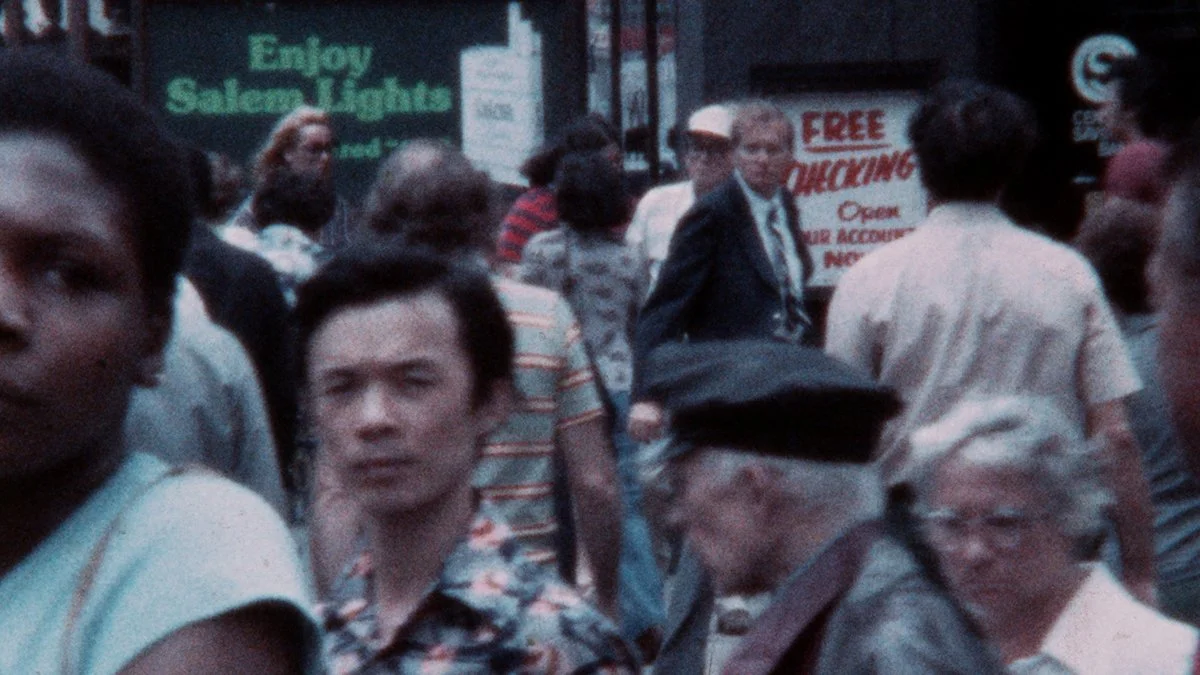
With SUICIDE NOTE, I didn't have imagery, but I did have an idea of the kind of imagery I wanted, in a way that I couldn't have explained at the time. The locations became obvious. I was living in New York, and he had lived in New York his whole life. I chose a variety of New York locales, some of which suited my interests and were generic, such as the shot in Herald Square. There's an implied persona in the film: the filmmaker, the victim's stepfather. It's a first-person film, meant to feel like everything is being seen from the point of view of the filmmaker. And then you have to rely on the filmmaker telling you that it's partly an attempt to imagine what someone else would have felt. But it is what I felt, too, sometimes.
KS: Did you find yourself looking for images that expressed something you already understood, or did the filmmaking itself help you discover what you were trying to express?
FC: More the second. The second section is the living room, decorated, so to speak, by my mother, next to the dining room that he came from. I had to shoot it three times, all after I'd moved to Chicago. The first two times, I thought, very naively, that everything I needed was in the way the living room was arranged. That's what it felt like when you looked at the living room as a live person. It was perfectly arranged, very nice, perhaps too perfectly arranged, airless. Nothing is moving. The one thing that is moving is enclosed in a glass bubble. I thought it was all there, and I just had to move the camera around.
Both attempts were complete failures. It was only when I realized I had to put much more into it, as if I were caressing the couches or traveling between one object and another, that it began to work. Each section of the film is meant to be both positive and negative. That's the sort of division of a person who's capable of thinking of suicide but doesn't do it. It was a learning process. Section six, which involves looking at art, is another example. I didn't know most of the art when I went there. A lot of it was made during a period when the art world was interested not in objects anymore, but in three-dimensional encounters and experiences. Sculptures you have to look at from all sides, for example, or various kinds of installations.
I was discovering how to respond to them. My reaction was something like, "Some of these are amazing, but there's a bit of phoniness here, too, even a little bit of silliness." I probably put more silliness in than was actually there. It became my attitude toward these things.
A friend once pointed out to me that the word "essay" originally meant "to try." You can write an essay in which you're trying to figure out what you think. The same thing applies to making a film. But if you're using filmmaking to tell you how to see or understand what you're seeing, you really have to work at it, both in looking and in editing.
KS: You worked on the film over several years, from 1976 to 1984. Did your understanding of its central concerns change during that period?
FC: Not hugely. Actually, 1984 is kind of a phony year. Nine of the ten sections were done and edited by 1982, I'm sure. The closing date is pretty accurate, but most of the work was done by '82. I shot most of it right away. Seven of the sections were shot before I moved to Chicago, in 1976. It took a long time even to start editing, but I was able to show a relatively complete version by 1982.
What changed was in the editing.
The way I edited was perhaps a little unusual. I might have ten or even twenty minutes of footage for each section, but not that much. What I would do was try to memorize it, looking at it again and again and again. Without any intellectual intervention, without writing down "What's my theme here, and what are the seven devices I might use?", I'd pretty quickly find a first shot and a last shot.
Once you know what those are, you're looking for a pathway that will logically lead from one to the other.
KS: That's an interesting editing strategy. Do you think beginning with those two images is itself a kind of storyboarding, albeit a more abstract form?
FC: Of course. It's preplanning. In the films I've been shooting now, sometimes I know what the first or last image is before I start shooting, and that helps propel the shooting forward.
I love both narrative and experimental films equally. Mizoguchi is as great as Brakhage. But because of the priority given to narrative films, and a particularly toxic priority in which the plot is the main point, which I think is an utter desecration of film as an art, I have a slang phrase I invented: "That branch of cinema that consists of paid actors walking around and talking."
For that type of film, there's often a storyboard. There's a script. You don't have the freedom to construct it the way I was able to construct most of my films. If you have someone like Hitchcock, whom I think is a great filmmaker, he is constructing, but he does that before he shoots. That isn't the way most filmmakers work, or most of the great ones. Storyboarding can be a blessing or a curse, or both or neither. I don't know.
KS: You've described the film's implied observer as someone who encounters beauty but remains unable to fully participate in the world. Yet filmmaking is itself an active process of looking, selecting, and composing. I'm curious about that contradiction. Can the act of making an image overcome the passivity that the image itself represents?
FC: That's kind of a theoretical question. I'm not sure that images represent passivity exactly.
KS: I guess I don't necessarily mean that the image represents passivity, but rather that an image in itself is passive.
FC: Oh, okay. Sure. Well, for me, contrary to people walking around and talking, what makes most of the films I love artworks is a sense of space that's developed through the unfolding of the imagery and then the editing of it.
I've been struggling for years to figure out how to say this. A moving painting that remains in your memory is a kind of virtual image of how all the images combine in space. Each shot influences the way you see another shot in the film, even if they're not adjacent, and you may not even remember them. In most films, they're so unorganized in that respect that all the memories are kind of random, and all you have left is the plot. But if you have a great film, it can sometimes even be the first and last image.
People might be shocked if I said that I think Robert Mulligan's CLARA’S HEART is a great, great film, because it was much derided as a stupid soap opera. Something I'm sure nobody noticed, and I certainly didn't on first viewing, is that it begins with a little boy at his sister's funeral, looking out into space. The boy develops a friendship with Clara, played by Whoopi Goldberg. As he's leaving her, probably for the last time, she looks out at him, and it's incredibly moving because the two looks are connected. They're not making a clear statement, either. The imagery is converted into an act of articulation of beauty and meaning by the photography itself and by the editing.
Mizoguchi is a great example because of his amazing camera movements, often very slow, and amazing static shots that feel alive, as if empty space has been engaged by the way they're composed and their positions in the frame. Rossellini, too, in his later films, is constantly zooming. Very slow zooms. They're creating a way of seeing. And it's a way of seeing that I think is related to mine, because what they do is create an expansiveness in which anything you see can change, and there are different perspectives from which you can see everything.
In SUICIDE NOTE, there's less of that because it's a suicidal film. It's about a viewer who's able to detect some beauty, but for whom the imagery is also passive. Of the ten sections, if you count the three separate reels individually, each section has one subject. In Herald Square, I'm within a radius of twenty feet. The living room is just the living room, and you never get to see out the window. In the art exhibit, everything is inside that building. The implied viewer is really passive. He doesn't look at the crowds in Herald Square and think, "Maybe if I'm across the street, I'd get a different angle," which is the way I would normally think.
KS: The film comprises ten sections, each with its own visual character and spatial relationships. How did you arrive at their sequence? Were you thinking primarily in terms of a progressive emotional or conceptual movement, or did the formal relationships between sections determine the structure?
FC: Both. But it's more complicated because there was this ridiculously grand plan that would have taken twenty years to complete. In all of the possible versions, there was an arc in my mind. Something like an initial discovery, and then some kind of progression that wouldn't have been linear. Near the end of the planned longer film, you would have reached the bleakest point, the representations of death. Then there were going to be a few sections afterward that I could jokingly call heaven or hell.
When I realized that the ten sections were it, and I wasn't likely to do any more, the way they were organized was definitely a progression. I wouldn't say section five is more depressive than section one, but section one is the most actively moving, with crowds of people in Herald Square visually colliding with one another. Even if it looks overcrowded to you, it has an exhilaration for me, just from the movement of crowds. The living room comes down from that, except it's very beautiful in some ways. Then there's the one section shot outside New York, in Middletown, Connecticut, which looks like a suburb or small town even though it's a city. That's fragmentary. For me, it's getting a little strange, these fragments of houses and benches. Not at all surreal, but verging on something a little different from realism.
That leads to another Herald Square section where people are crowded into reflections and layers. They have less autonomy visibly than in the first section. Then there's a store window displaying imported products with pretty packages.
It's a progression, in a way, toward death.
The section after that is the one about art, and maybe it's a little more exhilarating. It's longer, and it has a last shot that I think is really beautiful. But then we go to the Fourth of July celebration in New York Harbor in 1976. There are fireworks, but it's also about filling up the sky. There's a finger pointing toward the sky in an early shot, and then the nature of fireworks is that the sky becomes the fireworks. Then come the three short sections, each of which is like a tiny haiku, maybe, if that's not too obnoxiously pretentious.
After that comes the longest section, thirty minutes of pans taken from the 107th floor of the South Tower of the World Trade Center. It starts with the camera pointing downward toward nearby buildings, and in a series of very slow circular pans, it gradually raises the camera angle, so at the end you're looking at sky.
But what you see is space totally filled. There are some areas where there's empty soil and water, but it's obviously been altered, and you can infer that it's going to get built upon. The theme by that point becomes the occupation of space.
My idea is that we're the most invasive species on Earth by far, even though we keep talking about other invasive species, like the wrong bug brought in somewhere. That's a terrible problem, too, but we don't want to recognize our own invasiveness.
From almost the beginning, the film had three purposes. I wanted to write a suicide note for my stepfather, knowing that I didn't know him well enough and that it would be filtered through my biases. A suicide note for me if I were going to kill myself, although my notion is that because I'm making a film, I couldn't do both. Either I'm able to make a film or I'm able to jump, not both.
And the third is a suicide note for the grand suicide of the human race. There I'm quoting a 1953 film by Christopher Maclaine, which was anticipating the atomic holocaust. Now we don't just have that to anticipate. We have microplastics, climate change, and the possible deterioration of democracies into new wars.
KS: At what point did you begin thinking of the existing version as a complete work rather than an unfinished one? And do you think its relative compactness, compared with the original conception, ultimately gives it a coherence that the longer version might not have possessed?
FC: I do consider it complete. You can see it and hate it, you can see it and not know what to think of it, and you can see it and love it. But I think if you've got a brain, you'll see that it looks like a complete work. The ending is important. After the thirty-minute section of long takes, there's a three-minute, one-take film of a TV test pattern. What I say is, "That's death."
It's meant to represent television in general. Television has had some good things. I think of Ernie Kovacs as an artist of importance. But most television strikes me as a form of death. The colors of the test pattern are really perfect, in my view, and you have to look at it for three minutes.
As for the original conception, imagine eighteen one-reel sections, with each reel selected randomly out of six possibilities. They would have been related through subject matter. There would have been several different crowds, for example, probably in different parts of the country. I shot a huge amount of footage from Amtrak trains all across the country that was going to be one of the substitutions for the World Trade Center pans.
My idea was that somebody would go to a film that was very, very different from the one they'd just seen. They were supposed to go twelve times. Some of us have seen films twelve times or more because we love them. That was my hypothetical viewer. Each time it would look different, and the more times you saw it, the more differences you'd see. But after multiple viewings, the ultimate effect would start to look the same, as if every possible path leads to suicide. That was going to be the idea. Now we have a fairly fixed structure, with the oddness of the three short reels intruding a little bit.
KS: The film is silent, and you've cited Stan Brakhage's belief that sound can dominate the rhythms of moving images. How do you think silence changes the viewer's relationship to duration, particularly when the film asks for such sustained visual attention?
FC: I have to laugh a little bit. The reason you can say that is that most films don't require sustained visual attention. Can you imagine somebody asking Beethoven, "How can you write this hour-long symphony that requires so much more sustained attention than the folk songs we sing on the street?" It does require sustained visual attention, but that's only by comparison to what we've fallen into.
Silence will be a problem if people aren't used to it. I get students who say, "That was the first black-and-white film I've ever seen," or "That was the first foreign film I've ever seen," or "That was the first silent film I've ever seen." I tell students to look at BATTLESHIP POTEMKIN silent and then look at it with the sound. If they can't stand it in silence, at least try it for ten minutes. My claim is that the rhythms of the editing are destroyed by the soundtrack, and it's turned into a Hollywood war movie. Some of them say, "You're right, I looked at it without the sound, and it was better."
I told this to a friend who's a lot younger than I am, but older than those students, and he had a great answer. He said, "They may not be seeing it with the sound that comes with the movie, but don't assume they're seeing it silent." Which brings up the horrible thought of playlists.
I think anybody who's willing to attend to SUICIDE NOTE will find that the imagery grows more intense because of the silence. I would never say that about every sound film. A friend who praised it on my website pointed out that looking at the crowds reminds you of what New York City sounds like, and reminds you of what it looks like without the sound. In a way, I would defend that as the non-suicidal aspect of the film. It depends on my doing good filmmaking and editing, but if I am, then the silence allows you to see how rhythms and compositions can affect one another.
KS: The film remained largely unseen for decades, owing in part to the practical difficulties of exhibiting it, but you've also written about the emotional difficulties of showing it. What has it been like to finally present it to larger audiences after so much time has passed?
FC: It's heartening. I'm really glad Chicago Film Society did all this work. They would say I had to do a lot of work, which is also true.
You couldn't see how disorganized my life is. I couldn't find the film at all at first. We'd been talking about it for a few years, and I didn't know where it was. I'd been carrying and storing the reels in an empty typewriter case, but the last time I'd shown it privately, I didn't put them away there. It took me months to locate the main box, and there were other things we had to find, too.
I've worked as an artist mostly in oblivion. I've had a few gallery shows and a couple of very short articles, but mostly my work goes unrecognized. The short digital films I've been making have also gone unrecognized. I've been keeping count, not out of bitterness so much as curiosity. I sent twelve letters to twelve curators in seven cities, some of whom had brought me to do curated shows. I got two replies, both saying, "I haven't seen your films yet, but I'll take a look." That was the last I heard.
I gradually started to realize, and I don't mind if you print this, that curators often have a second agenda of creating a program that makes sense given the values of our time. Showing great films is not necessarily what they most care about anymore, and they have to somewhat suppress their own aesthetic.
On the other hand, my writing is starting to get recognized. Young people are finding something in it they didn't find anywhere else, an approach to cinema that can work with Stan Brakhage and Douglas Sirk. I've been making that case my whole life, and I've been ridiculed for it more than once.
Two younger friends, one of whom was about nineteen and living in Brazil, wanted to show my films. They thought they could organize a screening, but it fell through. There was no money involved. They couldn't have brought me there, so we would have done a Zoom call. But I thought these were two kids doing exactly what I did at sixteen or seventeen, starting a film society to show the films they most loved. There was a kind of purity to that which I found really heartening.
When Kyle [Westphal, of the Chicago Film Society] told me the New York Film Festival was going to show SUICIDE NOTE, I said, "No, no, no. They sent out the wrong letter. This is a clerical error." He laughed, but he double-checked that they'd seen it, because my other theory was that they liked the title. But the curators had looked at it and liked it, so it was a legitimate choice.
People thought this was going to be some huge thing that would make a huge difference in my life. Maybe it will, but I'm skeptical. When I sent an announcement to my mailing list, the first item was the New York Film Festival. The second was a Zoom call I was doing to analyze a film. The third was that I'd completed this seventy-six-minute film, but wasn't going to make it public. That was the right order for what other people would find interesting. It was the reverse order for me.
I got some pleasure out of the recognition. I met a great new friend at one of the festival screenings. But making one really good cut in INTERACTIONS 36: BRIDGES means more to me.
KS: One really good cut means more to you than the recognition?
FC: One really good cut. An editing decision that contributes to what I think could be a great film, and that I love and care about, means more to me than the recognition of the New York Film Festival. But I think that should be the case. Otherwise, you're letting curatorial decisions run your life rather than thinking about art.
KS: You began making SUICIDE NOTE fifty years ago, yet its critique of consumer culture and humanity's destructive relationship with the natural world feels especially resonant today. Do you think the film's meaning has changed in the intervening decades, or has the world simply caught up with some of its concerns?
FC: Of course, I would want to say the second. The effect of the film is going to be a little different. One negative review said it was only interesting for the automobile and clothing styles of 1976.
Among other things, we've gotten more and more self-centered, and that worries me a little bit. In art schools, there are going to be a lot more films about my horrible family, or my wonderful grandmother, or my abusive grandfather, than there are going to be about Bourges Cathedral, for example.
I don't particularly like that I'm playing into the self-centeredness that's become common in the culture. The language has changed. I never heard of an artwork or a film being called "relatable" until about ten years ago. I hope not too many people would think of the idea of a suicide film as relatable. Although it's meant for them in a way. It's meant for anyone who's experienced that feeling. So I sort of retract what I just said.
But it's also meant for somebody who never has. The great thing about art is that it takes you out of yourself. I can be moved by all kinds of things. It doesn't have to be something like me. New York is more cluttered than it was then. Interestingly, the streets aren't as crowded, but I think that's because people are at home on their phones.
The art world can still look ridiculous, even if the art is good, when seen through the wrong eyes. Store windows are eternally present. And we're still filling up the sky with all kinds of things. Look at what's happened to climate change. Nobody pays attention to it anymore. So yes, I think the world has caught up with the film's concerns, and in many ways they've become even more urgent.
