



🏳️🌈 REELING 2026: THE 44TH CHICAGO LGBTQ+ INTERNATIONAL FILM FESTIVAL
Landmark’s Century Centre Cinema — See below for showtimes
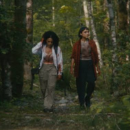
Gloria Mercer’s A SAFE DISTANCE (Canada)
Friday, 8:45pm
A SAFE DISTANCE opens on a provocative sequence: two women bury an unidentified man in the remote woods of western Canada, then make their way to the nearest bus terminal, where they plan to catch a ride to Winnipeg to cool their heels. After this introduction, the film flashes back to sometime earlier to show how the characters arrived at this dire situation. One of the women, Alex (Bethany Brown), is on a camping trip with Joey (Chris McNally), her boyfriend of eight years and coworker of ten. Their relationship is comfortable yet unfulfilling, at least for Alex, who seems disengaged with anything Joey wants to do. When Joey proposes to Alex during a hike, she turns him down, prompting him to sulk; in the middle of night, he drives home alone, stranding Alex in the woods. It’s after she’s left on her own that Alex crosses paths with Kianna (Tandia Mercedes) and Matt (Cody Kearsley), a modern-day Bonnie and Clyde who are hiding away from civilization after robbing several banks. Alex finds herself drawn to the couple, who are about ten years her junior, and decides to sojourn at their camp. In turn, Alex’s presence inspires Kianna and Matt to open up about their relationship, particularly with regards to their grievances about one another. It’s interesting to encounter a lovers-on-the-run story from the perspective of a third party, and screenwriter Aidan West and director Gloria Mercer deftly handle the transition from relationship drama to crime movie back to relationship drama. A SAFE DISTANCE gets much of its heft from the contrast between the two central male characters: Joey wants monogamy and stability, while Matt claims to reject the norms of capitalist, patriarchal society, though in the end they have more in common than they let on. These male disappointments all but force Alex and Kianna to find solace in each other, and the film finds positivity in this development, if not the possibility of renewal. (2026, 86 min, DCP Digital) [Ben Sachs]
---
Dean Francis’ BODY BLOW (Australia)
Friday, 9pm
In DR. STRANGELOVE, General Jack D. Ripper becomes obsessed with the loss of bodily fluids during sex, interpreting release of semen as a loss of essence. He assures Group Captain Lionel Mandrake that he doesn’t avoid women, he simply denies them his essence. The podcast that Aiden Hardwick (Tim Pocock) obsessively listens to in BODY BLOW sounds like a Ripper sermon. Hardwick sexually denies himself, as if no one learned from Ripper ending the world because he wouldn’t let himself ejaculate. Francis takes the machinery of the 1990s erotic thriller—cheating husbands, murder plots, corrupt police, sexual blackmail, and criminal conspiracy—and rebuilds it around Sydney’s queer nightlife. The Australian neo-noir rewrites its straight influences, from BODY HEAT, BODY OF EVIDENCE, BODY DOUBLE, and the direct-to-video thrillers that used to populate cable television more frequently. Sexual repression and dangerous sex drove much of this cycle, including its television counterparts Silk Stalkings and Red Shoe Diaries. BODY BLOW uses that framework for a story in which self-control becomes increasingly absurd and has even worse repercussions. Hardwick is a disgraced police officer reassigned to Sydney’s queer nightlife. His response to his sexuality is a campaign of abstinence involving obsessive exercise, a hand brace to prevent him from masturbating in his sleep, and finally a chastity cage—called a cock cage, and visually literalized by the roosters in a cage in Hardwick’s backyard. He meets Cody (Tom Rodgers), a bartender and sex worker-fatale, and uncovers conspiracies involving police corruption, robbery, and blackmail. At Fat Frankie’s, Harwick meets the multi-hyphenate drug dealer, drag queen, blackmailer, and supposed villain Fat Frankie. Paul Capsis as Frankie embodies all of those elements with seriousness and severity, even with a pair of vibrating sex toys in his anus. Francis drew partly from encounters with undercover police officers seeking security footage from his Surry Hills building, including gay officers whose presence suggested the contradiction at the film’s center: queer people working inside an institution with a long history of hostility toward their community. The fictional Inner East Police replaces the NSW Police Force, but the history is real. Sydney’s LGBTQIA+ community endured police violence at the 1978 Mardi Gras, raids on gay venues, and widespread distrust of law enforcement before male homosexuality was decriminalized in New South Wales in 1984. Francis turns that history into pulpy camp, making room for institutional power, corruption, narcissism, lust, blackmail, violence, and twinks. He uses real nightlife locations, including the since-closed Stonewall Hotel that are historical Sydney sites. Within the camp and homage, Francis refused to sanitize his queer characters; he wanted them to possess the same capacity for moral compromise and excess that had been long afforded to noir’s heterosexual protagonists. BODY BLOW reclaims a genre long reserved for straights. It’s a proudly excessive queer erotic thriller. Francis’ lesson: masturbation is the answer. Deny release long enough and your life can end in a shoot-out with cops or someone using power drills to kill people while hiding under bisexual lighting. (2025, 99 min, DCP Digital) [Shaun Huhn]
---
Sam McConnell’s TEST (US)
Saturday, 7pm
Inspired by his own background, Brock Yurich wrote the screenplay for Sam McConnell’s TEST and stars as its protagonist, Eddie, a small-town Ohio bodybuilder who’s working to become more established in the sport. When the film opens, he places third at a competition, having been coached by his overzealous but well-meaning mother (Tammy Blanchard). He soon connects with Mike, a gym owner and bodybuilding coach, while also reconnecting with his high-school girlfriend, Abby (Paloma Garcia-Lee), who’s temporarily back from New York City to take care of a sick family member. It’s a fascinating study of masculinity that eschews didacticism and shows rather than tells, seeming at times predictable but then moving in unexpected ways. For example, Eddie’s sexuality is not explicitly determined as gay or straight. In addition to entering into a brief affair with Mike, his new coach, he also reconnects physically with Abby, who ends up being his biggest ally. She teaches him some ballet, which he incorporates into his final performance, blending traditionally masculine and feminine modes in a way that epitomizes Eddie’s physical and emotional journeys. Yurich has noted he was inspired by a similar performance he experienced at a competition in real life; Bob Paris, a legendary queer bodybuilder, was also an influence. In the interview where he mentions this, his awe over the beauty of such performances is like that of my own for cinema. It emphasizes the understated artistry of bodybuilding that surpasses the mere corporeal form, which connects to the transcendence of masculine norms. Naturally Eddie meets with some homophobia, namely from his pastor (Matthew Morrison, from Glee, playing the anti-Will Schuester), and a lack of understanding from his mother in spite of their close relationship. None of this is unusual for such a story, but it’s nevertheless affecting when rendered so earnestly, and imbued with Yurich’s personal experiences, within the narrowness of this specific milieu. The film’s cinematography and production design by Ava Benjamin Shorr and Sonia Foltarz, respectively, are excellent; it’s a beautiful, heightened kind of realism that grounds one in the setting while also still embodying a distinct mise-en-scene. It’s a personal effort that distinguishes itself as a result. Followed by a conversation with Yurich, McConnell and founder of Han Training, Minky Kim, moderated by Richard Knight Jr. (2026, 113 min, DCP Digital) [Kat Sachs]
---
Jason Laurits’ LOVES COMPANY (US)
Sunday, 6:30pm
It takes a particularly kooky mind to end up on the premise “MISERY, but make it a dark comedy about a Paul Lynde knock-off,” and Jason Laurits does his best to deliver on it with his cheekily titled LOVES COMPANY. Rather than a depressed romance novelist, here we have a depressed has-been television personality, the flamboyant and fiery Blake De Troy (Jack Plotnick, oscillating between quippy and conniving), desperately clutching at whatever crumbs of fame have been left behind on the game-show convention circuit. An untimely death brings him to Palm Springs, Florida, where, after a deadly limousine crash, he finds himself under the care of his own personal Annie Wilkes in the delightfully named Antoinette Funk (Rachel Dratch, giving a top-notch oddball performance). Antoinette, a devotee of Blake’s work, especially on the Hollywood Squares-esque “Hollywood Surprise,” subjects her “kidnapee” to awkward karaoke sessions, bizarrely plated hot dog dinners, and the keys to a surprisingly earnest friendship (“Every girl needs a gay best friend,” she quirkily remarks early on). Rather than stick to the rabid fandom horrors that haunted King’s novel and Rob Reiner’s film adaptation, Laurits attempts to channel something much sadder and somewhat sweeter, taking great pity on Antoinette and Blake in equal measure, these two middle-aged rejects struggling to find any sense of relevance or connection so late in life. If Laurits’ work doesn’t necessarily deliver on the humor or the camp that its premise may initially seem to promise, it no doubt gives us its heart on a silver platter, which is a charming-enough prize in itself. Followed by a Q&A with Lauritis led by actor Michael Fain. (2026, 95 min, DCP Digital) [Ben Kaye]
---
Celyn Jones’ MADFABULOUS (UK)
Monday, 6:30pm
Though based on a true story, MADFABULOUS plays like a gay sendup of the Victorian-era dramas that have been popular over the past couple decades. It features all the usual staples of the subgenre—a manor, high society parties, venomous gossiping, and a devoted-bordering-on-angelic butler (played here by Rupert Everett)—but the tone is generally campy and light-hearted. Callum Scott Howells gives a spirited performance as Henry Paget, the heir to a large fortune in 1890s North Wales. Introduced in his early 20s, Henry shows up to claim his inheritance in one of his late mother’s gowns, and his actions get more flamboyant from there. Respecting no bounds in his taste for extravagance, he spends his fortune in shockingly little time, hosting balls, producing theatrical spectacles, and making one outlandish purchase after another. Eventually he goes deep into debt and has to mortgage all the property he owns on a small island community, thereby forcing a number of people into poverty. A title card at the end of the film informs us that he will die of tuberculosis at 29, after having been set up on a small allowance for his remaining few years. As director Celyn Jones presents it, Henry’s life was a short, sweet delight marked by high fashion and frivolous behavior, such as voguing for photographers decades before it was commonplace. The film effectively portrays Henry as gay, though it never shows him having sex or falling in love—one character brings up Oscar Wilde’s arrest as a reminder of what happens to gay people in the UK at this time, lest Henry get any ideas—suggesting that his eccentric lifestyle was a means of sublimating his sexual identity. Jones doesn’t force this observation, however, focusing instead on how this man lived his life to the fullest. Co-presented by The Annoyance. (2025, 108 min, DCP Digital) [Ben Sachs]
---
Nick Butler’s LUNAR SWAY (Canada)
Monday, 8:30pm
“Why do we do anything? It’s insane to think we understand why we do anything.” So says the flinty, gnomic Marg (a magnetic Liza Weil) like some existentialist antihero, justifying her immoral actions by denying them meaning. LUNAR SWAY takes her question both seriously and with skepticism, unveiling a world whose absurdist, dreamlike, putatively opaque logic in fact hints at “why we do anything.” At first, Marg has a direct mission: find the biological son she put up for adoption. That son, Cliff (buff, baby-faced Noah Parker), is now a young man working as a neon sign maker in the remote desert town of Mooncrest. (The film was shot in the grand British Columbia Interior, indistinguishable from the American West, whose iconography it borrows.) We originally see Cliff crying profusely over a painting of himself hanging in the general store, before he’s banned by the store owner for allegedly breaking a mug. Things aren’t going great, obviously; while he has loving parents, he’s making little money, struggling with his body image, and nursing complicated feelings toward his former gay flame, a painter for whom he frequently posed. Into Cliff’s life blows Marg, who offers the possibility for clarity and connection. However, Marg has other, more nefarious plans, which soon get tied up with a self-proclaimed bounty hunter named Bailey (Grace Glowicki) hot on her tail. There’s a lot going on, maybe too much, but LUNAR SWAY translates its unfocused excess into a droll shaggy-dog tale about seeking purpose in the chaos of life. Writer-director Nick Butler shines a particularly wry spotlight on the deranging intersection of capitalism and mysticism: between tarot cards, rabbits’ feet, and healing crystals, what should we believe in when so much of our culture is designed to create the illusion of truth and value? In Mooncrest, where sublime natural vistas share space with kitsch, Cliff and Marg discover that meaning is something you find for yourself, often in the strangest connections and from the most unexpected people. Followed by a conversation with Butler. (2026, 98 min, DCP Digital) [Jonathan Leithold-Patt]
---
MJ Strasburger’s LANGUID (US)
Monday, 8:45pm
Fans of late-career Terrence Malick who wish his films were just a little queerer might get a kick out of MJ Strasburger’s diaphanous, mood-driven LANGUID. Revolving around the nascent romance between Jo (Rin Kaseman) and Alex (Lucy Graff), the film abounds in those sensuous Malickian hallmarks: frolics through fields at magic hour, elliptical montage, woozy handheld camerawork, and solemn voiceovers whispering in your ear. Strasburger diffuses narrative into a vapor of audiovisual impressions channeling Jo’s and Alex’s affective worlds. A recurring vignette depicts the crackling orange blaze of a bonfire aglow between their bodies; elsewhere, while strolling a sidewalk at dusk, lens distortion bends the trees around them into a dreamy blur while Jo intones, “When I’m with you, I feel like I’m breathing underwater.” There’s also a third figure, Jo’s friend Anna (Mary Lonergan), who gives Jo a shoulder to lean on when Alex suddenly runs away from town. LANGUID hits on some social commentary with this development—the non-white Alex feels particularly vulnerable in the rural American Midwest—but the film otherwise omits context, echoing the way its shallow-focus cinematography blots out the characters’ surroundings. We are asked not to latch onto story or theme so much as drift along through an oscillating sensory field, enveloped by an ASMR-ready soundscape of wind, rain, cicadas, crickets, and ambient music. LANGUID is a pretty and gossamer thing, perhaps to a fault, whose title aptly describes the wavelength on which it wants to meet you. Followed by a conversation with Strasburger and actor Rin Kaseman moderated by Richard Knight Jr. (2026, 80 min, DCP Digital) [Jonathan Leithold-Patt]
---
Laura Hojman’s A FREE MAN (Spain/Documentary)
Tuesday, 6:45pm
A FREE MAN succeeds not only as an introduction to the Spanish playwright and novelist Agustin Gómez Arcos’ writing, but as a lesson in how to lead a productive, creative, and even joyful life while existing in opposition to fascism. As the film summarizes, Gómez Arcos was born in the Andalusian region to Republican parents in the early 1930s and began writing for theater in his 20s. Despite winning awards for his plays, which employed transgressive content to criticize life under Franco, he was unable to stage them due to government censorship. Gómez Arcos eventually grew tired of this and left the country, first for London, then for Paris, where he settled for good in the late 1960s. In the following decade, he turned to writing novels (and in his adopted French language), which continued the path laid by his theatrical work in their condemnation of fascist Spain but also introduced themes of feminism and queer identity. A FREE MAN considers why these books have long been more popular in France (where Gómez Arcos became something of a public intellectual) than in Spain, reaching the conclusion that even now Spaniards don’t like to confront the atrocities of their fascist era and that Gómez Arcos’ novels hit too close to home. At the same time, these books evoke what the author called “the eternal Spain,” a national character that transcended the fascist era and looked to alternative ways of living from the past and future. As the American viewers consider their own fascist era, they may take inspiration from Gómez Arcos’ example—not necessarily in making popular works of political art, but in upholding a sense of liberty in how they live their lives. Co-presented by the Instituto Cervantes of Chicago. (2024, 88 min, DCP Digital) [Ben Sachs]
---
Jeffrey Schwarz’s MINESHAFT: THE CRUISING MURDERS (US/Documentary)
Wednesday, 8:45pm
MINESHAFT: THE CRUISING MURDERS is not just an exceptional true-crime documentary, but a notable work of film criticism, taking into account much about William Friedkin’s CRUISING (1980) that gives the film shape beyond the controversy it generated. What’s most impressive is its handling of nuance: at its core is the queer community’s dissatisfaction with Friedkin’s film, which they believed portrayed them in a negative light, equating gratuitous violence with the gay lifestyle. For example, Vito Russo (archival interview clips of whom are featured in the documentary) wrote in The Celluloid Closet that CRUISING is “homophobic in spirit and in fact; it sees all its gay characters as having been ‘recruited,’ condemned to the sad gay life like modern vampires who must create new victims to survive.” The true crime aspect comes into play with the real-life murder that inspired CRUISING. When filming THE EXORCIST, Friedkin had recruited a real doctor and radiographer to play themselves in the scene where a cerebral angiography is performed on Regan; he would learn, several years later, that the radiographer, Paul Bateson, had been charged with the murder of New York-based Variety film critic Addison Verrill. Schwarz succeeds at balancing respect for Verrill, focusing intensely on him as a person rather than as just a victim, and exploring Bateson’s crime. The latter murdered Verrill following a hook-up, a crime which was then covered by Village Voice columnist Arthur Bell, whose beat was writing about issues related to gay life that weren’t covered by the mainstream media. Bateson, then yet unidentified, eventually reached out to Bell, giving the situation Zodiac-like intrigue. Bateson was later apprehended, tried and convicted, and Friedkin, realizing that he knew the man, went to visit him in prison, where he then got the idea for CRUISING. (It’s also loosely based on a 1970 novel by New York Times reporter Gerald Walker about a serial killer who targets gay men in the leather scene; the film addresses it briefly, but many believe Bateson to have committed other murders presumed to have been of gay men into leather, though there is no evidence to support that. Bateson's also a character on David Fincher’s Mindhunter series.) Friedkin went as far as to go, like Al Pacino’s character in the movie, “undercover” himself, spending time at leather bars and even dressing the part. I don’t know if one could argue that Friedkin respected the scene depicted therein, per se, but there’s a fascination that treats it with an abrasive gravitas, taking its own pathos very seriously. For better or worse, Friedkin wanted authenticity, hiring men from the scene as extras and having them do as they would in the clubs, no holds barred. (The fisting scene, for example, is infamous.) Just as ardently as Friedkin committed to gritty realism, the community in question protested the film, coming out in full force to disrupt shooting in New York City. Eventually CRUISING was released to derision from critics, too, though Friedkin remained proud of it. Over the years there's been a reappreciation for the film, with even affected community appreciating its artistry and subversiveness. But, as interviewee Dan Savage points out, if it hadn’t been for those protests, we might not have gotten the more positive reflections of queer life that we have now. The documentary suggests that it can perhaps all co-exist, the subversive, sometimes uncomfortable art and the depiction of queer lives in joyful and positive ways, as long as both are given that opportunity to just exist at all. (2026, 84 min, DCP Digital) [Kat Sachs]
---
Shorts Program: Bodies of Desire
Thursday, 8:30pm
To be in the world is to be at once subject and object, a desiring body that perceives and acts and a body that is perceived and acted upon. There is great pleasure to be found in both positions, especially erotically, as Moses describes in Benett Holgerson’s documentary portrait SUBJECT OF DESIRE (2025, 10 min). The film is a poetic snapshot of Moses, a seasonal employee on Fire Island who exults in his Blackness and queerness and turns his sexual encounters into visual art for all to see. At times, we see him watching himself on a fake reality TV show, creating a Moses hall of mirrors in which potential narcissism ends up looking more like liberating self-love. There are a greater number of subject-objects in the program’s other documentary, Husain Qaizar and Saad Zuberi’s BODY (2025, 13 min), which focuses on a photographer and the male fitness models he shoots in Pakistan. As the models flex their rippling muscles for the camera, they and their photographer muse on the hazy rules of their industry, where professionalism often bleeds into sexual favors and the gaze of a conservative Pakistani audience vacillates uncertainly between disgust and excitement. Taboos are also confronted in Saurav Dattatraya Mahind’s UPON STARVATION (2025, 15 min), about a pickpocket in India who sexually molests men on the bus while stealing their money. His ritual is complicated when his lust is reciprocated by a college student, culminating in a gorgeous, long dollying shot of the men’s intertwined bodies. Danger surrounds homosexuality in a different manner in Diego Franco’s 145 (2026, 19 min), a stylishly monochromatic slow-burn thriller with a jazz soundtrack and a body literally to die for. The estranged lovers of Sean Au’s SoCal two-hander JUST NOT NAKED ENOUGH (2026, 12 min) are only killing with their words, as their pre-birthday party poolside lounge devolves into a catty quarrel over long-simmering resentments. Joaquin Wall’s experimental HANGAR (2026, 5 min) brings us back to the physical immediacy of the body and the material world, intercutting cyan-soaked 8-mm images of planes, skies, and architecture with men in varying stages of undress and arousal. It’s incredibly erotic, not just because of the content but the pulsing visual and musical rhythms. Finally, Terry Blade’s MASCULINITIES (2026, 3 min) demonstrates that even a body alone is an active subject-object, as the filmmaker’s calisthenic movements in a light-filled white room doubly reveal his self-expression and the external conditions that make it legible. Followed by a conversation with Franco, Au and actor David Pevsner moderated by Iona Bodem. [Jonathan Leithold-Patt]
---
View the full schedule here.
🤘 33RD CHICAGO UNDERGROUND FILM FESTIVAL
Harper Theater — See below for showtimes
Shorts Program: Performance Review
Thursday, 4:30pm
Everyday, the tenuous link between reality and performance seems to crumble in real time, with smartphones and social media exacerbating our relationship to one another to the point where the performative version of ourselves that exists online threatens to consume us whole. This tortured relationship between our many selves haunts the short films in this program, none more so than the longest work of the bunch, PROJECT XXX (2026, 28 min), a film practically built upon the altar of self-reflection. Framed as a diegetic film being watched by an online film critic, we’re presented with a raucous birthday party being held in honor of Nelly Dansen, a mysterious presence who has asked her guests to attend this gathering assuming her identity entirely, to the point where, by the end of the night, no one is really sure of the identity of the “real” Nelly Dansen. Here, performance becomes a form of truth in itself, the act of presenting oneself as one of many “Nelly Dansens” emerging as the only real way of being “seen,” no matter what you may lose in the process. This particular desire for visibility in the vast attention economy exists on a spectrum in two other films in the program. In MANTIS STREAM! LIKE & SUBSCRIBE (2025, 9 min), visibility becomes a literal prison for our protagonist, whose real-time health crisis becomes nothing but fodder for nearby partners, family, and even paramedics, all of whom are absurdly committed to livestreaming their every waking move, to the point where authentic reality—or, the lack thereof —folds in on itself. Alternately, in THE MAN WHO CRAWLED WOLF (2025, 20 min), a performance artist attempts to resurrect a past work of endurance-based performance (specifically, the late Pope.L’s Tompkins Square Crawl), but struggles to adapt the act to today’s current surveillance state day and age, leaving the viewer to question the authenticity of his art by the end of things. Other shorts here also ask us not only to ponder who we are, but how we remember the world around us. With WHEN EVERYTHING WAS GONE (2025, 12 min), four employees of a company that has inexplicably vanished all contend with their competing explanations of how to solve this mystery, ranging from the supernatural to the overtly conspiratorial. Meanwhile, the outright hilarious giallo pastiche THE SEEING EYE DOG WHO SAW TOO MUCH (2026, 17 min) plays with our own shared relationship with the tropes and hallmarks of the beloved genre, reveling in glorious practical gore, hilariously poor ADR, and intensely convoluted plotting. It feels only right that the program begins with the brief but dynamic BOB, PAUL... BYRD AND PETE GO TO THE MOVIES (2025, 2 min), a flickering piece of animated storytelling about four friends going to the movies, where their shared experience— poetic and mystifying—barely has anything to do with movies at all. [Ben Kaye]
---
James N. Kienitz Wilkins’ THE MISCONCEIVED (US)
Thursday, 5:30pm
Imagine a thoughtful, low-budget indie film, maybe something like the recent LATE FAME, as a video game. That’s akin to what James N. Kienitz Wilkins’ THE MISCONCEIVED is—Wilkins used Unreal Engine, “a 3D computer graphics game engine,” the adjoining of words whose collective meaning baffles me, to animate a feature film that he’d originally intended to be live action. Co-written with Robin Schavoir, with whom Wilkins also co-wrote his 2019 film THE PLAGIARISTS, the latest is an unofficial sequel to that previous film. I might liken the intended progression to the difference between Judd Apatow’s KNOCKED UP and THIS IS 40, made five years apart, with the latter reflecting on the same characters from the previous film reaching a different stage of life. (I think Wilkins would appreciate this inane comparison.) The Tyler character from THE PLAGIARISTS was an aspiring filmmaker; an extension of the same character, also named Tyler, is the main character of THE MISCONCEIVED, a single dad and erstwhile creative who’s taken a job as a contractor on a home renovation. I’d heard about the film and knew its conceit but briefly forgot this and was wondering, just for a moment as it got underway, if these were real people, no less because some of them look like real, recognizable actors. If my confusion had continued any longer, it would have been dispelled upon seeing Mikey, the contractors’ young helper, who looks like a proper cartoon character, with big, clearly animated eyes and Keebler Elf ears. With the appearance of Mikey, Wilkins makes a statement that’s unclear in its clarity: this is seriously not serious, existential irreverence the name of the game. As luck would have it, the person whose house they’re renovating is Tyler’s college roommate, a successful artist. Mikey is, aside from looking like a cartoon character, an actual character. He’s crass, lazy, and an aspiring screenwriter who’s obsessed with the CHINATOWN script but hasn’t seen the movie. The lead contractor, Widgey, is an older man; he, Tyler, and Mikey represent three different generations of workers to varying degrees of existential disenchantment, with Widgey being more or less complacent; Tyler, who’s also a single father, on his way to getting there; and Mikey still raging against the machine. The roommate, Tobin, and his wife, on the other hand, represent a privileged creative class who can afford second houses outside the city. Among them all, Tyler and Tobin represent a binary of creative trajectories, the latter having gotten ahead—but still at war for relevance—and the former being left behind, creating in a different way, such as that of human life by way of a child and working in construction, where creation is both literal and pragmatic. (There’s more ironic symmetry also in that Tobin’s wife, Gwen, is a web designer. She creates sites but doesn’t actually build them, another consideration of whose ideas are brought to life and whose might be left to build those of others.) The film culminates in a party at the house with Tobin’s agent and a Whitney Biennial curator where conversations of art and creativity abound. If there’s a sense of misguided idealism toward the beginning, Tobin using examples of Steven Soderbergh making films on the iPhone and just A24 in general to highlight the opportunity that still exists for Tyler, that falls apart in Tyler’s climatic tirade, which diagnoses the state of creative culture and filmmaking in general. THE MISCONCEIVED might look like a video game, but it can’t be played—it suggests also that the game of life can’t be played either, at least not anymore. The fate of one’s creativity is circumscribed, like the films that may be born of it. (2026, 88 min, DCP Digital) [Kat Sachs]
---
Lynne Sachs’ EVERY CONTACT LEAVES A TRACE (US/Documentary)
Thursday, 6:30pm
I’m not related to Lynne Sachs, though I do know her personally, and one of the things I appreciate about her work is how it feels like an extension of spending time with her. Sachs often shares intimate details of her life in her films, yet she does so in a modest, convivial, and discursive way, as if she were initiating a discussion with the audience rather than simply confessing to them. She also reveals things about herself in order to get her onscreen subjects to do the same, regardless of whether they’re strangers or members of her family. In EVERY CONTACT LEAVES A TRACE, she engages in conversation with both; to find the strangers (or at least people she doesn’t know well), she draws on her collection of the roughly 600 business cards she’s collected over the past four decades and seeks out the contacts whom she thinks will make for compelling presences in her movie. The interviewees range from Sachs’ hairdresser to a forensic scientist to the artist and filmmaker Lawrence Brose, who through no fault of his own spent two years under FBI surveillance. Sachs interweaves these stories eloquently (perhaps not coincidentally, one of the interviewees gives her a lesson in stitching), creating a cinematic tapestry of interesting lives. In between the varied profiles, the filmmaker reflects on how these subjects have affected her, reminding us (as per the title) of how the lives we encounter can mark our own. Sachs doesn’t make a to-do about this; like Agnès Varda’s nonfiction work, EVERY CONTACT LEAVES A TRACE feels informal despite asking big questions. This informality, of course, is deceptive—you’re likely to come away from the film feeling stimulated, compelled to reconsider how each life is a make-up of various others. (2025, 82 min, DCP Digital) [Ben Sachs]
---
Ines Sommer’s THE FAIR (US/Documentary)
Thursday, 7:30pm [SOLD OUT]
It’s common to say that something is as American as apple pie, and the county fair is where you’d get just that, but probably deep fried and on a stick. It’s where you can get both the concession and the sentiment; county fairs are cherished Americana, a highlight of the summer social calendar in areas across the country. But as with many things, what one associates with America actually has its roots elsewhere. The first agricultural show took place in North West England in the mid-18th century—less than 100 years later, the first Menard County Fair was held not far from Petersburg, Illinois, according to on-screen text in Ines Sommers’ THE FAIR. That’s the subject of her documentary, a Wisemanesque, fly-on-the-barn-door look at the institution, focusing on craft and livestock competitions and the pageant that yields each year’s Miss Menard County. The description for the film notes its “patient ethnographic approach.” Though the usage is accurate, ethnography frequently suggests communities distant from our own, in more “exotic” locales, but in a way that’s still accurate here, too. Though the area of Ohio where I grew up was not quite as rural, it was close enough to places that were, so I’m familiar with this kind of county fair. But after having lived in Chicago for 15 years, I experienced a bit of culture shock, such as when one of the young women asserts in an interview with pageant judges that she hopes to return to Menard County after finishing college nearby. (Go back to my small town? The thought never crossed my mind.) More specifically relating to the city, when the previous year’s Miss Menard County gives her final speech, she jokes that among the opportunities afforded by her position was one to meet the Illinois governor (not named, but it would be J.B. Pritzer)—”Now don’t everybody cheer at once, I know you all love him,” she says. It’s the only explicit mention of politics and situated toward the end; the shadow of what came before darkens, cooling the summertime fun. I was then prompted to confirm what I assumed to be true: Almost 70% of Menard County voted for Trump in the last election, the highest majority since 1972. Wholesome rural life takes on an edge, becoming an incubator for a mode of so-called traditional life that rejects social progress. It’s like a barrel of apples. Looking at them, shiny and red (comparison to a MAGA hat not intended but apt nevertheless), it’s easy to forget that bad apples might exist in the bunch. Preceded by Gabrielle & Max Fitzpatrick’s 2026 short film DRIVEN (12 min, DCP Digital). (2025, 79 min, DCP Digital) [Kat Sachs]
---
Rob Rice’s PONDEROSA (US)
Thursday, 9:30pm
While preparing to write on Rob Rice’s PONDEROSA, I learned that there are currently just 12 Ponderosa Steakhouses left in existence (you can still find them in Michigan and Pennsylvania); at the height of the chain’s success in 1989, there were almost 700 franchises. I remember eating at Ponderosa while growing up in the northwest Chicago suburbs in the 1980s and ‘90s. The food wasn’t bad, but the most distinctive thing about it was how much of it there was. In addition to the hearty items you could order from the menu (principally steaks), there was also the salad bar/buffet, where you could build multiple meals from among the many options. Ponderosa Steakhouses exuded a sense of reassuring, all-American abundance—though it was started in the early 1960s, it seems fitting that the chain hit peak popularity during the Reagan-Bush years—so I’m not surprised that they’ve fallen on hard times in the 21st century. Rice, in his second feature as writer-director, doesn’t seem surprised by this either; his film has a matter-of-fact quality that throws his comedic ideas into stark relief. Set in an unidentified Midwestern town, PONDEROSA centers on Zeke (Jack Dylan Grazer), a boy in late adolescence whose single mom, Sandra (Alexis Bledel), works at a Ponderosa Steakhouse. In a turn that feels like something out of Harold Pinter, one day a regular customer at the restaurant—a 60-ish bachelor who owns a local construction company—decides he’d like to assume a paternal role in Zeke’s life. And so, George (Bill Camp, in a wonderful turn pitched somewhere between affectionate and creepy) begins showing up at Zeke’s house, taking him to his job site, introducing him to his male friends (including a downright frightening one played by Michael Patrick Thornton of Chicago’s Gift Theatre), and generally showing concern in ways Zeke doesn’t seem to want or need. In a sense, George becomes the kid’s own personal Ponderosa, offering a glut of things that are unnecessary yet distinctly American. A sports-loving man’s man and an entrepreneur to boot, George could be the main character of a forgettable sitcom if only he were funny. (In one rambling voicemail he leaves Zeke in the middle of the night, he says, “There was a joke I wanted to tell you about Iowa, but… I don’t know… maybe it’s too corny.”) PONDEROSA becomes more unsettling as it progresses and George’s intentions for Zeke come into focus, yet the overriding mood is one of loss, as Rice depicts an America clinging to a past glory that’s no longer tenable or realistic. Preceded by Jackson Coates’ 2026 short film BRAIN ROT (13 min, DCP Digital). (2026, 90 min, DCP Digital) [Ben Sachs]
---
CUFF begins Wednesday, 8:30pm, at the Siskel Film Center with the opening night film, Rodrigo Areias & Aaron Brookner’s NOVA ‘78 (2025, 88 min, DCP Digital), a documentary about the 1978 Nova Convention, where William S. Burroughs and artists across multiple disciplines convened in New York’s East Village to address the state of the American avant-garde. The festival continues mostly at the Harper Theater through Sunday, September 27. Many filmmakers in person for post-screening Q&As. Check back here next week for further coverage. For a complete schedule, visit here.
📽️ CRUCIAL VIEWING
Olivier Assayas' IRMA VEP (France)
Block Cinema (at Northwestern University) — Thursday, 7pm
IRMA VEP successfully takes on the influences of Truffaut, Fassbinder, and Louis Feuillade and still manages to include a lesbian subplot and address French racial attitudes in the film industry. The film takes place in an alternate reality where Maggie Cheung, playing herself, gets cast in her French feature-film remake of Louis Feuillade’s classic serial LES VAMPIRES (1915). As principal photography starts, the relationships between collaborators deteriorate and reality loosens its grip on both star and director. You might assume that the characters' problems could come off as niche; in reality, Assayas places the audience right in the middle of the chaos that is making a picture. The camera pans through the heart of production as all departments rush to get their work done on time, comparable to any busy office or dinner hour restaurant kitchen. As Assayas has mentioned in interviews, IRMA VEP specifically invokes Fassbinder's BEWARE OF A HOLY WHORE, with a short-tempered manic director in charge of a disorganized film; Jean-Pierre Léaud plays the director, slipping into an archetype previously played by Lou Castel in the self-reflexive 1971 classic. It should be noted that Fassbinder’s difficult auteur plays a difficult racist auteur in this film, as an artist frustrated that an Asian actress would be cast in a French film. Maggie Cheung, already a beloved star at this point in her career, gives a part of herself here, showing not her glamorous side, but seeming like a woman just trying to do her job well under constraints. It’s very easy to idolize stars but Cheung exemplifies the experience of many actors working in the industry, someone trying to get through the day, not get fired and maybe create some good work. On October 14, in concert with their screening of IRMA VEP, Block Cinema will be hosting a special 16mm projection of “Hypnotic Eyes,” the sixth episode of Louis Feuillade’s serial LES VAMPIRES, with live accompaniment by Chicago experimental string trio Whitney Johnson, Lia Kohl, and Macie Stewart. (1996, 99 min, 35mm) [Ray Ebarb]
Charles Burnett’s MY BROTHER’S WEDDING [Director’s Cut] (US)
Siskel Film Center — See Venue website for showtimes
I haven’t seen the 1983 version of MY BROTHER’S WEDDING, which Charles Burnett cut by more than half an hour when the film was restored in 2007, so I can only assume that the later version (which is the one playing at the Film Center this week) feels more concise by comparison. Regardless, the way the 2007 edit is arranged, with jagged cuts and random fades to black, connotes a sense of urgency—it’s as though Burnett needed to get these scenes to us now and couldn’t let the niceties of form get in his way. There are precedents for this kind of vernacular filmmaking in European cinema—the neorealist masterpieces of Roberto Rossellini and Pier Paolo Pasolini, the piercing domestic dramas of Maurice Pialat (who once said he tried to cut everything from his films that didn’t feel true)—but not so many in American movies, which speaks to how valuable Burnett has always been. In MY BROTHER’S WEDDING, every gesture is revealing; few movies made in this country have so much to say about class relations. Pierce Mundy is a 30-year-old man living in the Watts neighborhood of Los Angeles with his mother and father and helping them with their dry-cleaning business. Though he doesn’t have any overt aspirations, Pierce is a valued member of his community—one of the small pleasures of the film is seeing him go about the neighborhood and check in with various friends and small business owners. At the start of MY BROTHER’S WEDDING, there are two impending major events in Pierce’s life: the first is the titular wedding between his brother, who’s advanced in society and become a lawyer, and another lawyer from an upper-middle-class background; the second is the release of Pierce’s best friend Soldier from prison. Like Harvey Keitel’s Charlie in MEAN STREETS (1973), Pierce feels pressured to keep his streetwise friend out of trouble, as Soldier has already burned most of his bridges due to his reckless behavior. For all of Soldier’s faults, moreover, Pierce feels closer to him than he does his own brother, whose upward mobility he regards as a form of betrayal. Burnett’s powers as a social observer reach their height during an extended uncomfortable dinner scene at the home of Pierce’s brother’s fiancée, where all the characters’ class prejudices and resentments wind up on display. Remarkably, every scene of MY BROTHER’S WEDDING says something this meaningful about how class experience shapes a person’s behavior. Consider the passage that occurs midway through the film when Pierce’s mother has to ward off an attempted robbery. Rather than stick with her after she defends herself (the way she calmly reaches for her gun tells us plenty already), Burnett follows the would-be robbers back to their car, where they inform their associates of what went down. This brief shift in focus reminds us that no matter how misfortunate some of the characters in the movie may seem, one can always go further down the social ladder. It’s also worth noting that Burnett’s perspective here remains accepting of his characters, regardless of their actions, one reason why the filmmaker ranks among the cinema’s great humanists. (1983/2007, 81 min, New 4K DCP Digital Restoration) [Ben Sachs]
Andrei Tarkovsky's NOSTALGHIA (Italy/USSR)
Siskel Film Center — Saturday, 8:15pm; Sunday, 2:45pm; and Thursday, 6pm
Though not Andrei Tarkovsky’s most personal film (that distinction belongs to his 1975 film THE MIRROR, which is the most blatantly autobiographical), it may be fair to say that NOSTALGHIA is his second-most personal endeavor, considering that it’s about men torn between their native countries and the outside world. His first film made outside the USSR (it was shot in Italy), it explores, in addition to the titular theme of nostalgia, or homesickness, the consummate themes of boundaries—both literal and figurative—and alienation that tinge most of Tarkovsky’s films. As much as any Tarkovsky film can be said to follow anything, NOSTALGHIA follows a Russian writer called Andrei Gorchakov (Oleg Yankovsky, who appeared as the father in THE MIRROR) as he travels from the USSR to Italy to research the life of fictional 18th-century Russian composer Pavel Sosnovsky, whose own, more dire travails resembled those of Andrei’s. Accompanying him is a beautiful, young translator, Eugenia (Domiziana Giordano), who desires Andrei as much as she perturbs him. At the beginning of the film, the two visit Piero della Francesca’s Madonna del Parto fresco in Tuscany. Andrei declines to enter, and, in what sounds like a voiceover rather than direct dialogue, says, “I am fed up with all your beauties.” Both the sentiment and its ambiguity set the tone for the film, which is teeming with sublime yet cryptic imagery. After visiting the fresco, Andrei and Eugenia go to stay at a hotel next to a hot mineral bath, where they meet Domenico, a local eccentric who’d once kept his family locked away for several years in order to shield them from the fabled apocalypse. After being released from an asylum, as he tells Andrei, he became obsessed with trying to cross the pool with a lit candle. Throughout, there are enigmatic flashbacks, shot in a grayish black-and-white as opposed to the muted color used in the rest of the film, depicting a family in the Russian countryside, presumed to be Gorchakov’s wife, children, and dog. These and other asides—including interludes featuring the release of Domenico and his family from their home-prison and some featuring Eugenia, with Andrei’s wife and her boyfriend—succeed in imbuing the film with a dreamlike quality and in alienating it from its tenuous narrative, a strategy that drives home a sense of nostalgia or homesickness, which are ultimately forms of alienation derived from real or imagined boundaries. After completing the film, Tarkovsky and his wife made the decision to defect West, convinced that he’d no longer be able to make films in his home country; his resolve was likely solidified by the fact that the Soviet delegation campaigned against his being awarded the Palme d’Or for NOSTALGHIA. Yet even in retrospect, Tarkovsky did not consider it an “emigration” film. In an interview, he asked, in reference to it being about nostalgia, “How can someone live normally, fully, if he breaks with his roots? In Russian, ‘nostalghia’ is an illness, a life-threatening disease.” Ultimately, the film is a simple transference of internal feeling to an external source, the screen, one boundary in all this that could be said to have been successfully traversed. In another interview, Tarkovsky said, “I had not expected my psychological state to be capable of such clear embodiment in a film.” The final shots culminate with an almost nine-minute take of Andrei, instructed by Domenico, successfully carrying a lit candle across the baths; what follows is a scene of Andrei with his family in the countryside, which ends with the camera pulling back to reveal some Italian ruins surrounding them. It’s a personal film, but also an object simultaneously broader and more significant, a light, like the candle, that could be said to, as Tarkovsky put it, “display an entire human life… from beginning to end, from birth to the very moment of death.” Screening as part of the Andrei Tarkovsky: Complete Retrospective. (1983, 125 min, DCP Digital) [Kat Sachs]
Andrei Tarkovsky's STALKER (USSR)
Siskel Film Center — Saturday, 5pm; Sunday, 11:30am; and Monday, 5:30pm
Loosely based on the Soviet novel Roadside Picnic by Arkady and Boris Strugatsky, Tarkovsky's STALKER creates a decrepit industrial world where a mysterious Zone is sealed off by the government. The Zone, rumored to be of alien origin, is navigable by guides known as Stalkers. The Stalker of the title leads a writer and a scientist through the surrounding detritus into the oneiric Zone—an allegorical stand-in for nothing less than life itself—on a spiritual quest for a room that grants one's deepest subconscious wish. Tarkovsky composes his scenes to obscure the surroundings and tightly controls the audience's view through long, choreographed takes. Shots run long and are cut seamlessly. Coupled with non-localized sounds and a methodical synth score, sequences in the film beckon the audience into its illusion of continuous action while heightening the sense of time passing. The use of nondiegetic sounds subtly reminds us that this may be a subjective world established for the Stalker's mystical purpose. Where sci-fi films tend to overstate humanity's limitless imagination of the universe, Tarkovsky reappropriates the genre's trappings to suggest the cosmos' deepest truths are in one's own mind. STALKER posits—perhaps frighteningly—that, in this exploration of the self, there is something that knows more about us than we know ourselves. The writer and scientist, both at their spiritual and intellectual nadir, hope the room will renew their métier; the Stalker's purpose, as stated by Tarkovsky, is to "impose on them the idea of hope." But STALKER is a rich and continually inspiring work not for this (or any other) fixed meaning but rather for its resistance to any one single interpretation. Screening as part of the Andrei Tarkovsky: Complete Retrospective. (1979, 163 min, DCP Digital) [Brian Welesko]
David Lynch's TWIN PEAKS: FIRE WALK WITH ME (US)
Music Box Theatre — Tuesday, 5pm
I once knew a survivor of childhood sexual abuse who told me that David Lynch's TWIN PEAKS: FIRE WALK WITH ME is the only film that ever really got it right. The way incest deranges you, the unprocessable betrayal, the PTSD. Describing her abuse, she said she'd had her own personal Freddie Krueger, and Lynch portrays Laura Palmer's final days as a horror movie—scarier than most, and truer. Critics missed the thrust of this baffler, calling it the worst thing Lynch ever did, if not one of the worst films ever made. Today, it looks like a flawed masterpiece, exhausting and exhilarating. It's a singular portrayal of "garmonbozia" (pain and sorrow), the cream corn of evil—with all the Lynchian disjunctures that sentence implies. It's abrasive at every level, from Lynch's screaming, whooping sound design to the punishing immersion into Laura's hell. But its extremism is the source of its hypnotic power, and Lynch's corybantic surrealism fits the theme. Sheryl Lee is astonishing as doomed, anguished Laura; Ray Wise is terrifying (and, in deranging moments, loving) as her molester father. Then there's that first 35 minutes, which play like a savage parody of the TV show, with Chris Isaak and Keifer Sutherland investigating a murder in Deer Meadow, a negative image of our favorite Pacific Northwest town. Here, the coffee's two days old, the diner is seedy, the small-town cops are jerks, and the dead woman is not exactly the homecoming queen. (One suspects that the cherry pie would be damn poor.) The "Lil the Dancer" scene is a delightful thumbnail illustration of semiotics, and Harry Dean Stanton is on hand as Carl, manager of the Fat Trout trailer park. Angelo Badalamenti's score is creamy and dreamy, mournful and menacing. Actually, I suspect that if you're not already well-versed in the lore of Bob, Mike, the One Armed Man, The Arm a.k.a. The Man From Another Place, Mrs. Tremond and her grandson, and the Owl Cave ring, then you might have stumbled upon this site by accident. I'd guess our readers share my excitement that the stars, and the passage of 25 years, have aligned so that we are actually poised to reenter the Black Lodge. If you haven't boned up on this prequel, then hie to this revival. (Or even if you have: you'll see something new every time.) (1992, 135 min, 35mm) [Scott Pfeiffer]
---
Twin Peaks: Moving Through Time, a five-day journey through the complete original run of David Lynch and Mark Frost's groundbreaking series, screens Friday through Tuesday. Curated and introduced by Daniel Knox, the marathon screens all 30 episodes of Seasons 1 and 2, with Knox's specially assembled "commercial break" segments featuring deleted scenes, outtakes, interviews, original ABC promos, and cast appearances from the original broadcast era. More info here.
📽️ ALSO RECOMMENDED
4x4: Contemporary Art in Chicago
Logan Center for the Arts — Saturday, 2pm
Produced by local documentary house Pentimenti Productions, these short profiles of local artists are infused with pride in the Chicago scene. Each work brims with detail about the artist and their practice, and each considers how the figure in question fits into the city’s larger artistic community. The first piece in the program is we are two., directed by cai thomas, which looks at Jenn Freeman, who also performs under the name Po’Chop. This work considers how burlesque and striptease function as forms of creative expression, as these are essential parts of Freeman’s practice; it also meditates on the history of Black queer expression through looking at her work with the House of the Lorde, a studio-cum-meeting space dedicated to writer and activist Audre Lorde. In ERROL ORTIZ: HEADSPACE, the next piece in the program, directors Erin Babbin and Michael Sullivan visit the veteran Chicago Imagist in his home studio as he completes a new painting. This work may be the most poignant of the four, as Ortiz reflects on aging and his experiences with the other Imagists in between advancing on his latest work. Past and present intermingle, yielding a rich portrait of an artistic legacy. Alex Morelli’s BENEATH THE SURFACE OF THE EVERYDAY offers a profile of visual artist and author Deb Sokolow, whose work touches on (among other subjects) McDonald’s, conspiracies, and the movie ROCKY (1976). Per the title, this short is concerned with quotidian phenomena as well as theories about what may lurk behind them, with Sokolow serving as an engaging guide to her distinctive world. The piece also boasts attractive 16mm photography and pleasant street-level views of Wicker Park. Closing the program is I DREAMT OF COWBOYS, COTTON FIELDS, AND CLOUDS — BERNARD WILLIAMS, which profiles the painter and sculptor as he ruminates on his work in particular and Black history in general. Director Kevin Shaw depicts Williams as curious and thoughtful, addressing his investment in resurrecting aspects of the past through his practice. The piece culminates with Williams visiting the public installation of one of his sculptures, which reinforces the program’s theme of how artists engage with the community at large. (2026, Total approx. 67 min, Digital Projection) [Ben Sachs]
Chantal Akerman's D'EST (FROM THE EAST) (Belgium/France/Portugal/Documentary)
Siskel Film Center — Sunday, 12pm
Chantal Akerman said she wanted to travel around Eastern Europe and shoot everything that moved her, so she did. The result, D'EST (From the East) is part ethnographic documentary and part neorealism—a travelogue from East Germany to Moscow in the aftermath of the fall of the Berlin Wall. People-watching is one of Akerman's many talents. In some scenes she is a flaneuse—a woman, hidden from view, who follows the paths of unknowing subjects through city streets; in others she is seen, and acknowledged by her subjects, although often its more of an unsurprised glance than an acting out for the camera. Despite all this watching, Akerman's eye is not oppressive; her gaze comes from below, elevating and empathizing with the people she shoots. D'EST is in many ways much like an exhibition of stunning photographs or perhaps a meditative and somber Jacques Tati film; the scenes Akerman captures are at times so perfectly choreographed that it's hard to believe they are not planned and orchestrated. Maybe this is just another of Akerman's talents—the ability to compartmentalize the world into images both haunting and touching in equal measure. Unlike JEANNE DIELMAN, Akerman's three-hour masterpiece where audiences are forced to inhabit the oppressive tedium of one woman's daily routines, the everyday is anything but mundane in D'EST. Every image is more compelling than the previous one, proving that the more we look at one another, the more we want to look. Akerman's hope is that perhaps in looking we'll reach an understanding. Screening as part of the Contact Zones: Cinema of Globalization, 1989–2024 lecture series. (1993, 107 min, DCP Digital) [Beth Capper]
Clifton Holmes' IN THE DARK (US)
Music Box Theatre — Saturday, 9pm
One evening, with the millennium approaching, a librarian named Jane (Kim Garrett) discovers a white envelope with her name on it during a dead-end shift. The letter within leads her to seek out a copy of Look Homeward, Angel, which contains $50 and another clue, signed “Master of Games.” So begins IN THE DARK, a film of its moment whose time has come. Columbia College graduate Clifton Holmes chose its source text from several candidates to adapt by prolific “splatterpunk” horror novelist Richard Laymon and shot it on black-and-white digital video with homemade props, a cast of volunteers from local theater, a barely five-figure budget, and a steely confidence in the material’s extremity. Screenings at the Chicago Underground Film Festival and a smattering of other exhibitions found no buyers, and the movie vanished into the new century. Its premise reads now as an index of ‘90s cultural touchstones, the promise of a gamified alternative to wage work in the opening passages evoking OFFICE SPACE, THE MATRIX, and RUN LOLA RUN. And run Jane does—from clue to clue, the errands, dares, risks, violations, injuries, atrocities, and paydays all steadily compounding, often accompanied by concerned helpmeet Brace (Alex Ellerman), and sometimes by one of an ensemble of threatening male interlopers who may or may not be emissaries of the unseen M.O.G. (The acronym points to another antecedent for her flirtation with the abyss, adding an initial to the masked Svengali who signed his notes “Opera Ghost.”) The erotic thrill of the tasks begins to curdle with an early scene where the Master offers Jane to a stranger as his “servant” until midnight, opening the way for a dialogue about what exactly one buys when one puts their agency up for sale. The period-appropriate burnout fantasy of adventure for pay devolves quickly into a highly contemporary nightmare of life under late capitalism, at once a shell game operated by gimp-suited sadists and a gig-economy prison of one’s own optimized design. Holmes’ montage, set to a scoreless soundtrack of room tone and midnight air, plunges into Jane’s subjectivity as her game moves from a series of micro-transactions to an invisible trap that follows her like the camera lens—or like the third-person gaze of her anxious diversions into the video game Silent Hill, ambulating endlessly onto some obscure horizon. (Garrett’s impulsive, impassive, impudent performance should appeal to devotees of Riley Keough in the limited series The Girlfriend Experience.) Championed by the hosts of “scum cinema” podcast Live at the Death Factory in 2021, circulated on a 480p YouTube rip, and hailed online as a prescient forerunner of recent internet-horror classics like RED ROOMS, IN THE DARK has finally achieved a small measure of cinephile appreciation, and now enjoys the endangered status of a true cult movie—well regarded, if rarely seen. So buy the ticket, take the ride, and change that paltry frequency. Holmes in person for a post-screening Q&A. Co-presented by Saturn’s Core and Shudder, and screening as part of Music Box of Horrors Presents. (2000, 106 min, DCP Digital) [Brendan Boyle]
Jim Henson's LABYRINTH (US)
Music Box Theatre — Thursday, 9:45pm
LABYRINTH is one of the few movies I can quote from start to finish, given the number of times I watched it as a kid. It’s not hard to see why it was so compelling: a coming-of-age story about a girl with a big imagination who finds herself within the fictional world she dreams about. Add in Jim Henson puppetry and David Bowie and it’s not a hard sell. I still watch this movie often as an adult, and its deeper meaning has become more pronounced. This film both reflected and shaped my understanding of my own girlhood, of fantasy and desire, in ways that I’m still processing. Not as explicitly dark as other '80s coming-of-age fairy tales like RETURN TO OZ or THE COMPANY OF WOLVES, but it still contains themes of the tragic transition of growing up. Sarah (Jennifer Connelly) is a teen more obsessed with escaping into her romantic fantasy world than a social life. When her stepmother and father request that she babysit her baby brother, Toby, Sarah feels completely put upon. Dramatically she calls out to Jareth (David Bowie), the Goblin King, to take the baby away. And to her dismay, he does, stealing away Toby to his castle at the center of a magical labyrinth. Jareth gives Sarah a chance to get him back by solving the labyrinth within 13 hours. Along the way she meets a helpful group of friends as Jareth creates dangerous obstacles. LABYRINTH’s tone is often light and funny, alerting that this may be just a fantasy. But it also takes some stark turns, particularly in respect to Sarah’s struggle to move on from childhood, and her relationship to Jareth, who is both perilously controlling and completely alluring. Bowie’s performance here is dazzling, and he also provides the catchy songs heard throughout the film. The creature designs are memorable, too, so visceral and expressive—the Wiseman, performed by Frank Oz, stands out as one of the most impressive despite only appearing once. There are a lot of reasons LABYRINTH has become a cult classic, but the allowance of Sarah to be a melodramatic teenage girl, to indulge in her fantasies and decide for herself how or when to move beyond them makes the film resonate. Presented by Rated Q and Ramona Slick! - A Celebration of Queer, Camp, & Cult Cinema with preshow drinks and a DJ in the Music Box lounge at 9pm and a dragshow performance in the Main Theater at 9:45pm, with the screening to follow. (1986, 101 min, 35mm) [Megan Fariello]
Luciano Ercoli’s THE FORBIDDEN PHOTOS OF A LADY ABOVE SUSPICION (Spain/Italy)
Alamo Drafthouse — Tuesday, 9:30pm
Luciano Ercoli’s film looks like a giallo but sure doesn’t operate like one. There’s no masked killer stalking women, escalating body count, or elaborate murder set pieces. The central crime is blackmail, and the real mystery is whether Minou (Dagmar Lassander) can trust anyone around her or herself. Written by Ernesto Gastaldi and Mahnahén Velasco and photographed in Techniscope by Alejandro Ulloa, the film turns bourgeois domestic life into a conspiracy built on sex, money, and psychological manipulation. Minou is married to Peter (Pier Paolo Capponi), a businessman struggling with debt after the suspicious death of an associate. A stranger (Simón Andreu) tells Minou that Peter committed murder and claims to possess a recording proving it. His price for silence is sexual submission, which he secretly photographs and uses to continue blackmailing her. Minou retreats into alcohol and tranquilizers as the threats escalate, while her sexually uninhibited friend Dominique (Nieves Navarro, billed as Susan Scott) becomes both confidante and possible accomplice. When Minou discovers a photograph of the blackmailer among Dominique’s collection of erotic pictures, even that friendship becomes suspect. Ercoli and Gastaldi keep rearranging the evidence until Minou’s psychological state becomes part of the mystery. The eventual revelation is especially cruel, dealing with insurance and the destruction of credibility. The film’s treatment of female sexuality is complicated and exploitative, but its contrast between Minou and Dominique is unusually pointed. The woman who appears sexually liberated, and therefore morally suspect by respectable society’s standards, turns out to be the person Minou should probably trust. Ennio Morricone’s score, recorded the same year as his work on THE BIRD WITH THE CRYSTAL PLUMAGE, combines jazz, bossa nova, and Edda Dell’Orso’s vocals into an erotic counterpoint to the paranoia. THE FORBIDDEN PHOTOS OF A LADY ABOVE SUSPICION shows how much room the giallo had beyond its familiar formula—sometimes the most dangerous weapon is simply convincing everyone that the victim is crazy. Screening as part of Terror Tuesdays. (1970, 96 min, Digital) [Shaun Huhn]
Avalon Fast’s CAMP (Canada/US)
FACETS — Sunday, 12pm
“Are you guys all religious then?” Emily (Zola Grimmer) asks earnestly midway through Avalon Fast’s CAMP, struggling to piece together why her new cohort of rebellious camp counselors keep coming back to the Jesus-happy campgrounds where she herself has ended up. The answer from her new friend Rosie (Cherry Moore) is a firm, fast “No,” but perhaps that depends on how one might use the word “religious.” This young cadre of magically-inclined young women certainly aren’t as Christ-loving as the eager-to-please camp leader, Dan (Austyn Van de Kamp), but there’s a certain level of faith and devotion that they carry around with them as the summer days move along, a certain spirit and dedication to ritual and community that is anything but godly but could definitely be read as “divine.” This sense of trying to find somewhere, anywhere, to truly belong haunts Fast’s film, which focuses on Emily, a young woman who has inexplicably suffered twin tragedies in her brief venture into adulthood: years after Emily accidentally killed a four-year-old while driving, a close friend of Emily’s suffers a drug overdose in her car, leading Emily to wallow in what she believes is a cursed existence. Emily turns to her role as camp counselor as a means of finding space to exist again and integrate herself into society in a way where the sins of her pasts can no longer follow her. CAMP thrives in literalizing the way we build these narratives around our own choices; the film’s tense, spooky vibes emanate from every pore of Fast’s impeccably crafted world, animated stars and red lights filling the space, characters staring off into space feeling as magical as when they’re literally floating. It’s a “witchy” film, but its magic refuses to remain as simple and as that descriptor would suggest, leading us down a path of horror, sacrifice, and feminine anxiety that feels singular in its intimate exploration of youthful risk and exploration. You won’t find Jesus here, but you may find something even holier. Screening as part of the Must-Watch Indies series. (2025, 111 min, DCP Digital) [Ben Kaye]
Jim Jarmusch's GHOST DOG: THE WAY OF THE SAMURAI (US)
Alamo Drafthouse — Thursday, 9:45pm
Were the late 1990s and early 2000s a golden age of cinema, or do I just say this because these were the years when I was a burgeoning young moviegoer? This was a time of reverence for new sights, sounds, and experiences on my impressionable and somewhat growing mind; this was the time I began to turn my eyes and ears to the world stage of new and challenging cinema. I knew EYES WIDE SHUT was important even though I didn’t understand it at the time; I knew YI YI was a life-changing experience that I couldn’t wait to have; and I was deeply convinced I had to immediately clasp looks on some Iranian film called THE WIND WILL CARRY US. It wasn’t just these canonical classics—names like Claire Denis, Hou Hsiao-hsien, Pedro Costa, and others were beginning to percolate in my brain, entire worlds were opening up to me. Even if I couldn’t quite grasp their galactic reach, I still understood their reverence. There was at least one movie I saw during this time that I felt I could get a grip on, and that was Jim Jarmusch’s GHOST DOG: THE WAY OF THE SAMURAI. The film was readymade for my taste buds at the time, with its combined love of LE SAMOURAI and BRANDED TO KILL (both 1967), plus Isaach de Bankolé (who had dominated that last decade of cinema with his memorable roles in CHOCOLAT, NO FEAR NO DIE, NIGHT ON EARTH, and CASA DE LAVA), the great Henry Silva as a terrifying, cartoon-loving mobster, and the RZA-produced soundtrack, featuring tracks performed by Jeru the Damaja and a host of affiliated B characters from the Wu-Tang dynasty. These elements meld into something that, on the one hand, seems deadly serious in its portrait of steeled morality and brutal violence while, on the other, offers a deadpan parody of the hit-man genre and its graveness. In the hands of a lesser filmmaker, the components would combine like oil and water or resemble something closer to Jim Abrahams’ MAFIA! Instead, Jarmusch allows GHOST DOG to pierce the middle ground between heavy and light, making the film another unique entry in its director’s work within various genre formats. Revisiting this film for the first time since it was released, I am more than pleased to say it remains as comically cool as it always was—a gleaming example of what made that era something of a halcyon time for the movies. (1999, 116 min, DCP Digital) [John Dickson]
Cold Sweat Double Feature
FACETS — Friday
Jim Jarmusch's DEAD MAN (US)
7pm
Before making DEAD MAN in 1995, Jim Jarmusch had already proven himself as an arbiter of all that is simple, slow, and even sluggish—to realize this, one can just stream any of the five films that preceded DEAD MAN and fast forward to a random scene. Chances are it will be void of dialogue for several moments, or possibly longer, with only background noise or a haunting score to pierce the otherwise obstinate stillness. In many typical Westerns, and even also in Jarmusch's revisionist Western, the protagonist is on a journey that, without modern transport, will take a long time. Rather than speed up this process through narrative machination, Jarmusch instead reflects on William Blake's arduous journey, from his arrival in the town of Machine to his exit in the water. Blake, a character intentionally named after the poet and played brilliantly by Johnny Depp, goes to Machine for a job and is promptly threatened by the gun-toting business owner; any pretense of civility goes out the door with him and soon thereafter he meets and sleeps with a reformed prostitute whose charming paper flowers are as close to natural beauty as one might hope to see in the industrialized town. Any hint of romanticism then dies with the prostitute after she is shot by a jilted lover, and Blake, with the same bullet in his chest, emerges from Machine into the wilderness. Aided by Nobody, an American Indian who initially attempts to remove the bullet, and pursued by bounty hunters, Blake starts on his trek toward the unknown. Nobody sticks with him because he believes Blake to be the poet reincarnated and in search of his proper home in the spirit-world, an aspect that legitimizes Jarmusch's literary allusions. The film itself is cinematic poetry, reflecting seemingly incomprehensible ideas of the natural world. It reads as a poem and even moves like one, with the quiescent interludes providing breaks between stanzas of rhythmic action. (1995, 121 min, DCP Digital) [Kat Sachs]
---
Alejandro Jodorowsky's EL TOPO (Mexico)
9:30pm
"I ask of film what most North Americans ask of psychedelic drugs," said Mexican-Chilean-Jewish writer/director/actor/iconoclast Alejandro Jodorowsky in 1970. "The difference being that when one creates a psychedelic film... he needs to manufacture the pill." For the psychedelic concoction that is EL TOPO, Jodorowsky combines Bunuel, Leone, and Chinese mythology in a brew seasoned with blood, sex, and cryptic maxims. At the time of its release, the film was not shown at all in its native country because "All Mexico was against it, they wanted to kill me—they thought I was making a black mass!" And indeed, EL TOPO's characters seem capable of anything no matter how lurid, from covering a corpse in dead rabbits and playing Russian roulette in a church to forcing a mime and a dwarf to put on a live sex show. One viewer who was not turned off by the depravity was John Lennon whose intense advocacy for the film led to a lucrative distribution deal between Jodorowsky and Apple Records impresario Allen Klein. The relationship soured quickly, by one account because the director discovered feminism (EL TOPO is decidedly pre-feminist) and refused to work on an adaptation of Pauline Reage's masochistic novel The Story of O, by another account because he insisted that George Harrison show his asshole to a hippopotamus in his next film. (1970, 125 min, DCP Digital) [Mojo Lorwin]
Peter Strickland's THE DUKE OF BURGUNDY (UK/Hungary)
The 400 Theater — Sunday and Thursday, 9pm and Tuesday, 1:45pm
THE DUKE OF BURGUNDY is the most sumptuous of director Peter Strickland’s visually arresting films, all of which feel like they fit into the same world—familiar but so incredibly strange. This is, in part, due to Strickland’s visual language, one inspired by European genre films of the 70s. THE DUKE OF BURGUNDY pays homage to Jess Franco’s sensual films, including A VIRGIN AMONG THE LIVING DEAD (1973); the film features Monica Swinn, a Franco regular who hadn’t appeared in a film in over thirty years. Set in her stately home surrounded by nature, Cynthia (Sidse Babett Knudsen) is an expert in lepidopterology (the study of moths and butterflies). She is in a romantic relationship with younger student Evelyn (Chiara D’Anna), who is in a subservient sexual position to Cynthia’s dominant taskmaster role. The film follows the recurring routine and growing tensions of their relationship as expectations, needs, and bodies change. It all unravels in a dreamy unhurriedness; Strickland’s camera is sultrily voyeuristic, illuminating the true care between the two even through the shifts in their relationship. Color and textures reign here, predominantly the tactility and power of fabric, something Strickland would revisit more directly in his follow-up, IN FABRIC (2018). This is reflected in the wings of the insects they study—repeating shots of diagrams of their anatomy. Sounds as communication, too, are just as important for the insects as it is for the women, particularly the echoing dialogue of their recurrent sexual encounters. Pop duo Cat’s Eyes provides a melancholic autumnal score. Worth noting, too, is that THE DUKE OF BURGUNDY features only women on screen, even in the few crowd scenes—turning their complex internal world into unwavering cinematic lushness. (2014, 104 min, DCP Digital) [Megan Fariello]
Wong Kar-wai's CHUNGKING EXPRESS (Hong Kong)
Siskel Film Center — Saturday, 2pm; Monday, 6pm; and Tuesday, 6pm
Love is a beautiful thing. Film is a beautiful thing. To create something that celebrates not only love but also film requires the craftsmanship of a master and none are better equipped for this than Wong Kar-wai, as demonstrated in CHUNGKING EXPRESS. Centered on two separate tales of two different, lovelorn Hong Kong policemen, the movie explores what heartache and love can mean on a person-to-person basis. Is it about physical proximity, as in the case of the young policeman who tries nightly to reclaim his ex-girlfriend by phone while simultaneously trying to find a new lover, only to come “0.01 cm apart”—the closest he will get? Or perhaps it’s about the older policeman whose daily trip to a food stand and his subsequent flirtations with the young woman who works the counter; can this form the basis for a different kind of relationship? Beyond Wong’s thematic concerns, what truly makes CHUNGKING EXPRESS stand out is the aesthetic juxtaposition of the two storylines; the first story takes on a French New Wave vibe, both in its cinematography and its pacing, while the other has a more calculated pace, with patient shot composition and deliberate camera movement. The biggest question Wong asks is whether intimacy is defined as physical proximity in space to another or is it sharing of the same space while not in proximity? While the two plots are distinctly separate from one another, eagle-eyed viewers will appreciate the minute crossovers that can occasionally be seen in the background, à la THE RULES OF THE GAME. The film’s dreamy shot composition and well-curated soundtrack allows one to bask in the movie’s marvels and float downstream in tandem with its characters. A masterfully poetic musing on love, loss, memory, and the many forms they can take, CHUNGKING EXPRESS is the perfect entry point to the esteemed auteur’s filmography. Screening as part of the 25 For 25 series, revisiting standout titles from the Siskel's State Street history. (1994, 102 min, DCP Digital) [Kyle Cubr]
Avalon Fast’s CAMP (Canada/US)
FACETS — Saturday, 7pm and Sunday, 12:30pm
“Are you guys all religious then?” Emily (Zola Grimmer) asks earnestly midway through Avalon Fast’s CAMP, struggling to piece together why her new cohort of rebellious camp counselors keep coming back to the Jesus-happy campgrounds where she herself has ended up. The answer from her new friend Rosie (Cherry Moore) is a firm, fast “No,” but perhaps that depends on how one might use the word “religious.” This young cadre of magically-inclined young women certainly aren’t as Christ-loving as the eager-to-please camp leader, Dan (Austyn Van de Kamp), but there’s a certain level of faith and devotion that they carry around with them as the summer days move along, a certain spirit and dedication to ritual and community that is anything but godly but could definitely be read as “divine.” This sense of trying to find somewhere, anywhere, to truly belong haunts Fast’s film, which focuses on Emily, a young woman who has inexplicably suffered twin tragedies in her brief venture into adulthood: years after Emily accidentally killed a four-year-old while driving, a close friend of Emily’s suffers a drug overdose in her car, leading Emily to wallow in what she believes is a cursed existence. Emily turns to her role as camp counselor as a means of finding space to exist again and integrate herself into society in a way where the sins of her pasts can no longer follow her. CAMP thrives in literalizing the way we build these narratives around our own choices; the film’s tense, spooky vibes emanate from every pore of Fast’s impeccably crafted world, animated stars and red lights filling the space, characters staring off into space feeling as magical as when they’re literally floating. It’s a “witchy” film, but its magic refuses to remain as simple and as that descriptor would suggest, leading us down a path of horror, sacrifice, and feminine anxiety that feels singular in its intimate exploration of youthful risk and exploration. You won’t find Jesus here, but you may find something even holier. Screening as part of the Must-Watch Indies series. The Saturday screening will be preceded by an introduction from series programmer and film critic Marya E. Gates and followed by a live Zoom Q&A with Fast. (2025, 111 min, DCP Digital) [Ben Kaye]
Richard Quine's BELL, BOOK, AND CANDLE (US)
The 400 Theater — See Venue website for showtimes
Arriving as the studio-era dream was deteriorating at the end of the 1950s, BELL, BOOK, AND CANDLE presents a melodrama in form but not in subtext. Photographed by James Wong Howe, the film wraps Greenwich Village in Christmas Eve snow and a warm amber glow alike. Its bohemian Manhattan soundstage becomes a refuge for outsiders, artists, beatniks, and witches living parallel to postwar conformity. Based on John Van Druten’s Broadway play, the film functions as a barely disguised metaphor beneath its romantic surface. Van Druten, an openly gay playwright working under McCarthy-era pressure, coded his witches less as supernatural figures than as a hidden minority surviving through secrecy and private spaces. The Zodiac Club, where the witches gather, vibrates with queer subtext: a secret nightlife community beneath respectable Manhattan, filled with jazz, flirtation, and the understanding that outsiders “wouldn’t get it.” The supporting cast includes Elsa Lanchester, Ernie Kovacs, and Jack Lemmon—whose character thumbs bongos with proto-beatnik energy and offers an early glimpse of the comic timing that would later define Lemmon’s career. James Stewart’s Shep enters this witchy-world as an ordinary square engaged to the rigidly conventional Merle. While Merle is immediately uncomfortable inside The Zodiac Club, Shep is fully open to it. His disbelief about the existence of witches slides into fascination, then acceptance and allyship. Kim Novak’s Gillian is caught between assimilation and authenticity. She no longer wants her life of witchcraft, yet surrendering her powers for love drives much of the film’s melodrama. Beneath the romance lies a harsher implication: to enter heterosexual domesticity, Gillian must give up the very thing that makes her different. At the same time, Gillian is portrayed as a strong and independent entrepreneur. She has agency, respect, and the power of Pyewacket—her beautiful Siamese familiar. She can restock her entire inventory overnight and even rename her business on impulse. These witches are modern urban women with careers, desires, and agency rooted in power. Witchcraft is reframed as an alternate social identity existing outside patriarchal expectations. Howe and Quine fill the interiors with wafting smoke and festive holiday lights spilling across nightclubs and city streets. The famous green gels coating Novak’s close-ups become the film’s closest visual equivalent to the traditional image of a green-faced witch. One of the last glossy studio romantic melodramas before the rise of 1960s television, BELL, BOOK, AND CANDLE directly influenced Bewitched and helped normalize the witch as sympathetic and culturally modern. The film marks the beginning of a decades-long fascination with earthly witches as feminist symbols while delivering progressive ideas beneath a polished studio surface. By the end, fear of witchcraft gives way to acceptance, and the metaphor becomes impossible to miss. (1958, 106 min, DCP Digital) [Shaun Huhn]
Na Hong-jin’s HOPE (South Korea)
The 400 Theater, Alamo Drafthouse, and the Music Box Theatre — See Venue websites for showtimes
HOPE is the most expensive South Korean film to date, and when you set it aside any recent Hollywood monster movie of its scale, you realize just how idiosyncratic and daring it is. Na Hong-jin (returning to filmmaking after a ten-year absence) accomplishes some jaw-dropping shifts in tone, from subdued drama to white-knuckle horror to nauseating gross-out comedy, resulting in a truly panoramic blockbuster. For roughly its first half-hour, HOPE plays like a Godzilla movie by way of Nuri Bilge Ceylan, following a handful of human characters as they survey the damage wrought by some unseen giant alien creatures in and around a small town near the northern border of South Korea. Na’s commanding widescreen compositions make exceptional use of the woody, mountainous terrain and hint at everlasting offscreen space, where untold further atrocities wait to be discovered. A sense of dread builds slowly, artfully; like Ceylan, Na alternates unpredictably between wide and medium shots, so that every edit becomes an event. When the aliens do appear, however, HOPE shifts gears and becomes as kinetic a film as you’ll ever see. Indeed, this may be the most accomplished movie of its kind since MAD MAX: FURY ROAD (2015) in that it conveys worlds of detail while barreling forward at breathtaking speed. It will likely require multiple viewings to parse everything Na has put into his frames, but HOPE works perfectly well as a suspense picture, with multiple chase sequences so brilliantly engineered that the craft seems invisible and the action sucks you in like a cyclone. In between the action set pieces, HOPE develops much like Na’s previous two features, THE YELLOW SEA (2010), and THE WAILING (2016), two-and-a-half-hour affairs that carefully meted out their networks of characters in novelistic fashion. Here, the writer-director shifts focus between a few groups of characters, including law enforcement agents, some vigilantes who decide to hunt the aliens for sport, and finally the aliens themselves, whose perspective enters the film only near the end but has a seismic impact on everything that’s occurred before. The intricate visual design of the aliens reflects the richness of Na’s imagination, ditto the various human responses to their arrival. The film is ultimately concerned with civil society at present vis a vis how it’s likely to respond to great change, and Na’s observations on this front confirm the bitter irony of the title. (2026, 156 min, DCP Digital) [Ben Sachs]
Hayao Miyazaki's KIKI'S DELIVERY SERVICE (Japan/Animation)
The 400 Theater — See Venue website for showtimes
In movies about witchcraft, especially those centered on female teenage protagonists, magic is often a metaphor for the emotional vicissitude that is coming of age. The same is true of KIKI’S DELIVERY SERVICE, except that its director, Hayao Miyazaki, extends it to also include the young witch’s pragmatic development. In this world, derived from Eiko Kadono’s eponymous novel, witchcraft is as much an amendable skill as it is an innate gift; Kiki has a knack for flying (using a broomstick, as a witch does), and her mother is shown using her own magic to brew medicine for the locals. Though their skills are otherworldly in nature, it’s required that witches leave home at 13 to find a town that doesn’t have any witch inhabitants and make a living using their powers. With her sassy black cat Jiji in tow, Kiki starts her own delivery service, transporting various items around town with minimal effort but maximum mishaps. As is the norm with Miyazaki, there is no easy fix for Kiki’s problems—magic, unfortunately, can’t replace tenacity or account for a lack of self-esteem. “Magic in the film is a limited power no different from the talents of any average kids,” he wrote in a director's statement for its DVD release. About Kiki’s gender, which is an identifying factor of the film, that it’s concerned so intently with a young girl’s maturation, Miyazaki also said that “[s]he represents every girl who is drawn to the glamour of the big city but finds themselves struggling with their newfound independence.” This reflects the conflict between tradition and modernity that’s common in much of Miyazaki’s work. Also present is a preoccupation with flight that started in his childhood—his father manufactured fighter plane rudders during World War II. Despite said fascination, he does not give Kiki her powers so easily. At one point, she loses them altogether; talented painter and new friend Ursula tells Kiki that the same happens to her, that sometimes she’s completely unable to create. The film’s profound display of maturity and all that precedes its acquisition is standard for Studio Ghibli fare but decidedly less so for children's films in general. Its happy ending is predicated on the understanding that to be happy, one must persevere through bad times, sad times, and any doldrums in between. As always, its animation style is wholly ataractic, much like the Romantic and Impressionist painters beyond whose captivating canvases lay a whole complex world, both halcyon and tremulous, as honest as they are illusory in their artistic dissimulation. (The novel on which it’s based is set in northern Europe, and Miyazaki cited a couple of cities in Sweden as influences on the design. Yet another hat tip to the idea that even the most tranquil seas swell from time to time.) It’s the first Ghibli film distributed by Disney, a partnership that’s only recently come to an end with Disney granting home media distribution rights of the studio’s films to GKIDS, who’ve held the theatrical distribution rights since 2011. Miyazaki originally intended to just produce the film but decided to direct after being reluctant to cede his vision for the project. One can only assume that Kiki, in all her dewy wisdom, would do the same as it pertains to her witchy industry. Final note—and a spoiler: Perhaps the most heartbreaking-to-me scene in cinema is when Kiki stops being able to speak with Jiji, who’d previously been able to talk to her as if he was another human. If there’s a more apt metaphor for the transition from adolescence to adulthood, I have yet to hear of it. Still, though the magic of childhood may cease, there’s still some to be found on the other side. Screening as part of the Black Cats and Broomsticks series. (1989, 103 min, DCP Digital) [Kat Sachs]
Theodore Witcher's LOVE JONES (US)
The 400 Theater — See Venue website for showtimes
LOVE JONES is one of the all-time great Chicago movies and almost certainly its best romantic comedy (more of a dramedy, technically, but I dare not leave any room for some jabroni to claim that MY BEST FRIEND’S WEDDING or, god forbid, THE BREAK-UP has a truer claim to that title). As cliche as it is to say, it’s true that the city is its own character here, the omnipresent third party in the protagonist duo’s burgeoning romance. Nina (Nia Long) is a photographer who’s sworn off love after being ghosted by her fiance; Darius (Larenz Tate) is a poet who works for Newcity, a job he’s leaving to focus full-time on writing a book. They meet at a nightclub on a poetry night during which Darius proclaims his attraction to Nina by way of an improvised poem after they meet at the bar. It’s a literary meet-cute, representative of the way the arts play a role both in their lives and their burgeoning relationship. They meet again at a record store and soon have their first official date, ending their night at the Wild Hare, a real-life venue that was once Chicago’s only full-time reggae club. These locations aren’t incidental; who Darius and Nina are as people, specifically upwardly mobile, Black creative types, is suggested by these locales, sparing writer-director Theodore Witcher (who’s from the Chicago suburbs and is also a Columbia College alum) from having unnecessarily to explicate the characters’ milieu. In this way Witcher tells not just a love story but the story of a city, transformed in the early 20th century by the Great Migration, during which more than 500,000 of the approximately seven million African Americans who were moving away from the South settled in Chicago. And in favoring more subtle references to the social and racial factors that surround Darius and Nina, Witcher foregrounds their relationship while not sacrificing a richness of depth owing to the all-encompassing but still breathable mise-en-scene. A similar richness tinges the couples’ love story in spite of the overall formulaic approach, consisting of the meet-cute, the idyllic courtship, and then the routine roadblocks that put the ostensible happily ever after into jeopardy. The story may be stereotypical, as most movie romances are, but the characters are not; from their respective creative passions to their idiosyncratic trademarks (Darius smokes, Nina has a shoulder-length bob and favors 90s-friendly berry lips), both the protagonists and those in their orbit, Darius’ robust friend group and Nina’s wily BFF, are finely drawn characters whose races aren’t an explicit point of focus. Its title is a variation on jonesing, or yearning, for love; it’s this elusively simple yet enduringly complex feeling that supersedes all else. Tate (who was chilling in MENACE II SOCIETY) and Long have chemistry with one another and us viewers, too, as do the extended cast comprised of Isaiah Washington, Bill Bellamy, Lisa Nicole Carson and Bernadette Speakes, among others. Chicago-born musician Darryl Jones did the film’s score, “modeled [after] Miles Davis’s score for the 1958 suspense film ELEVATOR TO THE GALLOWS, which was recorded in a cavernous old building, as the movie played, in order to heighten the mood of the compositions,” per Danielle Amir Jackson’s excellent essay on the film for its Criterion release, which details the importance of its soundtrack, featuring music by Lauryn Hill, Maxwell, Cassandra Wilson, with hints of Chicago legends Buddy Guy and Curtis Mayfield in the film itself (1997, 109 min, DCP Digital) [Kat Sachs]
Gregg Araki's I WANT YOUR SEX (US)
FACETS — Saturday and Sunday, 5pm
It feels good to have Gregg Araki and his sex-positive, gonzo energy back on the big screen. After a twelve-year absence from feature-film making (though not for lack of trying, and with plenty of television work to keep his directing muscles active), one of the key figures of the 1990s New Queer Cinema movement remains as true to his spirit as ever, his worlds still full of bright colors, angsty young people, and cartoonish style centered around a disaffected, sex-obsessed culture. Araki was reportedly inspired to dig into I WANT YOUR SEX after a study came out stating that only 30% of Gen Z had been sexually active in the last year. Araki, who had built his career on art investigating a sex-crazed youth culture, knew that he had to respond to such a dire report with his own cinematic debate (carried out with both words and bodies) concerning contemporary sexual habits. Araki resists the temptation to merely finger-wag at younger generations, instead painting an earnest portrait of a young man (the ever-charismatic Cooper Hoffman) entering a submissive relationship with his domineering visual artist boss (a livewire Olivia Wilde) and exploring how such a relationship might manifest itself in 2020s America. I WANT YOUR SEX revels in Araki’s signature garish environments, now rendered in appropriately sickly digital cinematography, filling his frame with eye-popping costumes and deliciously decadent production design (there isn’t a wall that Araki can’t turn into a modern art piece), while his droll characters utter the kind of oddball quirky dialogue that Quentin Tarantino could only dream of. While the early portions of the film focus on the physical dimensions of Hoffman and Wilde’s relationship, much of the remainder of I WANT YOUR SEX attempts to dig deeper into the emotional toll such a power dynamic might take on such a young, impressionable mind. Even Araki, the secret softie that he is, can’t help but let his earnestness get the best of him as the plot unravels, though things are kept appropriately spiky by hilarious supporting turns from Chase Sui Wonders, Daveed Diggs, and Mason Gooding. It’s Hoffman and Wilde’s effortless chemistry, though, that carries even the duller moments in I WANT YOUR SEX, their ease across frequent dialogue scenes—alongside their respective performance styles’ natural fit within the larger Araki-verse—providing a believable and endearing emotional underpinning for a film that frequently tries to have its absurdist cake and eat it too. Naturally, Araki ends things back where they started, in the realm of the ridiculous, reminding us that all relationships are equal parts foolish, rewarding, and repulsive. (2026, 90 min, DCP Digital) [Ben Kaye]
Gregg Araki’s MYSTERIOUS SKIN (US)
Music Box Theatre — Friday and Saturday, 11:30pm
MYSTERIOUS SKIN marked Gregg Araki’s first attempt at adapting someone else’s work, a significant deviation from the previous six films that burst out fully formed from the skull of the New Queer Cinema titan. Yet this effort, an adaptation of Scott Heim’s 1995 novel of the same name, feels emotionally tethered to the rest of Araki's oeuvre, excising some of his usual arch humor and abrasive wit but still remaining as curious and empathetic. Within Heim’s text—a devastating work navigating the long-term effects of childhood sexual abuse—Araki clearly identified thematic elements that resonated with him: queer isolation, chosen family, our varying relationships with sex and intimacy, and, of course, aliens. Trauma finds itself wandering in multiple directions as two young boys, both the victims of sexual abuse by an older man, find vastly different methods of coping with their respective experiences. Brian (Brady Corbet) has fully erased the experience from his mind, cocooning himself deeper and deeper into the belief that this bizarre blip in his memory must be the result of a freak encounter with a UFO. Alternately, Neil (Joseph Gordon-Levitt) begins projecting his experience onto his continued sexual relationships with older men, eventually turning to sex work to perhaps regain some form of bodily autonomy over his sense of desire. Araki has always created characters who wear their emotions naked on their sleeve, and here is no different, his young actors yearning for escape and understanding, conveyed through dual narration from Neil and Brian, echoing the literary source material. In the filming of MYSTERIOUS SKIN, Araki went to noble lengths to make sure his youngest actors would not fall prey to the same mental abuses of the characters they were portraying, providing them with abridged scripts that only contained specific scenes and actions, with much of the more toxic sexual content crafted through shots and moments cemented back together again in the editing room. This careful, considerate filmmaking practice ultimately became an artistic boon for Araki, resulting in a film that never feels exploitative, toxic, or cruel, but rather built upon the implied relationship of images with one another, memories becoming refracted and distorted and eventually finding their way back together again. (2004, 105 min, New 4K DCP Digital Restoration) [Ben Kaye]
Mamoru Oshii's GHOST IN THE SHELL (Japan/Animation)
Alamo Drafthouse — Saturday, 2:45pm
Through miles and miles of cables, an unfathomable amount of data is created every day, and the horizon is plastered with copy-and-pasted skyscrapers looming silently above. It's 2029 Japan, and life is getting more complex every day. Take our main character: Motoko Kusanagi, a cyborg public-security agent who ponders her identity in between chasing criminals. She’s not only concerned about what she is but also why she is. It's explained she has some sort of brain despite her body having been manufactured by a tech company, but her enhanced strength and senses come at the cost of knowing who she was or even if she was. It's all a bit confusing, frankly—the philosophical dialogue is delivered quickly and can be a bit dense—however, it works perfectly. Mamoru Oshii gets how our minds and bodies are constantly overloaded with work demands, social media blasts, food cravings, car horns, gunshots, and so on. But he offers brief reprieves from all this, like when Motoko takes a serene dip in the water outside the city despite the potential damage she could cause to her “shell.” The film takes such detours between action set pieces and heavy text; in other films, it could all get tiresome, but in this one, the pacing is perfect. The animation is no joke either—every scene is meticulously designed to create something particularly spectacular. After she gets embroiled in a case teeming with mystery and political intrigue, Motoko finds herself down a path that could help answer the questions plaguing her. She may be trapped in a system programming her purpose, but the virus of rebellion propagates slowly, perhaps even offering some sense of freedom. (1995, 83 min, DCP Digital) [Drew Van Weelden]
Mark Jenkin's ROSE OF NEVADA (UK)
FACETS — Saturday, 2:30pm and Sunday, 3pm
Made with Bolex 16mm cameras and an acute attunement to physical detail, ROSE OF NEVADA is ravishingly haptic cinema; throughout, light leaks and scratches on the surface of the film form a quivering textural tapestry with pervasive images of rust, water, wood, and dirty skin. This materialist bent is well suited to the film’s milieu, an economically depressed coastal town in Cornwall, England, where nearly every surface bears the marks of decay. Into this village floats the Rose of Nevada, a fishing boat that was lost at sea with its crew 30 years ago. Its inexplicable reappearance draws two very different young men into its orbit: family man Nick (George MacKay) and drifter Liam (Callum Turner), who are recruited by the boat’s former owner Mike (Edward Rowe) to resume the fishing expeditions that once pumped blood through the village. That seemingly distant past returns, quite literally, when Nick and Liam disembark after their first voyage and are transported back to 1993, the year the Rose went missing. What’s more, both men are perceived by the community as the original crew members from the doomed ship. While Liam settles easily into the domestic stability this time warp affords him (he’s now married with child), Nick has inversely lost contact with his own wife and child and seeks desperately to reach the solid ground of the present. In the hands of Mark Jenkin—who served as writer, director, cinematographer, editor, composer, and sound designer (the intricate soundscape is entirely post-sync!)—ROSE OF NEVADA is not your grandfather’s time travel movie. More in the vein of Alain Resnais, it has an elliptical logic that borders on abstraction, making the spectator feel as disoriented as Nick. Jenkin tells his story primarily through images, prompting us to locate meaning in cryptic montage, varied shooting and editing speeds, and objects of peculiar fixation, particularly shoes and hands. What emerges most vividly from this mannered, sometimes impenetrable form is the plight of the working-class laborer, fed through a callous, cyclical system that values him only as an expendable source of profit. Will Nick and Liam simply repeat the fate of their predecessors, swallowed by the merciless forces of industry and time? Maybe, if Jenkin’s searing images are anything to go by, they will not be so easily forgotten. (2025, 114 min, DCP Digital) [Jonathan Leithold-Patt]
📽️ ALSO SCREENING
⚫ Alamo Drafthouse
Kevin Walker and Jack Auen’s 2026 film CHRONOVISOR (99 min, DCP Digital) screens this week. See Venue website for showtimes.
Tim Burton’s 1989 film BATMAN (126 min, DCP Digital) screens Friday at 5:45pm and Wednesday at 3:30pm.
Lana Wachowski and Lilly Wachowski’s 2008 film SPEED RACER (135 min, DCP Digital) screens Saturday at 5:30pm and Monday and Wednesday at 2:30pm.
Kwak Jae-yong's 2001 film MY SASSY GIRL (128 min, DCP Digital) screens Sunday at 3pm and Monday at 12:30pm.
Paul Verhoeven’s 1992 film BASIC INSTINCT (127 min, DCP Digital) screens Sunday at 9:45pm and Wednesday at 6:15pm.
Bruno Forzani and Hélène Cattet’s 2025 film REFLECTION IN A DEAD DIAMOND (87 min, Digital Projection) screens Wednesday, 9:30pm, as part of the Weird Wednesday series. More info on all screenings here.
⚫ The Beach Beneath the Street (1703 E. 55th St.)
René Viénet's 1973 film CAN DIALECTICS BREAK BRICKS? (90 min, Digital Projection) screens Monday at 7pm, presented by the Monday Night Film Club. Drinks and shareable snacks encouraged. Free admission. More info here.
⚫ The Brewed Coffee (2843 N. Milwaukee Ave.)
Tony Scott's 1983 film THE HUNGER (97 min, Digital Projection) screens Friday, 7pm, presented by Monster Movie Club and hosted by Fiends of Dorothy. Free admission. More info here.
⚫ Chicago Film Archives
Susan Stechnij's 1972 documentary MI RAZA: PORTRAIT OF A FAMILY (30 min, Digital Projection) screens Wednesday, 6:30pm, at the Sanctuary at the Epiphany Center for the Arts (201 S. Ashland Ave.), as part of Chicago Film Archives' Inside/Out: Stories of Origin and Dis/Placement series. The screening is presented by journalist Alexandra Salomon and followed by a post-screening conversation with Stechnij, Carlos Arango (former director of Casa Aztlan), and Norma Seledon (Director of Leadership, Development & Capacity Building at Equality Illinois). Free admission; RSVP at the link. More info here.
⚫ Chicago Public Library
The Chicago Public Library's Community Cinema program presents free film and TV screenings at dozens of neighborhood branches throughout the week. See the full schedule here.
⚫ ChiTown Drive-In (2343 S. Throop St.)
ChiTown Movies screens outdoor films throughout the week. More info here.
⚫ Cinema/Chicago
Cinema/Chicago presents Digging Deeper into Movies with Nick Davis: On the Road with Pawel Pawlikowski on Saturday, 11:am, at the Alliance Française de Chicago (810 N Dearborn St.). The free talk surveys Pawlikowski's career as context for his new festival film FATHERLAND.
Bassam Tariq's 2026 film YOUR MOTHER YOUR MOTHER YOUR MOTHER (112 min, Digital Projection) screens Tuesday, 7pm, at AMC NEWCITY 14 (1500 N. Clybourn Ave.) for Cinema/Chicago members.
Maya Angelou's 1998 film DOWN IN THE DELTA (112 min, Digital Projection) screens Wednesday, 6:30pm, at Kennedy-King College, as part of Cinema/Chicago's Community Cinema series and the Black Perspectives program. Free admission; advance registration suggested. More info on all screenings and events here.
⚫ DuSable Black History Museum and Education Center
The Chicago Council on Science and Technology presents Silver Screen Science: PROJECT HAIL MARY on Sunday, 3pm, followed by a panel discussion connecting its science themes to real-world research. More info here.
⚫ Eyewash Station
For this week's screenings at Eyewash Station, check the calendar here.
⚫ FACETS
Tim Kasher’s 2026 film WHO’S WATCHING (86 min, DCP Digital) screens Saturday, 11pm, as an official Riot Fest aftershow.
The annual series Czech That Film screens Sunday through Thursday. Dan Pánek’s 2025 film INVINCIBLES (118 min, DCP Digital) screens Sunday, 7pm (preceded by a reception at 6pm); David Súkup, Patrik Pašš, Leon Vidmar & Jean-Claude Rozec’s 2025 animated film TALES FROM THE MAGIC GARDEN (71 min, DCP Digital) screens Monday, 7pm; and Dužan Duong’s 2025 film SUMMER SCHOOL, 2001 (110 min, DCP Digital) screens Thursday, 7pm.
Sweet Void Cinema presents a screenwriting workshop on Wednesday from 6pm to 9pm in the Facets Studio. More info on all screenings and events here.
⚫ Latine Film Gang
Latine Film Gang presents a special Hispanic Heritage Month Film Gang Hang on Wednesday, 6pm, at Lincoln Park Room (2242 N. Lincoln Ave.), in partnership with Chicago Latino Film Festival, Lincoln Park Room, and Creator Collective Chicago. RSVP here.
⚫ Logan Center for the Arts (915 E. 60th St.)
MJ Doherty's documentary COSMIC CODA (86 min, Digital Projection) screens Monday, 6pm, presented by the Department of Astronomy and Astrophysics. Free admission. More info here.
⚫ Mouse Arts and Letters (555 W. 31st St.)
Mouse Arts and Letters presents Halsted St.: Interviewing 101 on Sunday at 4pm. The workshop covers a variety of interview tactics through screenings of Studs Terkel, As It Lays, celebrity interviews, and interrogation footage, followed by a field exercise conducting interviews in person. This is part of an ongoing series of skill shares for Mouse's group-led documentary HALSTED ST. Drop-ins welcome. Free and open to the public. More info here.
⚫ Movies in the Parks
The Chicago Park District's Movies in the Parks series continues throughout the summer, bringing free outdoor screenings of Hollywood classics, family favorites, and local films to parks across the city for its twenty-sixth season. Check the Park District website for the full schedule of dates, locations, and titles. More info here.
⚫ Music Box Theatre
Brydie O'Connor’s 2026 documentary BARBARA FOREVER (102 min, DCP Digital) and Walter Thompson-Hernandez’s 2026 film IF I GO WILL THEY MISS ME (95 min, DCP Digital) begin screening. (O'Connor in attendance for a post-screening Q&A following the Thursday, 6:45pm screening.) See Venue website for showtimes.
Carlos D. Marquez’s 1982 film MAFALDA: LA PELÍCULA (75 min, DCP Digital) screens Saturday, 11:30am, as part of both Crucemos al Otro Lado and the Indoor Kids matinee series.
The shorts program Chicago, Alli, y Mas screens Sunday, 11:30am, with filmmakers in person for a post-screening Q&A. Screens also as part of Crucemos al Otro Lado, programmed by Salvador Salazar.
Mohammed Ali Naqvi’s 2026 film HANGING BY A WIRE (78 min, DCP Digital) screens Wednesday, 7pm, with Naqvi in attendance for a post-screening Q&A.
A program of Barbara Hammer Shorts on 16mm screens Thursday, 4:45pm, with an introduction by Byrdie O’Connor, the director of BARBARA FOREVER. More info on all screenings here.
⚫ Oak Park IL Film Festival
The Oak Park IL Film Festival, dedicated to films with an Oak Park connection, runs through Sunday in Oak Park. More info here.
⚫ Sandy Film Festival
Steve Carr's 2003 film DADDY DAY CARE (92 min, Digital Projection) screens Friday, 9pm, in the courtyard of the Parkway Ballroom (4455 S. King Dr.), presented by Parkway Picture Show and Sandy Film Festival as part of the Feature Fridays: Kings on King series. Free admission. More info here.
⚫ SAIC Film Club
SAIC Film Club presents Céline Sciamma's 2021 film PETITE MAMAN (72 min, DCP Digital) on Wednesday, 8:15pm, at the Siskel Film Center. Open to all. More info here.
⚫ Siskel Film Center
Rafael Manuel’s 2026 film FILIPIÑANA (100 min, DCP Digital) screens Friday at 6:15pm and 8pm.
Jonatan Etzler’s 2025 film BAD APPLES (100 min, DCP Digital) screens all week. See Venue website for showtimes. More info on all screenings here.
⚫ Smudge Cinema Project
Smudge Cinema Project presents the 1st Occasional Experimental Digital Shorts Festival on Sunday, 6:06pm, at 1542 N. Milwaukee Ave., 2nd floor. Free admission. More info here.
⚫ Uprising Theater & Cafe (2905 N. Milwaukee Ave.)
Poh Si Teng’s 2026 documentary AMERICAN DOCTOR (91 min, Digital Projection) and Padraic McKinley’s 2026 film THE WEIGHT (114 min, Digital Projection) screen this week. See Venue website for showtimes. More info here.
MANAGING EDITORS // Ben and Kat Sachs
CONTRIBUTORS // Brendan Boyle, Beth Capper, Kyle Cubr, John Dickson, Ray Ebarb, Megan Fariello, Shaun Huhn, Ben Kaye, Jonathan Leithold-Patt, Mojo Lorwin, Scott Pfeiffer, Drew Van Weelden, Brian Welesko
