


📽️ CRUCIAL VIEWING
Alla Nazimova and Charles Bryant's SALOMÉ (US/Silent)
Chicago Film Society at the Music Box Theatre — Saturday, 11:30am
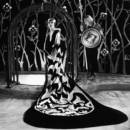
Tradition dictates that histories of avant-garde cinema begin with MESHES OF THE AFTERNOON or perhaps UN CHIEN ANDALOU, but there's an equally rich counter-tradition that locates underground taproots in the flamboyant set design of certain works of silent cinema. Despite its ghastly narrative trappings, Robert Weine's THE CABINET OF DR. CALIGARI (1920) offered generations of filmmakers license to regard cinema as a plastic art, but it's only the most infamous beachhead in that respect. The late archivist James Card offered up Edgar Keller's "futurist" short THE YELLOW GIRL (1916) as the "first American avant-garde film." Karl Heinz Martin's FROM MORN TO MIDNIGHT (1920) exceeds even CALIGARI in its sharp-elbowed, almost punkish commitment to Expressionist set design. Is that enough? Can a film's set decoration and art design by themselves ever be sufficiently alienating and indigestible to earn an otherwise-pedestrian work a hallowed spot among the radical reprobates? Let us say only that Alla Nazimova's in-no-way-pedestrian SALOMÉ was never in any danger of entering the history books on a technicality. Yes, the stark, Aubrey Beardsley-inspired sets of the independently-financed SALOMÉ mark a break with the grounded studio style of Nazimova's earlier films for Metro, but that's the least of it. Nazimova leans on Oscar Wilde's play for structure and lifts some of his text for the film's intertitles, but SALOMÉ is a forward-looking film, a queer beacon slicing through the fog. (Kenneth Anger claimed that every actor in the cast was gay—a factually dubious but philosophically crucial assertion.) The Russian-Jewish lesbian Nazimova used husband Charles Bryant as a beard in more ways than one—he was SALOMÉ's sole credited director, but most scholars now regard the film as substantially Nazimova's creation. The film is a showcase for Nazimova, but also the distinctive set and costume design of Natacha Rambova, including a fetching set of male nipple plates that pre-date BATMAN & ROBIN by three-quarters of a century. The showcase aspect is often literal—the plotting is minimal and the action unfolds so slowly that it would still play as an unhurried pirouette if projected at 48 frames per second. Yes, Salomé eventually kisses the severed head of Jokaanan, but this movie is mostly foreplay; every erogenous limb sings the body electric and every stolen glance winks DTF. But ultimately it's a lot of waiting around—and that's SALOMÉ's chief contribution to the canon of American underground cinema, that stupor of arousal and angst that courses through J.S. Watson and Melville Webber's LOT IN SODOM (1933), Stan Brakhage's DESISTFILM (1954), Jack Smith's FLAMING CREATURES (1963), Barbara Rubin's CHRISTMAS ON EARTH (1963), and much of Anger's MAGICK LANTERN CYCLE (1947-81). Writing in the Evergreen Review in 1967, Parker Tyler coined 'drugtime' to the describe the peculiar form of narcotized concentration demanded and perhaps induced by Andy Warhol's films; in that light, Nazimova's work emerges as an essential precursor, the first effort to slow the medium to a furtive flicker. Preceded by Jack Smith's 1963 short film OVERSTIMULATED (5 min, 16mm). Presented by the Chicago Film Society as part of Sapphopalooza, with live musical accompaniment by the MIYUMI Project Japanese Experimental Ensemble. (1922, 73 min, 35mm) [K.A. Westphal]
Karen Sperling's MAKE A FACE (US)
Block Cinema (at Northwestern University) — Friday, 7pm [Free Admission]
Karen Sperling’s MAKE A FACE (1971) is the year’s greatest rediscovery. With its original 35mm prints and negatives lost or discarded, the Block Museum has digitized the only extant 16mm reduction print, and it’s a miracle that this is seeing the light of day. Last year, Sperling’s second feature film THE WAITING ROOM (1973) played in Chicago, and now it’s time for her debut: an unplaceable, enigmatic, and evocative psychodrama that follows Sperling as the expressionless Nina, an artist in an ostensibly constant state of dissociation. Critics at the time made facile comparisons to Milton Moses Ginsberg’s COMING APART (1969), Roman Polanski’s REPULSION (1965), and Susan Sontag’s BROTHER CARL (1971), but MAKE A FACE is more unwieldy than those films. For one things, it’s in color: muddy swirls of brown, beige, and orange fill every image. If anything pops, it’s because of the grey flickers of a television screen or the scant images of buildings’ white walls. So antiseptic is the latter’s sheen that it almost feels safer to reside in the film’s more uneasy passages, where shadows and bounce lighting transform an apartment into a site of mystique. Sperling is part of the Warner family—the granddaughter of Harry Warner, the niece of Jack Warner, and the daughter of Milton Sperling—but her film has little to do with Hollywood sensibilities. Independently funded and utterly audacious, MAKE A FACE is built on ideas from psychiatrist R. D. Laing, constructing an experience where “dreams, fantasy, and reality are all equal.” Surrealist filmmakers had been doing such a thing for decades by the 1970s, but Sperling—who already knew of Maya Deren at the time—understands the importance of matching form with content. One of the film’s most brilliant tactics is the use of an ever-present radio, telegraphing the world’s many woes. At first, it may seem like a portentous signpost to hear such incessant news, but its never-ending presence becomes something to accept, and the way it casts dread serves as an analogue to our present-day doomscrolling. There are also scenes with hand-crafted split-screen, offering further tension and disorientation. The overarching sense is of constant displacement, further amplified by the men in Nina’s life, including a boyfriend who was Sperling’s actual boyfriend at the time. This is, however, not a film about fact vs. fiction or of docufiction antics: it’s about the way that all these things are connected—the destructive state of the world, the collapsing of our social lives and selves. The film begins with a connect-the-dots game of Nina’s face and concludes with a close-up of it, the lighting in constant motion to blur the contours of her head. It’s unclear what emotion she’s conveying—it feels more honest that way. Sperling in attendance for a post-screening conversation. (1971, 90 min, DCP Digital) [Joshua Minsoo Kim]
Ludwina Ról-Łuszczkowa, Antonina Błazończyk & George DeBelina’s HIGHLANDERS WEDDING (US)
Film Studies Center (at the University of Chicago) — Friday, 7pm [Free Admission]
The making of this film would be an interesting movie in and of itself—an immigrant community comes together to document the customs of their homeland, forever preserving a part of their heritage even as they’re at a great distance from it. That’s exactly what a group of Polish Highlanders did upon their move to Chicago. They set out to make a feature-length representation of their wedding customs, resulting in HIGHLANDERS WEDDING, has just recently been digitized and a new 16mm print struck, the latter of which will screen at the Logan Center for the Arts in what the press release says may be the only opportunity to see the film with English subtitles. It’s “the earliest known moving-image documentation of performative practices within the Polish Highlanders community in the United States”; for those like me who were unfamiliar with the group, Highlanders, also called the Górale, “are an ethnically diverse group of mountain people inhabiting an area stretching west to east from the Ostrawica Valley in today's Czech Republic to Poland's Biały Czeremosz Valley,” per one source. The film details the wedding custom from proposal to the ceremony itself, taking place entirely on one set. Though relatively crude in its execution, there’s a stunning vitality to the recreation. The ceremonial clothing is stunning, with bright reds, corals and other colorful patterns popping against swaths of black, white and beige. Some of the items appear to be embroidered with sequins or beads, my favorites of the clothing; I also love the women's shoes, which are laced up over socks. The customs themselves center on song and dance, the former bellowed lively and the latter performed jauntily, men and women moving in tandem just as the dynamic between the two might be realized in life. The women’s dancing, in particular, looks simple—even though I know it probably isn’t—yet creates such a mesmerizing effect. Staged almost like a play, there’s a charming, if attenuated, narrative that elicits investment in the ostensible story, the marriage between a young man and a young woman, crafted for the purpose of exhibiting their customs. The songs echo the narrative arc from courting to betrothal to marriage; for the most part it’s joyful, but there are trenchant and at times even mournful aspects as well. It’s appears to be a patriarchal culture inasmuch as those from this part of the world usually are (though a Google search illuminates how it’s paradoxically matriarchal in some ways)—some of the songs suggest the gender essentialism inherent to more traditional cultures, a serious factor otherwise wrapped like a gift one might bring to such an event. But at the heart of this document is a rough-hewn tenacity that defines immigrant life and shows the unique way film can play a part in it. Presented with introduction from Agata Zborowska, in partnership with Chicago Film Archives, the Polish Highlanders Alliance of North America, and Zborowska’s Not-So-Ordinary project, with support from the Department of Slavic Languages & Literature and the Department of History. The screening of Highlanders Wedding will be followed by a reception. (1961, 88 min, 16mm) [Kat Sachs]
Barbara Loden's WANDA (US)
Block Cinema (at Northwestern University) — Thursday, 7pm [Free Admission]
Inspired by Jean-Luc Godard's BREATHLESS, the little-known but very talented actress Barbara Loden wrote and directed her first and only film, WANDA, in 1970. Although she cast mostly nonprofessional actors for other roles, Loden herself stars as Wanda Goronski, a coal miner's wife who leaves her husband and children because she's "just no good." Put down as "Lover" and "Blondie" by other men she meets afterward, Wanda eventually takes up with a married bank robber (Michael Higgins) who tells her to call him Mr. Dennis, and they kill time on the road, running from the law through a landscape colored by distinctly American poverty. From a distance, the often expressionless, yet beautiful Wanda may appear like one of the lifeless mannequins that cinematographer Nicolas Proferes shoots in a department store; but Wanda is aware that she is a lost soul. Loden later described her partly autobiographical character: "She's trapped and she will never, ever get out of it and there are millions like her." Throughout this slow film of long takes, Wanda is always with some man or another, believing that she cannot take care of herself, that she is not a self. She finds herself in the hands of a criminal who only tolerates obedience, the same demand made of her by society. Loden's Wanda is both an impenetrable cipher and a fully embodied human being. She tells Mr. Dennis, "I don't have anything. Never did have anything, never will have anything." He bitterly responds, "That's stupid. You don't want anything, you won't have anything. You don't have anything, you're nothing. May as well be dead. You're not even a citizen of the United States." But while Wanda means nothing, it's not because she doesn't try. Society never gave her a chance. WANDA is a masterpiece of independent filmmaking that portrays what is rarely found onscreen—the true experience of a woman's life. Film scholar Dr. Elena Gorfinkel will appear in person to introduce a rare screening of the only known 16mm Kodachrome original print of the film and discuss her extensive research into Loden’s life and cinematic legacy. (1970, 102 min, 16mm) [Candace Wirt]
David Cronenberg's eXistenZ (Canada/UK)
Film Studies Center (at the University of Chicago) — Thursday, 7pm [Free Admission]
The World Wide Web became available to the masses for public consumption on April 30, 1993. Before the world stepped into their first IRC chatroom or understood how to use the AOL disks, society harbored a fear of this emerging technology. Cinema had cemented these fears from the start, with HAL-9000 from 2001: A SPACE ODYSSEY (1968), the replicants of BLADE RUNNER (1982), and espionage via non-reality vacations in TOTAL RECAL (1990). As technology evolved the fear of that tech evolved, the early 1990s saw films depict virtual reality (VR) as humanity’s next existential threat. In MINDWARP (1992), people traded real life for a virtual one. THE LAWNMOWER MAN (1992) explored the madness VR could induce, while BRAINSCAN (1994) linked VR games to murder. By the mid-1990s, VIRTUOSITY (1995) and JOHNNY MNEMONIC (1995) warned of AI and humans becoming little more than organic storage devices. As the millennium approached, anxiety over technological dependence culminated in the threat of Y2K, inspiring the cathartic juggernaut THE MATRIX (1999). Released in the same year Josef Rusnak’s THE THIRTEENTH FLOOR and David Cronenberg’s eXistenZ offered alternative views of the simulation we could be living in. Cronenberg, long fascinated by the intersection of technology and humanism—whether represented by automobiles, TV stations, or transport pods—crafted eXistenZ as a visceral exploration of virtual reality's implications. eXistenZ is a new virtual reality game designed by the renowned Allegra Geller (Jennifer Jason Leigh). Alegra and the marketing team from Antenna Research have invited guests to test her latest game. Allegra is targeted by a militant group of "Realists" who oppose VR. After Allegra is shot in the shoulder, Ted Pikul (Jude Law) is tasked with keeping her safe. The game pods that connect players to Allegra's new VR game require body-mod spinal bio-ports, which Pikul lacks. Their journey leads them to a black-market mechanic (Willem Dafoe) who installs the port in a sequence laden with sexual symbolism, the port itself looks like an anus and accepts a phallic UmbiCord connection that must be stimulated and lubed prior to insertion. These elements echo Cronenberg’s earlier works, such as VIDEODROME (1983) and CRASH (1996), where themes of technology, human flesh, and sexuality converge. Once inside the game, the line between reality and simulation blurs as characters navigate multiple VR layers, until the confusion of reality or game becomes Cronenberg’s thesis: which reality is reality? eXistenZ masterfully bridges 20th-century fears and 21st-century anxieties, encapsulating society’s transition into the digital age. Presented as part of the Year of Games. (1999, 97 min, 35mm) [Shaun Huhn]
Wojciech Has’ THE HOURGLASS SANATORIUM (Poland)
Doc Films (at the University of Chicago) – Friday, 7pm
Generally speaking, the surrealist art to come out of eastern Europe in the interwar years was more political in nature than its western counterpart, as novelists, painters, and playwrights employed dream logic, absurd humor, and exaggeration to comment indirectly on the nightmarish political situation they inhabited. Chicago’s great Trap Door Theatre pays tribute to one of these artists at least once a year, and fans of their productions might appreciate THE HOURGLASS SANATORIUM as a big-budget version of what they do. Based on a collection of short stories by the Polish Jewish writer Bruno Schulz (a figure who’s been likened to Kafka), the film follows a young man named Josef as he goes to the titular sanatorium in search of his father, who retired there some time ago and hasn’t been heard from in a while. Josef learns early on that his father is dead but “doesn’t know it yet”—the doctors at the sanatorium have managed to stop time in what they believe to be a healing mechanism, meaning that many of their patients are both dead and alive. Not only does our hero interact with his father, he also revisits episodes from his childhood and enters various dreams, with reality seeming to transform each time he steps into a new room. (Also, the train conductor from the ride over keeps showing up to demand that Josef pay his fare.) Writer-director Wojciech Has, working with the gifted cinematographer Witold Sobocinski (a collaborator of Wajda, Polanski, and Skolimowski), takes this premise and makes it even more disorienting by employing low angles, wide lenses, and roving tracking shots; he also assembles a cluttered, dirty-looking mise-en-scène that anticipates many of Terry Gilliam’s features. Some say that it was the grunginess of the film’s settings that upset Polish authorities, who saw in them an exaggeration of the country’s deteriorating institutions and subsequently banned the film. (The director still smuggled it to the 1973 Cannes Film Festival, where it won the Jury Prize.) Others speculate that it was the film’s Jewish content that got Has in hot water. Occasionally during THE HOURGLASS SANATORIUM, Hasidic Jews wander into the frames to pray, sing, or perform rituals, making the compositions seem like living Chagall paintings. Have the doctors managed to revive the three million Polish Jews who died in the Holocaust? (Schulz, one of these three million, was killed by Nazis in 1942.) Sadly, anti-Semitism didn’t end with the Holocaust in Poland. From 1968 to 1972, the Polish Communist Party expelled roughly 20,000 Jews as “enemies of the state,” effectively forcing them to emigrate. Has’ depiction of Jewish life as thriving was perhaps the one fantastical element the authorities couldn’t handle. Screening as part of the Psychodynamic Cinema series. (1973, 124 min, DCP Digital) [Ben Sachs]
📽️ ALSO RECOMMENDED
Mehrnaz Saeedvafa's JERRY & ME (US/Documentary)
Haymarket House (800 W. Buena Ave.) — Tuesday, 6pm
There remains a presumption that Jerry Lewis is some kind of unaccountably French hang-up, a defining preference that demonstrates the incredulity of Gallic taste. To the average viewer, Lewis's on-screen persona—putty-faced and childish, naughty in an impenetrably private way—doesn't even rate as an American caricature; he's more like a stateless cartoon character with little purchase on adult consciousness. So it's definitely refreshing that Columbia professor Mehrnaz Saeedvafa's JERRY & ME starts with the assumption that Lewis is a distinctly American phenomenon and an apt figure for understanding US society. On balance, though, the most compelling footage and commentary has little direct connection to Lewis: Saeedvafa includes an extraordinary home movie of herself discussing whiteness with her son and provides a fascinating overview of the Iranian revolution and its eradication of a flourishing local appropriation of Western film culture. Saeedvafa in person for a post-screening discussion moderated by Ali Tarokh of the Syrian Community Network and the Risheh Institute. Snacks and refreshments will be served and all proceeds from the screening will go towards supporting the work of the Syrian Community Network. (2012, 38 min, Digital Projection) [K.A. Westphal]
Abbas Kiarostami's EXPERIENCE (Iran)
Doc Films (at the University of Chicago) — Wednesday, 8:30pm
When reviewing a body of work by a director as prolific and accomplished as someone like Abbas Kiarostami, it’s always fascinating to see how assured their filmmaking roots and style are in their early work. His first feature, EXPERIENCE, follows an orphaned fourteen-year-old working as an errand boy for a photography studio. Mamad’s daily life revolves around his work until one day when he meets a girl who seems attracted to him, spurring a change within him to get closer to her while improving his own conditions. The film is steeped in neorealism. Largely devoid of any kind of major plot, it instead chooses to focus on his daily grind and, most importantly, the many hardships he faces. “I’ll say this for him, he has a knack for misfortune,” comments a woman in his neighborhood aware of his struggles, but Mamad is nevertheless resolved to press on. Although shot in the 1970s, the film features a 1930s-esque sound design, which lends it a rather tactile quality. Hands turning on faucets with a satisfying squeak or trimming the edges of recently developed photographs with a weighty ka-chunk only further the deep sense of immersion Kiarostami was seeking as the audience experiences Mamad’s slice of life. EXPERIENCE is equal parts beauty and tragedy about the daily baggage one carries throughout life and announces the voice of a director whose work would become deeply influential to a new generation of filmmakers. Screening with Amir Naderi's 1974 film WAITING (43 min, DCP Digital) as part of the Iran Through the Lens of Childhood series. (1973, 57 min, DCP Digital) [Kyle Cubr]
Ages of Agnès
Siskel Film Center — See below for showtimes
Agnès Varda’s LE BONHEUR (France)
Friday, 6:15pm and Monday, 6pm
In her essay for the Criterion release of Agnès Varda’s enigmatical third film, LE BONHEUR, Amy Taubin writes, “Few films have inspired as many wildly differing interpretations in the decades since their release as… LE BONHEUR.” (The film’s title translates to ‘happiness,’ appropriately deceptive in its professed sincerity.) She surmises a couple of theories: “Is it a pastoral? A social satire? A slap-down of de Gaulle–style family values? A lyrical evocation of open marriage?” I’d agree with the social satire part. But more than that, I’d say, it’s a lyrical provocation (rather than evocation) of the male gaze, not just how a woman looks or even is desired by a man, but their value to men in terms of the titular sentiment. The film opens on a field of sunflowers, a flora destined to be represented on canvas and screen; ironically—at least in the context of Varda’s "exquisite fable of infidelity,” per an old version of the film’s poster (which adorns my wall)—the sunflower symbolizes loyalty and adoration, and is at the center of the Greek myth of Clytie and Apollo, the former of whom was in love with the latter, the God of the Sun, and, when his attention wandered to another woman, a Babylonian princess, went so far as to tell her father of the affair so that he’d punish her by death. Clytie nevertheless failed to win back Apollo, and thus turned into a flower, the sunflower, after spending so long gazing up at the sun. François (French television star Jean-Claude Drouot) might fancy himself a god, maybe even that of the sun, as the world revolves around his happiness, a notion presented straightforwardly, even a bit whimsically; he’s a carpenter, and his wife, Thérèse (Claire Drouot; the nuclear family of the film is played by a real-life family, complete with their kids playing the children in the film), a homemaker and seamstress. Their relationship is idyllic—the couple are clearly still in love, and as a family they spend weekends in the French countryside, where sunflowers bloom with abandon. (Varda remarked in an interview that she centered the film around these picnics so as to guarantee being able to spend a month outside.) François then meets Émilie (Marie-France Boyer), a beautiful post-office worker, with whom he enters into an affair. The tension of the film, or perhaps the lack thereof, isn’t that François loves another woman more than his wife, but that he loves another woman in addition to her and sees no problem with it. This, for him, is happiness, he at the center, like the sun, and his two loves idolizing him like blooming flowers dependent on his star’s luminous rays. If you haven’t yet seen the film or heard about what transpires in it and want to be surprised, I’d recommend reading no further. Because though at first Thérèse seems okay with the revelation, she’s later found dead in the lake where they take their outings, whether or not she committed suicide or accidentally fell into the water unclear. François mourns but soon goes on to marry Émilie, having effectively slotted her into the spot left by Thérèse, the viewer left to wonder if it could be just any woman. As Chantal Akerman said, aptly identifying the axiomatic of this masterfully canny fable, “The idea is extraordinary: one love is worth the same as another, a person can be replaced by another. For me, LE BONHEUR is the most anti-romantic film there is.” Fitting commentary from another Belgian-born filmmaker who made another classic of male-gaze deconstruction (though Varda’s probing occurs in the film, while Akerman’s dismantling exists entirely outside of it). Illustrating all this are some of Varda’s most romantic tableaux, filled with warm sunshine, cool pastels, and abundant bouquets of flowers, all while Mozart plays; it looks and even sounds like a bucolic love story but could be, actually, the most understated of cautionary tales. The film is certainly a Rorschach test of sorts, except with sunflowers instead of ink. (1965, 80 min, DCP Digital) [Kat Sachs]
---
Agnès Varda's VAGABOND (France)
See Venue website for showtimes
Not all who wander are lost, but it could also be said that not all who wander wish to ever find or be found. Some are happy to be forever sans toit ni loi (the film's original French title)—without roof or law. Such is the case for Mona, the protagonist of Agnes Varda's staggeringly recusant VAGABOND. The aimless wanderer in question is played by a teenaged Sandrine Bonnaire; her greasy-haired, unwashed lack of naïveté brings a decidedly enigmatic element to the film's already elusive structure. The plot accounts for Mona's last weeks before she freezes to death in a ditch, with Varda employing a combination of narrative enactments and documentary-like interviews with those who encountered her before she died. A mysterious narrator voiced by Varda herself declares that no one claimed her body after she died, and that she seemed to emanate from the sea; Mona is then seen emerging naked from a cold ocean while two boys admire her from afar. Thus begins the film's overarching point of view, one in which the vagabond is little known and used only as a blank slate onto which her acquaintances project their own expectations and disappointments. Though it opens with Mona's death, the rest of the film is not at all hampered by the inter-film spoilers. She lived just as aimlessly as she died, and the details of her life weeks before her demise present another slate onto which viewers can project their hopes for the seemingly apathetic drifter. Varda's poetic filmmaking encourages the disconnect between the viewers and the characters, and even between the characters themselves. Slow tracking shots imitate a voyeuristic gaze and first-person interviews reveal some deceit among the fictional subjects. Even Varda's use of nonlinear structuring suggests such discord, as the confusion imitates Mona's mysteriousness. A string-heavy score betrays underlying anxiety, while music from The Doors and Les Rita Mitsouko highlight her rebellious nonchalance. The film's disarray comes together to present only one knowable fact about Mona: that no one really knew her at all. (1986, 105 min, DCP Digital) [Kat Sachs]
---
Agnès Varda’s ONE SINGS, THE OTHER DOESN’T (France)
See Venue website for showtimes
If I had to sum up the droll sagacity of Agnès Varda’s scintillating cinematic timbre, it would be this exchange from ONE SINGS, THE OTHER DOESN’T: a handsome man, a photographer, surrounded by pictures of women in various poses and states of undress, exits his darkroom to find a teenaged girl perusing his gallery. “Waiting for me?” he asks. “People sometimes give up.” The young woman replies: “So put up a doorbell,” referring to his lack of such a necessity. The delivery is pure Varda, capriciously pragmatic, as if the answer to every question—the benign and the momentous alike—is an obvious one. It’s also a hilarious inversion of art world tropes, the handsome male artist chided rather than celebrated for his gratuitous eccentricity. It’s an apt representation of Varda’s work as pointedly feminist art, of which ONE SINGS, a film that could be described as an abortion musical, is a perfect example. The aforementioned young woman is Pauline, a fiery redhead who stumbles into the man’s gallery to discover that one of his subjects, Suzanne—also his partner and the mother of his children—is a former neighbor. The two become close after Pauline, learning that Suzanne is pregnant, helps her to procure the funds for an abortion. A sudden tragedy, which I won’t reveal here, bonds them further. They meet again ten years later at a demonstration for reproductive rights, centered around the watershed Bobigny trial, where Pauline, now going by Apple, performs protest songs about abortion (the lyrics written by Varda herself), and Suzanne reveals that she’s opened a family planning center. Their reunion is joyful, albeit brief, and the rest of the film traverses the next several years of their largely long-distance friendship (the section set in Iran is especially wondrous). Flowing through the permeable narrative are delightful songs performed by Apple and whatever band she’s with at the time, the music political and avant-garde but still entertaining. (A soundtrack exists—I highly recommend it.) The film teems with Varda’s effortless ebullience, its world scooped from inside her head and thrown into the frame like paint onto a canvas. Speaking of which, Charles Van Damme’s cinematography is painterly à la the best of the Impressionists, and the production and costume design, both from Franckie Diago, imbue the women with even more sense of character, each having their own distinct style. (1977, 122 min, DCP Digital) [Kat Sachs]
Clint Eastwood’s THE BRIDGES OF MADISON COUNTY (US)
Alamo Drafthouse — Saturday, 3:15pm and Tuesday, 1:15pm
In a 2024 interview with critic Nick Pinkerton, Clint Eastwood gave his best impression of John Ford, dodging every attempt by his interlocutor to analyze his artistic impulses or working methods. The binary that the nonagenarian filmmaker evoked over and over was “the difference between emotionalizing and intellectualizing,” and in repeatedly claiming a preference for the former, evoking Ford’s curt replies to Peter Bogdanovich in the critical documentary DIRECTED BY JOHN FORD (1971). While the mythology around Eastwood’s cinema is not so developed as that of Ford’s, an enduring fascination of the Honkytonk Man’s career has always been how his brisk, unstudied shooting methods have produced a body of work with recurrent preoccupations and the development of pet themes. Perhaps no film better expressed the binary, or gradient, between the intellectual and the emotional, the head and the heart, as THE BRIDGES OF MADISON COUNTY. Adapted from the bestseller by Robert James Waller, Eastwood joined the Amblin production first in the lead role of National Geographic photographer Robert Kincaid, then took over directing duties from Bruce Beresford after clashing over the casting of the female lead. Beresford had favored a European actress for the role of Italian-American housewife Francesca Johnson, but Eastwood insisted on an American, eventually wooing and winning over Meryl Streep. The framing device sees Francesca’s adult children discovering her record of a four-day affair with Robert, traveling on assignment to photograph covered bridges in the rural area encompassing Des Moines, Iowa. (The landscapes are real, while the downtown jazz club fronted by the James River Band, featuring Kyle Eastwood, is a movie construct, shot at the local Pheasant Run Pub.) The suspicious glares of neighboring Iowans and the children’s delayed outrage skewer both provincial attitudes and Baby Boomer morality, even as the affair reinforces Francesca’s commitment to her marriage and family. While Robert Kincaid is an impossibly chivalrous interloper— though perhaps not more impossible than the director’s shredded physique at 64—and a too-flattering self-portrait of Eastwood’s record with women, the screen romance is ingeniously staged as a gradual lowering of Francesca’s guard. Streep’s highly technical, mannered style of acting reveals the character through a series of decisions to invite Robert closer, creating the impression that Eastwood’s more intuitive star presence has coaxed this performance out of her a half-step at a time. Francesca’s son refers to Robert and by proxy, Eastwood as a “perverted photographic mind,” though the commercial and conservative logic of the story dictates that everyone returns to their rightful place by the end of this four-day pass. The finale’s showstopping gesture is a weepie twist on a Fordian image, that of the itinerant cowboy framed in a doorway, like a country lyric about two hearts separated by a river of tears. (1995, 135 mins, DCP Digital) [Brendan Boyle]
Caroline Golum’s REVELATIONS OF DIVINE LOVE (US)
The Davis Theater — Saturday, 7pm
“It’s an unfashionably sincere movie,” director Caroline Golum has said of her latest spiritual cinematic endeavor, and it’s hard to argue with her there. In adapting the words of Julian of Norwich, a 14th-century anchoress whose “Revelations of a Divine Love” still stands as the earliest surviving female-penned piece of English-language writing, Golum addresses her task of cinematic transliteration with nothing less than unabashed sincerity, her approach as faithful and sacrosanct as that of Julian recording the sixteen visions of Holiness she received in 1373. There’s something heartwarming in seeing a filmmaker eschew the typical contemporary artistic impulses towards postmodernism, poisoned irony, and snark, and instead build something earnest and tactile in both body and spirit. For the uninitiated: at the age of thirty, Julian of Norwich became gravely ill and, upon what was seemingly her deathbed, received sixteen “shewings” of Christ Almighty. Now fully healed, Julian exiled herself from secular society and lived out her days of isolation writing these visions down, the world of Norwich moving swiftly around her through plague and class revolution. There is little overt humor in REVELATIONS OF DIVINE LOVE, but there is an abundance of warmth and a generosity of spirit emanating from the production, the handcrafted models and gorgeously-lit sets providing a comforting atmosphere to glide along Golum’s textured frames. As the anchoress centering the story, Tessa Strain makes a remarkable screen debut, her face filling the screen with a radiant empathetic glow, her awe and wondrous spirit immediately palpable for the viewer. Golum’s work has shades of Pier Paolo Pasolini, dashes of Sergei Parajanov, but is entirely its own object, a paean to the human spirit’s capability to give oneself to something greater than, simply because we must. A hazelnut becomes a key totem for Julian, a tiny object in the grand scheme of things, but Christ tells Julian that this nut “is all that is made.” The smallest thing containing the vastness of the universe inside it. So too, in Golum’s world before us. Presented by Oscarbate, with Golum, producer Kate Stahl, and co-writer Laurence Bond in attendance for post-screening Q&A. (2025, 73 min, DCP Digital) [Ben Kaye]
Sophy Romvari's BLUE HERON (Canada)
Siskel Film Center – See Venue website for showtimes
Like a long-lost childhood memory, Sophy Romvari’s BLUE HERON exists within a series of flitting moments of comfort before shifting suddenly and revealing something entirely raw, pulling the rug out from under you in the process. Though this is her feature debut, Romvari has already made a name for herself with an array of short films that explore the uncanny marriage between media and memory. Her particular fascination, and the patient, anthropological methodology with which she explored it could have only culminated in something like BLUE HERON, a jarring yet kindhearted work whose efforts to prod nostalgia reveal nothing but a tender bruise in the aftermath. Romvari has oh-so slightly twisted and morphed her own biography to create the family at the center of the film, a Hungarian-Canadian quintet who have recently moved to a scenic new home on Vancouver Island in the late 1990s. The summer weeks that follow comprise the first half of the narrative, where brief, jutting memories emerge as revelatory moments within young minds. A young girl, Sasha, amusingly draws a mouse on Microsoft Paint while her two brothers play in the other room; an older brother, Jeremy, steals a bird keychain from a nature gift shop, while Mom peels potatoes, Dad develops photographs, and summer hours idle away. Romvari’s camera prefers static wide shots, entire canvases of nature bathed in cool tones providing the backdrop for a young family that is unknowingly in the midst of a personal crisis. Jeremy, the only child born from the mother’s previous relationship, has begun behaving in exponentially more aggressive ways, building to his own arrest for shoplifting, with his parents struggling to come to terms with their own inability to manage his social and emotional needs. The cast, comprised of both actors and nonactors (Edik Beddoes, playing Jeremy, was discovered from a clip Romvari had found of him talking about video games), move through these difficult spaces almost effortlessly, their naturalistic styles meshing together with ease. This would all be well and good for a charming film debut, but BLUE HERON levels up and takes a turn about halfway through, shattering the chronology we’ve become accustomed to and shifts from the story of a struggling family into the story of a struggling mind. We follow one of our characters, now twenty years older, and using the archival tools at her disposal to try and see where things all went wrong two decades ago. We eventually begin to grapple with how helpful it really is to use the art of film, of photographs, of recreation, to try and, in essence, bring someone back to life. BLUE HERON builds to a scene where characters move across time and space to dissect whether there’s any catharsis to even be found in using cinema to excavate trauma. Romvari has no answers, our distrust in our own memories merely a feature, not a bug, of this ugly, beautiful world of ours. But that doesn’t mean we can’t cherish the things we do remember, the lives we do live, and the art we do create. (2025, 90 mins, DCP Digital) [Ben Kaye]
John Frankenheimer's SECONDS (US)
Doc Films (at the University of Chicago) — Monday, 7pm
SECONDS is probably the only other movie John Frankenheimer directed that’s comparable to THE MANCHURIAN CANDIDATE (1962) in that it avoids genre classification at nearly every turn, shifting between science fiction, black comedy, horror, and melodrama. Blatantly allegorical, the film ponders the health of the American Dream circa 1966, observing a 60-ish banker who’s given the chance to fake his own death and be “reborn” as a different, younger man through extensive surgery and the assumption of a new identity. Formerly blacklisted actor John Randolph plays the character for the first 40 minutes, until he’s transformed into Rock Hudson—an inspired piece of casting, since Hudson always seemed to be playing another person’s dream of virility anyway. A successful movie star but an underrated actor, Hudson delivers some of his best work in SECONDS; his performance, which serves as a subtle commentary on his career, adds a critical layer of text to the film. The flashiest contribution, however, comes from the great James Wong Howe. Is this ever a DP’s movie. Not only does the stark black-and-white photography set the sense of foreboding throughout; the cinematography all but steals the show. Howe shoots scenes hand-held, executes brilliant, expressionistic lighting schemes, and even straps the camera onto one of the actors to convey his character’s paranoia. That sentiment, already so pervasive in MANCHURIAN CANDIDATE and Frankenheimer’s follow-up, SEVEN DAYS IN MAY (1964), comes to overwhelm the second half of the movie, when Hudson’s character starts suspecting something isn’t right with his new life, despite the fact that it seems to have been engineered to satisfy his deepest desires. (The dramatic irony feels very Twilight Zone, which may well have been an influence on the movie as a whole.) If SECONDS is an energizing, sometimes frightening film to watch, it becomes more melancholy the longer you think about it, when you’re left with the core narrative of a man who’s cursed to be unhappy even when given everything he wants. Screening as part of the Painting with Light: The Cinematography of James Wong Howe series. (1966, 106 min, DCP Digital) [Ben Sachs]
Andrew Donoho, Lacey Duke & Alan Ferguson's JANELLE MONÁE: DIRTY COMPUTER (US)
Music Box Theatre — Friday, Midnight
DIRTY COMPUTER, the companion film to Janelle Monáe’s third album, culminates a decade-long project that reframes the android as an allegorical “other”: a figure through which Blackness, queerness, gender fluidity, and interior life become sites of both desire and state control. Across The ArchAndroid (2010), The Electric Lady (2013), and Dirty Computer (2018), Monáe draws from Fritz Lang’s METROPOLIS (1927)—a touchstone she has explicitly cited for its staging of class conflict—while reworking Afrofuturist lineages associated with Octavia Butler and Sun Ra. What distinguishes DIRTY COMPUTER is how it extends these influences into the grammar of the film musical. As an “emotion picture,” Monáe treats the musical number (à la Minnelli or Busby Berkeley) not as interruption but as topography: a space where latent desire becomes legible, where taboo identities can be staged, and where love briefly escapes social constraint and hegemonic order in an arcadian, post-punk paradise. While Minnelli provides the film's enunciative logic, DIRTY COMPUTER draws on BLADE RUNNER (1982) and PURPLE RAIN (1984) for dystopian scaffolding and the concept of performance as self-revelation, respectively. Monáe’s synthesis of genres (psychedelia, hip hop, funk, jazz) finds a visual analogue in the film’s shifting environments, each sequence reflecting the sensibilities of her Wondaland collaborators. Most notably, color becomes the film’s primary expressive system, anchoring elaborate, Renaissance-style tableaus and sweeping desert plateaus, marking the divide between repression and desire while rendering interior states spatially visible. In “Pynk,” the desert is saturated in pink, desire diffused across bodies and landscape alike; in “Make Me Feel,” gradients echo the bisexual flag, coding sexual fluidity as atmosphere rather than identity. By contrast, the memory-erasure facility reduces color to sterile whites punctured by flashes of transgressive red to signify people as "dirty computers" in need of "cleaning," a palette inverted in “I Like That,” where black and red dominate a mise-en-scène that positions Jane simultaneously as subject and spectator. DIRTY COMPUTER oscillates between utopian projection (“Americans”) and dystopian warning (“Django Jane”), insisting that the same systems that threaten totalitarian control also produce the conditions for resistance. Marginalized identities are cast as both targets and agents: figures who refuse assimilation and instead turn visibility, pleasure, and performance into acts of defiance, one beat at a time. Preceded by a 20-minute music video preshow. (2018, 49 min, Digital Projection) [Alex Ensign]
Yasuzō Masumura’s BLIND BEAST (Japan)
Doc Films (at the University of Chicago) – Thursday, 9:30pm
A cinematic exploration of the phenomenological experience of touch, BLIND BEAST is visually engaging while skillfully portraying a sensual voyeurism beyond sight. Based on a novel by macabre master of the perverse Rampo Edogawa and directed by notable postwar Japanese filmmaker Yasuzō Masumura, the film is contained in its scope, taking place predominantly in one room. Aki (Mako Midori) is a successful erotic model, posing for S&M photographs for a respected artist. She is stalked and kidnapped by Michio (Eiji Funakoshi), a blind sculptor whose obsession with developing a new kind of sensory art. Michio focuses on the importance of touch and wants to use Aki as his ultimate muse. As he holds her captive in his studio warehouse, the space becomes surreal. She’s surrounded by walls of various oversized sculpted women’s body parts; the wall of eyes is the first to be seen, largely looming over the scene—not the only reference to Hitchcockian images and themes throughout the film. Michio has been reproducing women’s body parts from his memory of touching them, organizing and cataloging, disembodying them as objects lost from any subject. Two large sculptures of complete bodies with limbs akimbo take up the floor space of the studio, with Aki resorting to crawling over them to try to escape, eventually spending most of her time on the stomach of one. Aki is savvy enough to realize this situation could benefit from a psychoanalysis of Michio, who also has an unnervingly close relationship to his mother (Noriko Sengoku), who’s helped him with his plan. Through their conversations, Aki’s initial horrified feelings towards the situation become more complex, eventually giving way to Michio’s desires of all-encompassing esthesis. BLIND BEAST is as theoretical as it is transgressive, resulting in the character’s sadomasochistic and very corporeal investigation of pleasure and pain, embodiment and disembodiment. Screening as part of the Arthouse Vulgarity series. (1969, 84 min, DCP Digital) [Megan Fariello]
Grace Glowicki's DEAD LOVER (Canada)
FACETS — Saturday, 7:30pm and Thursday, 9pm
Grace Glowicki’s DEAD LOVER is absolutely repulsive, and thank goodness for that. Brought to vivid, odorous life by a quartet of performers playing multiple roles across a variety of spaces—evoking the irreality of storefront theater more than anything—this is the kind of film whose particular brand of crassness can only be supported by immense creative minds working at the height of their depraved powers. In assembling this “Frankenstein meets Sarah Squirm” nightmare, Glowicki has concocted a stew of admirable artistic inspiration, drawing on traditions of silent cinema and German expressionism in conjuring the images onscreen, with outsized performance styles matching the outre genre ambitions on display. My mind also kept wandering to Guy Maddin, a fellow Canadian mining the cinematic techniques of the past to create new living dreams. Kicking off with a Mary Shelley epigraph, lest we forget what aesthetic realm we’re playing in, we enter the world of The Gravedigger, played by Glowicki as a foul smelling, foul-mouthed romantic whose quest for companionship continually hits the stumbling block of her own off-putting aura. She eventually becomes entangled with The Lover (the film’s co-writer, and Glowicki’s real life partner, Ben Petrie), a man entirely enamored with all that has made the Gravedigger repellent to the world around her (“I want to lick your stink,” he utters, in a manner frighteningly palpable). Sadly, he meets his end far too soon in a freak accident, and the Gravedigger is left with no choice but to turn to the dark scientific arts in an attempt to reunite with her deceased beau, with her mantra of survival (“Dig deep, dig hard, never stop digging”) burrowing itself further and further until she hits upon a plot of resurrection that would make Mary Shelley wince. Glowicki and Petrie are joined by Leah Doz and Lowen Morrow, exchanging costumes as town gossips, sailors, and nuns engaged in illicit behavior (call it “cun-nun-lingus,” perhaps), injecting the film with a playful energy, all engaging in a work whose tactility and collaborative spirit provides a welcome respite from the digital sludge of daily life. Glowicki’s film is horny, sickly, poetic, and at times, very, very stupid, all of which, well, Frankensteins itself together to make something you immediately want to fall in love with. Some moviegoers may even be lucky enough to come across one of the few “Stink-O-Vision” screenings occurring for the film, harkening back to the scratch-and-sniff cards pioneered for John Waters’ POLYESTER (1981). What a delight to revel in something so gloriously rotten. On Saturday, the screening will be presented in Stink-O-Vision with special scratch-and-sniff cards. (2025, 84 min, DCP Digital) [Ben Kaye]
Curry Barker’s OBSESSION (US)
Alamo Drafthouse, the Davis Theater, Landmark's Century Centre Cinema, the Music Box Theatre and others — See Venue websites for showtimes
With a “One Wish Willow” sold at your local magic shop, all your dreams can come true. But what would you wish for? Since “The Monkey’s Paw,” horror cinema has warned that every wish carries a shadow. In OBSESSION, however, the wish itself is almost secondary. Curry Barker understands that supernatural objects do not create darkness so much as expose what already exists beneath the surface. Alongside roommate and creative partner Cooper Tomlinson, Barker dropped out of film school in 2017 to pursue independent filmmaking full-time, building an audience through their sketch-comedy channel “That’s a Bad Idea.” Their comedy often sprung from minor social discomforts spiraling into absurdist chaos, an instinct essential to OBSESSION. After the viral success of “The Chair” (2023) and the release of the $800 found-footage film MILK & SERIAL (2024) on YouTube, Barker found himself with a budget near $1 million for OBSESSION. The story centers on Bear (Michael Johnston) who has been in love with Nikki (Inde Navarrette) since childhood. Even his best friend Ian (Tomlinson) grows tired of hearing about it. Ian urges him to simply ask her out, but Bear is too emotionally paralyzed to risk rejection. Instead, he buys a One Wish Willow—“A love only the branch of a Willow tree could conjure.” A familiar idiom (be careful what you wish for, you might just get it) gradually mutates into a body-horror film about consent, disguised as romantic fantasy. After Bear makes his wish, Nikki immediately becomes devoted to him. At first, it resembles a dream come true, but Barker poisons every interaction with stomach-churning wrongness. Bear notices it. Their friends notice it. Nikki herself occasionally appears trapped beneath the performance, as if her real consciousness is screaming somewhere inside her own body. Yet Bear continually chooses fantasy over reality. Barker’s sharpest insight is recognizing how entitlement disguises itself as vulnerability. Bear never sees himself as monstrous, which makes him even more disturbing. Johnston balances Bear’s sympathy and selfishness effectively, though the film ultimately belongs to Navarrette. Already carrying the energy of a future scream queen, she channels shades of Mia Goth in PEARL while creating something uniquely feral and tragic. Barker has joked that Johnston and Navarrette’s lack of chemistry helped secure their casting, and that tension becomes crucial to the film’s unease. Navarrette pivots from flirtation to psychosis in seconds, occasionally snapping back into terrified lucidity before the wish reasserts control. Visually, Barker and cinematographer Taylor Clemons create a world defined by loneliness. Center-composed frames and oppressive headroom make every room feel emotionally vacant, even when crowded. Barker’s intentionally off-rhythm editing prevents scenes from settling naturally, keeping comedy and horror on the same unstable wavelength. Laughter curdles into revulsion almost instantly. What makes OBSESSION linger is how human the horror feels beneath its supernatural mechanics. Barker transforms romantic desperation into body horror without losing sight of the sadness underneath it all. Somewhere between internet sketch comedy, splatter horror, and poisoned melodrama, Barker has created something distinctly contemporary: a horror film where the monster never stops believing they’re the good guy. (2025, 108 min, DCP) [Shaun Huhn]
Boots Riley's SORRY TO BOTHER YOU (US)
Alamo Drafthouse — Saturday, 12:15pm and Sunday and Monday, 10pm
Boots Riley’s debut feature about a Black man who can only become a success in America by using a white voice at his bottom-feeder telemarketing gig is a trenchant, by turns hilarious and horrifying take on the state of our country. Cassius “Cash” Green (Lakeith Stanfield) can’t make headway interrupting people’s lives on the phone until an older coworker (Danny Glover) shows him how to use a white man’s voice to project confidence and trust, enabling him to become the star of the office. But his newfound talent and riches come at the cost of losing his girlfriend and friends, who are all battling an economic system that is literally turning citizens into chattel. Riley uses conspiracy theories and surreal horror to illustrate the very real situation many Americans, but especially African-Americans find themselves in—trapped in a cutthroat system which values profit over basic human decency at every turn. While Armie Hammer’s evil mogul may be an ugly caricature, he will not be unfamiliar to any halfway-informed resident of 2018 United States of America. His company, Worry Free, which offers food and shelter in exchange for freedom, is like a funhouse mirror version of gig economy juggernauts like Uber or AirBnB. They offer a cheerful illusion of independence as they’re robbing their customer/workers of basic rights. By the time the horse-people appeared, I was ready to accept anything Riley threw in front of me because his feel for setting and tone is so assured that even the most out-there moments fit the overall premise. He has created a parallel world not unlike the ones found in the work of Gogol, Kafka, or Paul Beatty’s great 2015 novel, The Sellout, where people are turned into monsters and do outrageous and reprehensible things and no one bats an eye. Much of what he shows has already come to pass and the rest will as well unless we fight like hell against it. Presented as part of Alamo’s Boots Riley Guest Selects for his new film, I LOVE BOOSTERS. (2018, 105 min, DCP Digital) [Dmitry Samarov]
Robert Aldrich's KISS ME DEADLY (US)
Alamo Drafthouse — Sunday, 4pm
Robert Aldrich's low-budget noir classic, a loose adaptation of the Mickey Spillane novel, goes off the rails almost from the get-go. A nightmarish midnight driving sequence—complete with a hysterical nuthouse escapee—sets the tone, evoking a sense of terror that eventually bookends the film. After being intercepted on the road, knocked cold, and with the woman dead, P.I. Mike Hammer (Ralph Meeker) later finds himself interested in her case. In search of a mysterious object, "the great whatsit," Hammer navigates the warrens of Los Angeles to discover its contents. Shot on location in L.A.'s Bunker Hill neighborhood, KISS ME DEADLY uses the actual settings that so many noir films took as inspiration in the studio. This added realism helps ground the melodramatic nature of its plot, albeit one rife with plot twists and brutal violence. Eventually culminating in a beach house and a magnificent reveal of the MacGuffin, KISS ME DEADLY supposedly captures the paranoia of cold war America. More than that, Aldrich's film comes at the waning of the classical noir period, and it both embodies and critiques the genre. Aldrich called his laconic main character a "cynical fascist" and said that KISS ME DEADLY demonstrated that "justice is not to be found in a self-anointed, one-man vigilante." (1955, 106 min, DCP Digital) [Brian Welesko]
Lamberto Bava’s DEMONS 2 (Italy)
Alamo Drafthouse — Tuesday, 9:30pm
DEMONS 2 moves the setting to a high-rise building, where each individual apartment’s television set airs another film all about the contagious demons. The referential nature works slightly better in the sequel, as the insidiousness of the demon film infiltrating the domestic space through broadcast is more unnerving. The apartment building itself is a dynamic setting, filled with iconic '80s paraphernalia like multiple neon signs as indoor décor, in addition to a new batch of impeccably dressed victims. The melodramas of the many characters take a back seat to the film's overall dazzling design; this includes the impressive, at times cartoonish, gross-out demon special effects from Sergio Stivaletti. That’s not to say the unruliness of the plot and numerous characters aren’t a hoot—the mixture of highly stylish visuals and eccentric plots make DEMONS 2, like its predecessor, essential horror viewing. Screening as part of the Terror Tuesday series. (1986, 92 min, DCP Digital) [Megan Fariello]
Daisy von Scherler Mayer's PARTY GIRL (US)
The Davis Theater — Thursday, 9pm
PARTY GIRL is the mid-'90s incarnate. The first person on screen is legendary New York City drag queen, Lady Bunny, seen as the camera wobbles up the stairs in a point of view shot to the entrance of a rave; it’s an immediate demonstration of the sincere homage to the downtown queer club scene in NYC in the 90s. Daisy von Scherler Mayer’s independent classic is also known for being the first ever film to make its premiere on the internet. Its costume design, too, is a bold exemplification of '90s aesthetic, all layered outfits of tights and jackets, with clashing colors and metallics. These fashions, never settling between grounded and whimsical, work so well because of Parker Posey’s iconic turn as carefree Mary, who spends her time clubbing and throwing house parties. When she’s thrown in jail for helping to organize an underground rave, Mary reaches out to her godmother, Judy (Sasha von Scherler), a librarian. Judy gets Mary a job as a clerk in exchange for posting her bail. At first, Mary is annoyed by the work, but slowly starts to dedicate herself to the Dewey Decimal System. The eventual clash of her two worlds, however, threatens her place in both and Mary needs to decide which path to take. Filled with engaging side characters, von Scherler Mayer spends enough time with each to build out a lived-in and complex world surrounding Mary and her journey. PARTY GIRL, with humor and sincerity, ingeniously celebrates career club goers and librarians alike. Screening as part of the Not Quite Midnight and Spotlight on Women series. (1995, 94 min, DCP Digital) [Megan Fariello]
Amanda Kramer's BY DESIGN (US)
Alamo Drafthouse — Wednesday, 9:30pm
At the Sundance Film Festival premiere of Amanda Kramer’s latest cinematic curio, BY DESIGN carried with it a brief but tantalizing logline; “A woman swaps bodies with a chair, and everyone likes her better as a chair.” Kramer, in her own idiosyncratic way, has always been fascinated by the physical and emotional limitations of the human body, whether as a fragile vessel for entertainment and public consumption in GIVE ME PITY! (2022), or as a canvas to be imploded and reassembled to escape the confines of systemic gender roles in PLEASE BABY PLEASE (2022). It was only a matter of time, then, before this continued exploration of bodily autonomy—told through Kramer’s signature aesthetic gumbo of modern dance, garish aesthetics, and melodramatic performance—would find itself venturing into the world of magical realism via literal soul-switching transformation. Enter: the chair, a stunning piece of design—bright wooden features, curved arms, a sensible squeak when sat upon—that captures the eye of Camille (a daringly committed Juliette Lewis), a woman who seemingly has never felt jealousy towards any woman before, but feels a burning, passionate desire to be seen the way the world sees this damn chair. And so, a wish is granted, and our Freaky Friday But With Furniture narrative kicks off. With the aid of running narration from Melanie Griffith that evokes the tenderness and absurdity of a George Saunders short story, BY DESIGN turns this seemingly bizarre premise of interior design dramatics into something truly human, that universal itch to walk a mile in someone else’s shoes (or seat, I guess) providing the engine for Camille’s emotional journey, finally becoming “someone’s favorite thing,” if only for a fleeting moment. As the chair, Camille falls under the ownership of Olivier (Mamoudou Athie, giving a balletic fireball performance), a down-on-his-luck piano player who turns all his energy and attention into a life devoted to his new seated soulmate. Meanwhile, Camille’s body, a lifeless blob resting in her apartment, inexplicably becomes more open and available to the people around her, her literal nothingness providing a springboard for her nearest and dearest to project themselves upon. How depressing that in her very absence, Camille becomes the person her friends have always wanted her to be? Kramer fills the margins with a delicious ensemble cast, with the likes of Betty Buckley, Clifton Collins Jr., and the late Udo Kier providing texture to this world, alongside a soundtrack filled with soothing Gershwin and Irving Berlin covers, and the spaces not filled with monologue otherwise enveloped by dance. (Kramer has never met an interior emotion she couldn’t transform into a movement piece.) BY DESIGN is, fittingly enough, just like the stunning chair at its center: sleek, well made, familiar yet slightly off-kilter, and containing more beneath the surface than you could imagine. I know that I’ll never look at a chair the same way again. Screening as part of the Weird Wednesday series. (2025, 92 min, DCP Digital) [Ben Kaye]
📽️ ALSO SCREENING
⚫ Alamo Drafthouse
Andrew Adamson and Vicky Jenson's 2001 film SHREK (90 min, DCP Digital) screens Sunday at 12:30pm and 3:15pm, and again on Monday, 6:30pm, as part of the 25th Anniversary Movie Party series; audience props included.
Boots Riley's 2026 film I LOVE BOOSTERS (105 min, DCP Digital) screens Tuesday, 5:30pm, followed by a livestream Q&A with Riley and cast.
Francis Teri's 1990 film THE SUCKLING (88 min, Digital Projection) screens Tuesday, 9:30pm, as part of the Terror Tuesday series. More info on all screenings here.
⚫ Chicago Film Archives
A Celebration, a large-scale video installation by experimental filmmaker and Chicago Film Archives curatorial assistant Colin Mason, is on view through Saturday, July 4, in the lobby of 150 N. Riverside Plaza (enter via Randolph Street); free and open to the public Monday–Friday 4–7pm and Saturdays 11am–5pm. The installation is part of the 150 Media Stream arts program, curated by Chicago video artist Yuge Zhou, and was produced in partnership with Chicago Film Archives. More info here.
⚫ The Davis Theater
Alex Mallis and Travis Wood's 2025 film THE TRAVEL COMPANION (91 min, Digital Projection) screens Sunday, 7pm, with Wood and writer-producer Weston Auburn in attendance for a post-screening Q&A.
Joe Swanberg presents Arabella Oz and Nick Canellakis's 2026 film MALLORY'S GHOST (87 min, Digital Projection) on Monday, 7pm, with Oz, Canellakis, and actor Anjelica Bosboom in attendance for a post-screening Q&A. Screens as part of the Spotlight on Women series.
Charles Crichton's 1988 film A FISH CALLED WANDA (109 min, Digital Projection) screens Tuesday, 7pm, as part of the Big Screen Classics series. More info and tickets here.
⚫ Doc Films (at the University of Chicago)
Elizabeth Chai Vasarhelyi and Jimmy Chin's 2018 documentary FREE SOLO (100 min, DCP Digital) screens Friday, 9:30pm, as part of the Board Picks series.
Two new DCP restorations of films by the French critic-turned-filmmaker Luc Moullet screen back-to-back Saturday afternoon and evening as part of the New Releases and Restorations series: Moullet and Antonietta Pizzorno's 1976 film ANATOMY OF A RELATIONSHIP (79 min, DCP Digital) screens at 4pm, and Moullet's 1971 film A GIRL IS A GUN (75 min, DCP Digital) screens at 7pm.
Andrew Stanton's 2008 film WALL-E (98 min, DCP Digital) screens Saturday, 9:30pm, as part of the Board Picks series.
Two films by Judit Elek screen Sunday afternoon as part of the Judit Elek: Reality by Itself series: her 1974 documentary ON THE FIELD OF GOD IN 1972-1973 (A HUNGARIAN VILLAGE) (120 min, DCP Digital) screens at 2pm, and her 1976 film A COMMONPLACE STORY (90 min, DCP Digital) screens at 4pm.
A program of eight short films selected by Robert Beavers as formative influences —Renate Sami's WENN DU EINE ROSE SIEHST (1995, 4 min), James Edmonds's A RETURN (2018, 6 min), Ute Aurand's KOPFUEBER (2009, 15 min), Luke Fowler's N'IMPORTE QUOI (2023, 9 min), Eva Claus's TIRANA (2020, 2 min), Ewelina Rosinska's EARTH IN THE MOUTH (2020, 20 min), Peter Todd's ROOM WINDOW SEA SKY (2014, 3 min), and Todd's TOGETHER (2018, 3 min)— screens Sunday, 7pm, all on 16mm, as part of the Robert Beavers: My Hand Outstretched to the Winged Distance and Sightless Measure series.
Jacques Rivette's 2009 film AROUND A SMALL MOUNTAIN (84 min, 35mm) screens Tuesday, 7pm, as part of the Jacques Rivette's Late Style series.
Robina Rose's 1981 film NIGHTSHIFT (68 min, DCP Digital) screens Wednesday, 6pm, with a post-screening talk by film scholar, critic, and programmer Elena Gorfinkel.
Doug Atchison's 2006 film AKEELAH AND THE BEE (113 min, DCP Digital) screens Thursday, 7pm, as part of the Black Girlhood series. More info on all screenings here.
⚫ Dorothy (2500 W. Chicago Ave.)
Jessica Bendinger's 2006 film STICK IT (103 min, Digital Projection) screens 7pm, hosted by queer culture writer and curator Shelli Nicole, as part of the monthly Queer Movie Monday series. Free admission; 21+ only. More info here.
⚫ FACETS
The May edition of Cold Sweat, FACETS's monthly double-feature horror series curated by Cineromero Productions, takes place Friday with Shunya Itō's 1972 film FEMALE PRISONER SCORPION: #701 (87 min, DCP Digital) at 7pm and Pascal Laugier's 2008 film MARTYRS (99 min, DCP Digital) at 9pm.
Cherien Dabis's 2025 film ALL THAT'S LEFT OF YOU (146 min, DCP Digital) screens Saturday, 2pm, as part of the Must-Watch Indies series, with a special pre-recorded message from Dabis.
Harry Lighton's 2025 film PILLION (107 min, DCP Digital) screens Saturday and Sunday at 5pm as part of the Must-Watch Indies series.
MY FIRST MOVIES + MAKE AND PLAY, a curated program of international animated shorts from the New York International Children's Film Festival (approx. 50 min, Digital Projection) presented in partnership with Chicago Danztheatre Ensemble, screens Sunday, 10:30am, followed by hands-on Make and Play craft stations.
Brad Bird's 2007 film RATATOUILLE (111 min, Digital Projection) screens Sunday, 2pm, followed by an Animation Lab stop-motion workshop for kids.
Sweet Void Cinema’s Industry Hobnob takes place Sunday starting at 5pm in the FACETS Studio. The group’s screenwriting workshop takes place Wednesday from 6 to 9pm. More info on all screenings and events here.
⚫ Goethe-Institut Chicago (150 N. Michigan Ave.)
Lateral Entrant, a site-specific exhibition by Chicago-based interdisciplinary artist Maya Nguyen incorporating video, photography, and performance, exploring migrant strategies of camouflage and adaptation across languages and visual cultures connecting Vietnam, Germany, and the United States, is on view through July 31. Public viewing hours are available by advance registration on Eventbrite, and a state- or federally-issued photo ID is required for building check-in. More info here.
⚫ Music Box Theatre
Jim Harman’s 1975 cult classic ROCKY HORROR PICTURE SHOW (100 min, 35mm) screens Saturday at midnight. Every screening has a shadowcast of the film (that’s actors acting in front of the screen during the film) performed by Midnight Madness.
Also screening as part of the Sapphopalooza series are Naoko Yamada's 2018 anime feature LIZ AND THE BLUE BIRD (90 min, DCP Digital) on Sunday, 11:30am, co-presented by Animation Adventures and introduced by Aja Essex and Gurinder Chadha's 2003 film BEND IT LIKE BECKHAM (112 min, 35mm) on Thursday, 9:45pm, presented by Rated Q and Ramona Slick with preshow drinks and a DJ set in the Music Box lounge beginning at 9pm and a drag show performance in the Main Theater at 9:30pm. More info on all screenings here.
⚫ New Lines Magazine
The Art Of Documentary Film: A Conversation With Thom Powers, a free public talk in which Toronto International Film Festival lead documentary programmer Thom Powers discusses his new book Mondo Documentary, takes place Saturday, 2pm, at Nighthawk (4744 N. Kimball Ave.), as part of the Juxtapositions: Conversations on Art, Ideas and Global Cross-Currents series co-presented by New Lines Magazine and Nighthawk. Copies of the book will be available for purchase. More info and free registration here.
⚫ Siskel Film Center
Chloé Robichaud’s 2025 film TWO WOMEN (100 min, DCP Digital) opens Friday and runs through the week. See Venue website for showtimes.
The SAIC Film, Video, New Media, Animation, And Sound Festival concludes its three-day run Friday and Saturday, with programs at 6pm and 8pm on Friday, and five programs (11am, 1pm, 3:30pm, 6pm, and 8:30pm) on Saturday. Free admission.
Mati Diop’s 2024 film DAHOMEY (68 min, DCP Digital) screens Sunday, 12pm, as part of the African Cinema: From Independence to Now lecture series. More info on all screenings here.
⚫ Tone Glow
My Heart Falls At Daybreak: Films By Parine Jaddo, a program of three new digital restorations of works by the Iraqi-Lebanese filmmaker—ATASH (THIRST) (1995, 14 min), AISHA (SURVIVING) (1999, 32 min), and TEYH (ASTRAY) (2002, 21 min)—screens Saturday, 6pm, at Eyewash Station, a new microcinema in Logan Square (address emailed to RSVPs on the day of the event; DM @misterminsoo on Instagram for the address in advance). More info here.
⚫ Tone Glow Film Festival
Shadow Stepping: The Films of Isao Kota, a program of eight restored short films by the overlooked Japanese filmmaker—FAR FROM THE EXPLOSIVE FORM OF FRUIT (1972, 8 min), ASCENSION (1972, 4 min), DUTCHMAN'S PHOTOGRAPHS (1976, 7 min), PREPARATION (100-FEET VERSION) (1977, 3 min), FULL TIDE (1981, 7 min), ECHO (1982, 9 min), SHADOW STEPPING (1983, 14 min), and BIG STONE AND SMALL NIGHT (1991, 12 min)— screens Thursday, 6pm, at Chicago Filmmakers (1326 N. Damen Ave.).
Afterwards, Rhayne Vermette's 2025 film LEVERS (95 min, DCP Digital) screens at 8pm, also at Chicago Filmmakers (1326 N. Damen Ave.), as the Opening Night of the Tone Glow Film Festival, preceded by Kim Westfall's 2026 short LANDSCAPE PSYCHOSIS (6 min, DCP Digital). Vermette appears in person for a post-screening Q&A. Co-presented by the Center for Native Futures. More info on all screenings here.
CINE-LIST: May 15 - May 21, 2026
MANAGING EDITORS // Ben and Kat Sachs
CONTRIBUTORS // Brendan Boyle, Kyle Cubr, Alex Ensign, Megan Fariello, Shaun Huhn, Ben Kaye, Joshua Minsoo Kim, Dmitry Samarov, Brian Welesko, K.A. Westphal, Candace Wirt
