


📽️ CRUCIAL VIEWING
John Ford's YOUNG MR. LINCOLN (US)
Chicago Film Society at the Siskel Film Center – Sunday, 6pm
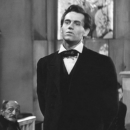
Given John Ford's stature in world cinema, it's easy to forget that the first twenty-one years of his career were undistinguished by the standards of his later films. Certainly there were great films during that period (particularly his Will Rogers films), but it wasn't until 1939, with a trio of early masterpieces, that the core of what would define his style and thematic complexity would emerge. STAGECOACH, DRUMS ALONG THE MOHAWK, and especially YOUNG MR. LINCOLN would see the synthesis of elements that had appeared scattershot in his previous films: an epic sense of history; an Americana tinged as much by darkness as by nostalgia; a growing sense of moral ambiguity; and a visual style that sets his heroes apart from those around them. Ford's characters are often dominated by space—usually in the vast expanses of the West—but even in YOUNG MR. LINCOLN, which feels more like a backwoods and courtroom chamber piece, Henry Fonda's Abe Lincoln is frequently cut off from others, through lighting, through camera movement, and through Fonda's studied posing which works to create mini-tableaux within the shot. Ford is walking a thin line between heavy-handed mythologizing and punctuating a sense of historical foreshadowing and inevitability. Of course, he succeeds and creates a tension that falls between a near-parody of the Lincoln myth and a grandeur that hints at the larger historical events to come that dwarf even Lincoln. Ford had reached a union of style and vision which itself foreshadowed things to come. Preceded by Hal Hartley’s 1991 short film AMBITION (9 min, 16mm). Screening as part of an ongoing series featuring prints from the CFS collection. (1939, 100 min, 35mm) [Patrick Friel]
King Vidor's STELLA DALLAS (US)
Music Box Theatre – Sunday, 11:30am
The ending of King Vidor’s STELLA DALLAS is an emotional tribute to cinematic spectatorship. Stella (a luminous Barbara Stanwyck) gathers with a crowd on the street, peering through a large window into the home of her ex-husband, which frames her daughter’s wedding ceremony inside; her eyes fill with tears as she expresses both happiness and sorrow, having selflessly given up a relationship with her daughter to give her a better life, relegating herself to simply a spectator in this important event. The visual connection between the audience and Stella is staggering, and many have pointed out the power of this mirrored moment, especially for how it complicates the legacy of the women’s film genre. Film scholar Linda Williams writes of STELLA DALLAS, “I would argue that [it] is a progressive film not because it defies both unity and closure, but because the definitive closure of its ending produces no parallel unity in its spectator. And because the film has constructed its spectator in a female subject position locked into a primary identification with another female subject, it is possible for this spectator… to impose her own radical feminist reading on the film.” It’s the quintessential maternal drama, wrought with emotion, driven effortlessly by Stanwyck’s performance. Her Stella is complex, with a constant tension between allowing herself to have what she wants and sacrificing everything. Stella, determined to make it out of her lower-class home, marries the wealthy Stephen Dallas (John Boles), and they quickly have a child, Laurel (Anne Shirley). Stella’s ostentatious nature and inability to fit in with the upper-class crowd drives a wedge between her and Stephen. Laurel's well-being, however, becomes her priority. As Laurel grows up, a series of embarrassing incidents occur surrounding how the world sees her mother—as a tacky, crude woman; Stella realizes her daughter may be better off without her. The ending is cinematic melodrama at its finest, but only made so by the film in its entirety, brilliantly paced with tension and heartbreak as Stella comes to realize her fate. It’s easy to identify with Stanwyck’s Stella, as we ultimately find ourselves staring through the frame at another frame, spectators of her poignant spectating. Screening as part of the Working Girl: The Films of Barbara Stanwyck series. (1937, 106 min, 35mm) [Megan Fariello]
Robert Altman's NASHVILLE (US)
Block Cinema (at Northwestern University) – Friday, 6:45pm
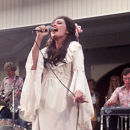
It remains debatable as to whether NASHVILLE is Robert Altman’s crowning work (one could make as strong a case for MCCABE AND MRS. MILLER, THE LONG GOODBYE, or CALIFORNIA SPLIT), yet in no other film, save for perhaps SHORT CUTS, did the director achieve so many of his ambitions in one go. Indeed, the most remarkable thing about NASHVILLE may be how it threatens to collapse on itself at any moment but somehow doesn’t—Altman’s direction of this two-hour, 40-minute opus is comparable to a captain steering an ocean liner around a range of icebergs without even rattling the passengers. The film famously juggles two dozen principal characters and about half as many different storylines, but no less remarkable is the way Altman succeeds with multiple formal experiments that could have easily come off as gimmicky or distracting. Several of these experiments have to do with sound. Building upon the multi-track audio of CALIFORNIA SPLIT, Altman shot much of NASHVILLE with up to 16 separate microphones, seldom letting the actors know who would be recorded directly and mixing the wealth of sonic material in post-production. Roger Ebert once wrote that the beauty of Altman’s films often lies in basking in the music of a room, and by that token, NASHVILLE is a veritable symphony of jargon, offhand remarks, noise, and actual songs. Most of the songs, in fact, were written by the actors who sing them, and another one of Altman’s fascinating experiments was to insist that not all them be good. To reflect the range of quality one finds in Nashville’s music scene, Altman included great songs (like Keith Carradine’s Oscar-winning “I’m Easy” and the classic-style country numbers sung by Ronee Blakeley, arguably the best singer in the cast), hokey songs (like the self-aggrandizing tunes of Henry Gibson’s Haven Hamilton), and even terrible songs (like the ones performed by Gwen Welles’ heartbreakingly naive Sueleen Gay). Similarly, NASHVILLE alternates between a number of tones, ranging from poignant to sardonic to bitter to menacing. Altman creates the impression that he’s discovering the movie as it goes along, which is fitting, given how it was shot. Screenwriter Joan Tewkesbury created characters and situations for the film, but per Altman’s instruction, wrote very little dialogue; that was left to the actors, whom Altman directed to improvise as much as possible. As Altman put it, “We would stage events and then film the events,” resulting in a fiction film that has the look and feel of a documentary. In one way, NASHVILLE is a documentary about post-60s political disillusion in America—one significant through line comes in the form of campaign speeches by an erstwhile third-party presidential candidate named Hal Philip Walker, who roams the city in a tour bus, blasting calls for political upheaval. The movie ends at a Walker campaign rally that goes catastrophically wrong, then regains ground through the giant sing-along of another Carradine-penned number that would seem to contradict the spirit of liberty that’s run through the epic poem that preceded it. For even a few minutes after the credits end, the song’s haunting refrain repeats: “You may say that I ain’t free, but it don’t worry me.” Introduction by Heather Hendershot, Professor in Communication Studies at Northwestern University, in celebration of the October publication of her new book, NASHVILLE, from BFI Film Classics. (1975, 160 min, 35mm) [Ben Sachs]
Jocelyne Saab’s The Beirut Trilogy (France/Lebanon/Documentary)
Siskel Film Center – See Venue website for showtimes
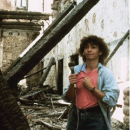
At its best, documentary can be both archive and monument, directly engaging with the present while saving it for posterity. The work of Lebanese filmmaker Jocelyne Saab fits this bill, owing to her background as a journalist that informed her sustained and unflinching documents of war in her country. Saab’s Beirut Trilogy, three mid-length documentaries spanning the beginning of the Lebanese Civil War in 1976 to the Israeli bombardment of Beirut in 1982, was part of a career-long project of documenting her home city of Beirut. BEIRUT, NEVER AGAIN (1976, 35 min, DCP Digital), made the same year as Saab’s seminal CHILDREN OF WAR, starts the filmmaker’s documentation of the Lebanese Civil War by returning to various sites in the city following their bombardment. This is a common approach that morphs across the three films of the trilogy, here deployed in an attempt to sort of archive elements of the city lost to destruction. Her footage is often structured by absence, documenting places where personal and cultural landmarks used to be, with her choice of subject itself usually dictated by what/who she can afford to shoot between bouts of violence. There’s special care given to parts of the city that might not otherwise be memorialized, like the red light district where dead bodies had remained after bombing due to a general belief the area was “cursed” by sin. By tracking the changes in Beirut over the next 6 years, Saab extends her original lament to study a place in constant flux, where even sites of memory marking lost places eventually become lost themselves. She takes a more active role in LETTER TO BEIRUT (1978, 48 min, DCP Digital), made after returning two years later to make a more conventional study of the city and its people in the course of the Israel-Palestine proxy war. She finds an interesting variety of material across all three films but especially here, where she includes the most footage of herself navigating the city. She’s not just a disembodied voice, nor a person-on-the-street interviewer looking for soundbites. We see Saab live a somewhat typical (if hyper-social) life while onscreen, chatting up everyone from strangers on a bus to PLO soldiers. In a series of films about the loss of a way of life, there’s an admirable sort of manifestation in these sequences, with Saab’s documentation doubling as an enactment of a way of life so as not to let it disappear. This sense of optimism is all but gone from the bleak final film of the trilogy, BEIRUT MY CITY (1982, 35 min, DCP Digital) which contains the films’ most harrowing images following the destruction of the city by Israeli siege. The film becomes almost hypnotic in its repetition of rubble-laden street photography, nearly every sequence documenting a place that merely was something once. We see the dead and injured in hospitals, malnourished children covered in flies, and even the able-bodied have a sad listlessness as they sort through what remains of their homes and communities. “The truth of the city sprung from the wounds inflicted on its living body” Saab states in a furious bit of poetry from the film’s narration. It’s here she finds some glimmer of hope in the idea that the city, though battered, revealed its depth of character by surviving at all. Saab would set her astute sights on other places in later work, but her body of work documenting Lebanon through this period of conflict ranks among the most vital documentary filmmaking in the 20th century, a monument both to a lost country and to the necessity of a politically involved direct cinema. [Maxwell Courtright]
Ross Lipman’s THE BOOK OF PARADISE HAS NO AUTHOR (US/Experimental)
Music Box Theatre – Wednesday, 7pm
Adam Curtis by way of Orson Welles’ F FOR FAKE, archivist, author, and filmmaker Ross Lipman’s THE BOOK OF PARADISE HAS NO AUTHOR isn’t a traditional film. Described as “an eclectic spin on the concert film,” it’s one of Lipman’s live documentary performances that’s been recorded, with included media shown as it typically would be in a film. It shows Lipman as he stands at a podium in front of a screen, on which the aforementioned media is being shown in the room. This is necessary and appropriate, as Lipman grounds his fascinating consideration of the supposedly cave-dwelling Tasaday from the Philippines' Mindanao island and the surrounding controversies in Plato’s allegory of the cave, both as it might apply to the people and the media clamor. In 1971, upon “discovery” by Manuel Elizalde, a rich crony of President Ferdinand Marcos, the Tasaday attracted global attention for apparently being a primitive indigenous group that had theretofore been isolated from Philippine society. A Tasaday boy swinging from a vine adorned the cover of National Geographic, and soon a cottage industry of news documentaries about the group began to materialize. Using footage from these shows, Lipman details—I was tempted to use the word “crafts,” which would have been ironic for reasons that will soon become clear—the world’s initial reaction to the group, one of awe over their seeming naivete, living secludedly in edenic terrain with a vocabulary free of words like enemy or weapon, and the slow unraveling of this so-called revelation as a potential hoax, serving any number of possible machinations. It’s not so straightforward, as Lipman inserts the allegory of the cave, to illuminate (pun intended) the philosophical nature of the dilemma at hand, and also vintage advertisements shown alongside the broadcasts. Lipman astutely connects the latter via semiotics, of the images themselves, and the underlying politics of broadcast news and the machine that propels it. In bringing the Tasaday out of their literal and proverbial caves, it was the world at large that saw the light of this idyllic microsociety—but also maybe the shadows. Then, as suspicion over the veracity of the claims of this being a secluded tribe grew, many began to see them only as shadow puppets, taking a logical conclusion to its extreme. All this is illustrative of the inherent deception, both benign and malignant, of images and how they can be manipulated, an apt parallel for our day-and-age of fake news and AI slop. There are no easy conclusions to be drawn; Lipman quotes Nabakov, who said that “reality is one of the few words which means nothing without quote marks around it.” In effect this is those marks, putting into stark relief the shadowplay that is existence. Introduction and post-film Q&A with Lipman, who be available in the Music Box Lounge before and after the program to sign copies of his book The Archival Impermanence Project: Film Restoration Poetics, Case Studies, and Histories. (2025, 82 min, DCP Projection) [Kat Sachs]
Bette Gordon's VARIETY (US)
Doc Films (at the University of Chicago) – Saturday, 9:30pm
There have been two great films about women working in porn theaters to enjoy revival within the past few years: Marie-Claude Treilhou's Paris-set SIMONE BARBÈS OR VIRTUE (1980) and Bette Gordon’s VARIETY (1983), the latter of whose protagonist takes tickets at one of New York City’s porn palaces of a grittier, pre-Giuliani yesteryear. Both are excellent, though the films have only superficial elements in common; where Treilhou's SIMONE BARBÈS is almost Varda-esque in its sexual and sociological whimsy, VARIETY is both more erotic and more alienating with regards to its protagonist’s concupiscent transformation. Sandy McLeod stars as Christine, an unemployed woman who learns of a job selling tickets at a porn theater, called Variety, from her bartender friend Nan (played by Nan Goldin). At first the job seems like an opportunity for bemusing anthropological study, an edgy but still suitable fortuity for Christine, whom it’s hinted at is a writer of some sort. But Variety soon yields an object of obsession for her: a mysterious, wealthy older man, a Michel Piccoli-type per Gordon’s own admission, who takes her to a baseball game only to leave midway through, after which Christine begins following him all around New York and even to Asbury Park, New Jersey. Her interest in the enigmatic businessman—who may or may not be a mafioso taking part in the fishmonger’s union scuffle that Christine’s journalist boyfriend (Will Patton) is investigating—is at once passive and acute, much like the gaze of the men looking at women on or behind the screens at Variety and other such voyeuristic establishments. Passive more so initially, as she quietly follows the man and begins making herself up more provocatively in the confines of her miniscule studio apartment; acutely in bewildering erotic monologues she delivers to her disinterested boyfriend and her increasingly erratic behavior toward this inexplicable object of her desire. Gordon, working from a script by Kathy Acker based on an original premise by the director, doesn’t just reverse the gaze but wholly assumes it, universalizing the elements of desire that compel us in our day-to-day lives and sometimes account for violent outbursts of yearning. It’s in this universalization—this wink to knowing audiences that women can and do have the same sexual impulses as men—that the protagonist is empowered and, by extension, those who identify as women in the audience, all of us satisfied in having reflected back to us our own prurient attraction and its mystifying impact. The cinematography by John Foster and future Jim Jarmusch collaborator Tom DiCillo emphasizes the sordid beauty of live-nude-girl sleaze, and music by John Lurie renders sonically what it means to look, to lurk, and to desire. Cinephiles are undoubtedly aware of how a movie theater can change you; it’s in her ticket booth, compressed between public and private spheres of desire, that Christine begins to realize her own. Screening as part of the City Serendipity series. (1983, 100 min, 35mm) [Kat Sachs]
Brittany Shyne’s SEEDS (US)
Block Cinema (at Northwestern University) – Thursday, 7pm
When discussing her debut feature SEEDS, director Brittany Shyne has described the film as "the maintenance of legacy and cultural presentation." This becomes painfully clear as the full scope of her work comes into view, a kaleidoscopic look at the lives of Black farmers in the American South that, like the best documentaries, acts as both art and artifact. Originally conceiving of the film as a project while in grad school, Shyne, also acting as cinematographer here, wanted to use her filmic voice to capture a perspective that she had yet to see portrayed faithfully, if at all, on camera. Structurally, SEEDS exists as a “process” documentary; there are no talking heads, no descriptive voiceovers, simply the footage of these farmers in Georgia and Mississippi working, talking, and simply living, Shyne’s imagery providing enough context and artistry to paint a sumptuous picture as is. We are thrust, in pristine black-and-white, into the world of these “centennial farmers,” those whose families have owned their respective land for over a hundred years, their cultural footprint measured in acres, struggling to keep up with an agricultural community that has systematically left them far behind. Shyne’s compositions are gorgeously intimate, her camera finding its way into the deep crevasses of gigantic mechanical cotton pickers, into funeral homes during reverentially joyful services, and even to Washington DC, joining the farmer’s mass protests against the blatantly racially discriminatory practices of the Department of Agriculture (during the Biden Administration, mind you). Two figures who find themselves poking through the artistic morass of agricultural imagery are Willie Jr. and Carlie, two enigmatic farmers whose presence particularly highlights how this profession—for Black southerners, at least—still mainly rests in the hands of the elderly (Carlie is 89 in the footage here, but has since passed). There is an existential weight at the heart of SEEDS, of Black Americans finally owning land in a country that has brutally othered them for centuries, hoping that there will be someone to whom they can pass down these fields of legacy. Cotton and corn will continue to grow, but will those who have given their lives to cultivate these crops still be given the space to do so, to grow even fuller, even stronger? Shyne in person for a post-screening conversation. (2025, 123 min, DCP Digital) [Ben Kaye]
John Sayles’ THE BROTHER FROM ANOTHER PLANET (US)
Music Box Theatre – Saturday, 11:30am
John Sayles made THE BROTHER FROM ANOTHER PLANET while he was waiting to secure funding for MATEWAN (1987), and the film has a casual, almost tossed-off vibe that goes a long way in establishing its charm. According to Sayles, it was inspired by some of his dreams, which may explain why the premise is so evocative and why the story doesn’t try to resolve anything. Joe Morton stars as a space alien who crash-lands on Earth near Ellis Island and winds up in Harlem. Since his skin is Black, he blends relatively easily in with the local population, and because he doesn’t speak, he winds up becoming the confidant, Chance the Gardener style, of multiple people that he meets. If it weren’t for the other two space aliens trying to capture him, our hero would have a pretty good time of it in New York City. He makes friends with the regulars at a bar, who help him find clothes, community, and a place to stay. He also has magic powers that enable him to fix broken machines just by touching them, and this ensures him a steady supply of jobs as a mechanic. He even finds romance (however fleeting) with a beautiful soul singer. Thanks to Sayles’ understated direction, all of this unfolds naturally, almost realistically, as though there would be little difference between the experience of an immigrant and an extraterrestrial in New York. The film is, on one level, a tribute to that city’s brand of bonhomie, and it’s plenty satisfying on those terms. As to what it means otherwise is hard to say. Is Sayles commenting on race relations in the Reagan era? Some global (or beyond-global) qualities of the Black experience? THE BROTHER FROM ANOTHER PLANET is ultimately open-ended as to what it’s about, which makes it something of an outlier in the writer-director’s filmography, even though the sharp dialogue (rooted in Sayles’ talent for capturing regional speech) and underlying leftist sentiment make it characteristic in others. Screening as part of the Brothers from Another Planet series. (1984, 108 min, 35mm) [Ben Sachs]
📽️ ALSO RECOMMENDED
Larry Charles’ MASKED AND ANONYMOUS (US)
Music Box Theatre – Tuesday, 6:30pm
Though it was generally dismissed on first release, MASKED AND ANONYMOUS looks scarily relevant in the 2020s, which makes it worthy of serious consideration. The film imagines an alternate reality in which the United States resembles a Latin American dictatorship that’s been in a state of civil war for decades. Bob Dylan stars as Jack Fate, a legendary singer-songwriter who’s let out of prison to headline a benefit concert for the victims of the war that will be aired on the one national TV station. On his journey from jail to the TV studio, Fate witnesses a country plagued by violence and partisanship; when he arrives to film his performance, he encounters producers, journalists, and various showbiz hangers-on, all of whom come off as cynical profiteers. Dylan cowrote the script with director Larry Charles (both pseudonymously), and per Charles, the film was intended to be like a feature-length Dylan song. The film definitely succeeds on that level—MASKED AND ANONYMOUS is a poetic mix of allegory, Americana, and verbose pontificating that has a tendency to frustrate audiences who like their art readily explainable. Jonathan Rosenbaum (one of the few critics to take the movie seriously in 2003) noted that it’s like a William Faulkner novel except that instead of everyone talking like Faulkner, they all talk like Bob Dylan; this can frustrate some viewers as well. Regardless, the incredible cast—which includes Jeff Bridges, Penélope Cruz, John Goodman, Luke Wilson, Giovanni Ribisi, Jessica Lange, and Val Kilmer—has a blast delivering Dylan’s oddball dialogue, and it can be refreshing to find an American movie that’s so invested in language. The imagery is sometimes potent too, namely when Charles and company apply the trappings of dictatorship to American-looking settings. (2003, 102 min, 35mm) [Ben Sachs]
---
Introduced by author, filmmaker and Cine-File contributor Michael Glover Smith, who will be signing copies of his new book Bob Dylan as Filmmaker: No Time to Think in the Music Box Lounge following the screening.
Elfi Mikesch & Monika Treut’s SEDUCTION: THE CRUEL WOMAN (West Germany)
Music Box Theatre – Wednesday, 9:15pm
SEDUCTION: A CRUEL WOMAN is the story of Wanda (Mechthild Großmann), an intense and transfixing dominatrix who runs a dungeon with a small circle of underlings. She stages sadomasochistic rituals that border on performance art and videotapes semi-instructive BDSM encounters with clients. The film’s color palette is blues, blacks, grays; its textures are concrete, metal, and nylon. There is no slick vinyl or latex, no gaudy reds outside of the occasional draw of blood or dress cast in dim light. The backgrounds are peppered with giant, looming container cranes, the foreground occasionally holds a majestic Borzoi, an overturned resting stool, or a tiered display of high heels. It is moody, industrial, muted, and evokes a dreamlike quality that comes from the niche world the characters inhabit as much as the filmmaking. A good deal of the film is photographed with Dutch angles; the tales told are all but straightforward. As the film rotates from in-house submissive to in-house submissive, we learn small details of Wanda’s personal life, what she has sacrificed to commit to this lifestyle and the power she holds because of it. In this rotation, we too see the personalities and lived experiences of her slaves, what they desire, what they may gain, and most potently, their commitment to Wanda, regardless of how much she may hurt them, both physically and emotionally. Their lives are enmeshed in an amalgam of fervent passion and extreme restraint, a constant balancing act, a sadomasochistic circumstance in and of itself. SEDUCTION is steadfastly forthright and honest about the nuances of desire and their intersections with pain, and even sadness. In the first performance we see of Wanda and Co., a woman in the audience openly sheds a tear when viewing the display. Each sexual infliction and response is not immediately weighted with exposition; they are regarded as natural and, in a way, simple, interpretation left to the viewer. What the film chooses to opine on instead is the dungeon’s personal turmoil and hierarchy. The fascination lies in the dynamics of power and sensitivities of those within the hierarchy, especially when unrest and disintegration slowly rise to the surface. The clinical, minimal tableaux of sexual acts are never at odds with the melodramatic undercurrents; they blend seamlessly into a concoction about the conflict of human appetite. Screening as part of the Female Misbehavior: The Films of Monika Treut series. (1985, 86 min, DCP Digital) [Olivia Hunter Willke]
Anne-Marie Miéville’s WE’RE ALL STILL HERE (France)
Doc Films (at the University of Chicago) – Tuesday, 7pm
Filmmaker Dan Sallitt once said that “filming two people sitting in a room talking is the ultimate in cinema.” I come back to this quite often, and it came to mind as I ruminated on Anne-Marie Miéville’s WE’RE ALL STILL HERE, a tripartite that features two sections of people doing just that. Originally intended for a theater project in Switzerland, the film’s dialogue largely consists of pre-existing texts. In the first section, two women, played by Aurore Clément and Bernadette Lafont, have an intensely philosophical discussion taken from Plato’s Gorgias, with Clément as Socrates and Lafont as Callicles. In Gorgias, Callicles argues that pleasure is paramount and that the strongest are superior, whilst Socrates asserts otherwise, poking holes in Callicles’ tenuous but assured stance. Miéville’s film is much like Gorgias overall, with its various considerations and focus on philosophical debate; part of Gorgias is the debate of philosophy itself, which Callicles says, “if one spends more time with it than he should… [is] the undoing of mankind.” In the second section, the shortest of the three, Miéville’s long-term partner Jean-Luc Godard delivers a monologue based on Hannah Arendt’s “The Origins of Totalitarianism” on a minimally adorned stage with only a picture of the political philosopher in the background. In his monologue he considers, via Arendt, both loneliness and solitude, as well as the risk philosophers take by engaging too much in the latter. Frustrating as though the conversations before and after this segment may be, they point to the need for discourse, born of solitude but still in opposition to loneliness. (Going back to Plato, this evokes the allegory of the cave and the effects of isolation on perspective.) The third section plays almost like the sophisticated version of a romantic or even screwball comedy; Clément and Godard’s characters are married and in various contexts have conversations about any number of things, ranging from the trivialities of coupledom (Godard’s character, for example, dons a pompom-adorned beanie that Clément’s doesn’t like) to the externalities of being. The dynamic between a pair is central in this section, that of two discrete consciousnesses inherently rejecting a necessary solitude out of fear of isolation. Olivier Seguret wrote that it “may not seem so, but [it] is a very cruel film.” Indeed, the connection between this and those prior is a violent one, perhaps likening the couple’s dynamic to that of Socrates and Callicles or subject to the same inevitabilities as totalitarianism. Still, there’s an endearing tenderness that underlies the tense rhetoric (Godard, who took on the role two weeks before filming after the original actor dropped out, is quite charming) and points to another sort of inevitably: that of love, simply between two people. (1997, 80 min, DCP Digital) [Kat Sachs]
William Castle’s THE NIGHT WALKER (US)
Music Box Theater – Friday, 10pm
The opening narration of William Castle’s THE NIGHT WALKER flatly asks, “What are dreams?” The voiceover is accompanied by surreal, nightmarish imagery as eyes, women falling through the night, and demons, most notably the one featured in Henry Fuseli’s oft-referenced painting The Nightmare. Bookended by the text, “pleasant dreams,” Castle draws the audience into part meta-consideration of the nature of dreams, part melodramatic horror. Irene (Barbara Stanwyck) is married to a controlling and wealthy inventor, Howard (Hayden Rorke), who keeps her confined to their large house (a common theme in Castle’s work is a tortuous relationship between husband and wife). Blind, Howard has turned the house into a soundscape with a plethora of ticking clocks, and he’s hidden recording devices in every room. Having overheard Irene talk in sleep about a handsome young man, Howard is convinced she’s having an affair. When he’s killed in an explosion in his lab, Irene’s dreams heighten, becoming indistinguishable from reality, with her dream lover (Lloyd Bochner) becoming more and more corporeal. She seeks help from Howard’s lawyer, Barry (Robert Taylor), to determine what is real and what is a nightmare. Bits of the surrealist montage trickle into the narrative of THE NIGHT WALKER, and, along with its impressive black and white cinematography by Harold E. Stine, makes for a plush looking horror. This is especially noticeable in the scene where Howard ascends one last time to his laboratory. There is also a standout score from Vic Mizzy (who also wrote the Addams Family theme); the 60s instrumentation is simultaneously buoyant and ominous, adding to the uncertainty of the goings-on. Stanwyck, however, is the focus, bringing her melodramatic flair to this psychological horror, always balancing Irene’s sense of composure as she also grapples with a fracturing of reality—it’s marvelous to watch. While not the most over-the-top of his gimmick films, B-movie legend Castle did have some tricks up his sleeve for THE NIGHT WALKER, including heavily promoting the fact the film was written by Robert Bloch, author of Psycho. A contemporary trailer for the film features documentary footage of non-actors undergoing hypnosis to access their nightmares. Casting, too, was strategic; Stanwyck and Taylor had been divorced for over ten years before reuniting to work on this film. Screening as part of the Working Girl: The Films of Barbara Stanwyck series. (1964, 86 min, 35mm) [Megan Fariello]
Aki Kaurismäki's THE OTHER SIDE OF HOPE (Finland)
Doc Films (at the University of Chicago) – Monday, 7pm
Building on the themes of immigration and refugees explored in LE HAVRE (2011), THE OTHER SIDE OF HOPE finds Finnish director Aki Kaurismäki tackling the refugee and humanitarian crisis caused by the Syrian Civil War. After stowing away onboard a Polish coal frigate that lands in Helsinki, Khaled (Sherwan Haji) seeks asylum in Finland with the hopes of finding his sister, whom he lost as they fled Syria. Similarly, traveling shirt salesman Waldemar (Sakari Kuosmanen) flees his old way of life and wife after it is implied he can no longer tolerate the monotony of his current existence. After Khaled’s request for asylum is denied, he flees the immigration center in order to avoid being sent back to Syria and soon crosses paths with Waldemar who now owns a middling restaurant that employs a trio of colorful characters. THE OTHER SIDE OF HOPE has a very distinct aesthetic. Its unique set design has an understated blandness that intentionally juxtaposes the bleakness shown in Aleppo after a series of bombings that make Helsinki seem like a paradise by comparison. Kaurismäki combines this aspect with masterful uses of space, especially his overabundance of physical separation of set pieces as an analogy for Finland’s remoteness in relation to the humanitarian crisis occurring in Africa and the Middle East. Kaurismäki’s film has a deadpan, dry wit to it that draws humor from the awkwardness of everyday situations. During one sequence in which Khaled is having identity papers forged for him, he exclaims, “I don’t understand humor” which serves as a reminder that sometimes it's difficult to find the laughter in life when a person is too close to a situation. THE OTHER SIDE OF HOPE’s unique panache and grounded story make for a delicate and delightful showcase for one of the modern world’s most pressing issues. Screening as part of the City Serendipity series. (2017, 100 min, DCP Digital) [Kyle Cubr]
Suzannah Herbert’s NATCHEZ (US/Documentary)
Siskel Film Center – See Venue website for showtimes
When visiting a new city, there’s a lot you can learn from a tour guide, depending on what version of history you’re looking to learn, and what they’re looking to share. It seems only fitting that Suzannah Herbert’s NATCHEZ primarily unfolds through the words of tour guides, tourism being a prominent economic factor in keeping the city of Natchez, Mississippi, alive today. But there are two Natchezes being shared here. In one are lush mansions filled with Antebellum Southern decadence, white guides dressed in hoop skirts gliding between rooms transporting you back to Civil War-era Mississippi, a Southern fairy tale to luxuriate in and forget about the present-day world. And then there’s the Natchez that pops the fairy tale bubble, a city built upon slave markets, cotton picking, and the subjugation of Black Americans, where the echoes of slavery reverberate today. You can get lost in the fairy tale with a guide like David Garner, the Parkinson-stricken, elderly, white owner of Choctaw Hall, whose guile and charm lull you under the spell of his covertly White Supremacist leanings (the casual nature with which David frequently uses the n-word near the film’s conclusions practically gives the game away). Or you can hop in the tour bus with the effervescent Tracy “Rev” Collins, his motto proudly exclaiming that he’ll show you “the REAL Mississippi.” Rev’s tour isn’t shy about how the gorgeous architecture is the product of slave labor, leading his guests to the Forks of the Road Slave Market, a piece of land home to the second-largest slave market in the Deep South, now currently in a land dispute with surrounding businesses who refuse to cede their property to pay proper homage to this piece of tragic but essential history. The white owners of the Natchez Exhaust across the way see little reason to keep bringing up that “slavery thing” all these years later, though, in a brilliant work of editing, Rev eloquently guides a series of tour groups through the path that history took for slavery to lead to the creation of discriminatory Jim Crow laws. The push-and-pull between the white and Black citizens of Natchez becomes the heart of Herbert’s film, providing dueling narratives at war to see what parts of history are worth preserving. Herbert, along with cinematographer Noah Collier, craft a handsome and visually resplendent world, highlighting the intricacies of the objects that continue to conjure up the past residents of these ornate mansions. Those who ignore history are doomed to repeat it, and it remains powerful to see who in Natchez truly takes that phrase to heart and who doesn’t. Post-screening Q&As with Herbert at select showtimes; see Venue website for more information. (2025, 86 mins, DCP Digital) [Ben Kaye]
Hlynur Pálmason’s THE LOVE THAT REMAINS (Iceland)
Siskel Film Center – See Venue website for showtimes
Movies about the dissolution of a marriage are a dime a dozen, but I’ve never seen one quite like THE LOVE THAT REMAINS. Told in an elliptical, impressionistic style that’s more experimental than narrative-driven, the film gives only sidewise glances at the marital drama between mixed-media artist Anna (Saga Garðarsdóttir) and fisherman Magnús (Sverrir Guðnason). Instead of documenting their relationship in any straightforward manner, Pálmason evokes the tensions between them—and their three young children—in branching poetic tangents that are by turns droll, rapturous, and surreal. Most of these vignettes regard Anna and Magnús apart from one another in their respective work spaces, with equal time given to the play, curiosity, and angst of their kids. One of the most memorable recurring images is a fixed-perspective shot of a dummy dressed as a knight, tied to a post on a serene bluff as the seasons change around it. The children, whom we see put this scene together, fire arrows into the knight in an apparent displacement of their anger toward their parents. Displacement is a theme throughout THE LOVE THAT REMAINS; feelings are not so much spoken as they are transferred to animals, objects, and other people, whether roosters, fish, mushrooms, rusted metal, or a snobbish, ill-fated Swedish art gallery owner. Acting as his own cinematographer, Pálmason creates images of pellucid and sometimes eerie beauty, filming the Icelandic landscape with an eye toward tactile, mist-shrouded grandeur. At certain moments, he surprises us with jolts of magic realism, while at others he shifts into essayistic montage or screenlife aesthetics. The freewheeling, loose-knit structure might be frustrating for those seeking more definition to the characters, but it’s what makes THE LOVE THAT REMAINS such a fresh, continuously unpredictable treat. (2025, 109 min, DCP Digital) [Jonathan Leithold-Patt]
John Woo’s A BETTER TOMORROW (Hong Kong)
Alamo Drafthouse – See Venue website for showtimes
In 1986, when Hong Kong cinema was cycling through comedies and reinvented martial arts spectacles, John Woo detonated something stranger and more enduring with A BETTER TOMORROW. Its Chinese title translates roughly to “True Colors of a Hero,” and that is the heartbeat beneath the gunfire. With the veneer of a gangster narrative, Woo meditates on yi, the ancient code of righteousness and loyalty that binds men to one another even as the modern world erodes around them. Ho, a senior triad counterfeiter played with bruised restraint by Ti Lung, is betrayed on a job in Taiwan and sent to prison. His closest friend Mark, embodied by Chow Yun-fat in a star-making turn, is maimed and humiliated by the same underling who engineered Ho’s downfall. Meanwhile, Ho’s younger brother Kit, portrayed by Leslie Cheung, rises through the police academy, determined to sever himself from the shame of his sibling’s criminal life. Two brothers, one cop and one criminal, orbiting a past that refuses burial. Even as boys, their dying father recalls, they played cops and robbers. Destiny in this universe is a trap. What makes A BETTER TOMORROW revolutionary is not merely its violence but the way that violence feels. Woo borrows the cool fatalism of Jean-Pierre Melville and the blood-soaked brotherhood of Chang Cheh’s films, then transplants them into neon-lit Hong Kong streets. The restaurant shootout early in the film, with Mark dual-wielding pistols, announces a new cinematic grammar. Gunplay becomes choreography, bullets creating percussion in an aria of loyalty and rage. Slow motion stretches seconds into lamentations. Action ceases to be functional and becomes expressive, an outward manifestation of inner codes cracking under pressure. Yet for all its stylistic bravado, the film retains a tenderness between its three leads. Instead of American machismo and muscle men firing rockets with blind patriotism, Woo lingers on scenes of humiliation, regret, and the awkward distance between brothers who love each other but can’t reconcile their morals. Ti Lung’s performance anchors the melodrama with gravity; he plays Ho as a man who understands that redemption demands more than survival. Leslie Cheung leans into operatic anguish, while Chow Yun-fat splits the difference between swagger and vulnerability. Cast because Woo believed he did not resemble a conventional action star, Chow emerged as something rarer: an icon. In his trench coat, dark glasses, and matchstick hanging from his mouth, he became a generational emblem. Young men across Hong Kong and beyond copied the look, sweating in heavy overcoats beneath subtropical suns. The film was well received and gave rise to what critics would call heroic bloodshed, a cycle of films that fused operatic sentiment with bullet ballets and visceral carnage. Later landmarks such as THE KILLER (1989) and HARD BOILED (1992) would refine Woo’s technique, but A BETTER TOMORROW represents the first of a new era. Its influence rippled outward into Hollywood action cinema and beyond, where emotional stakes and physical spectacle increasingly intertwined. And still, its resonance is more philosophical rather than historical. Released during a period of anxiety about Hong Kong’s future, the film presents heroes suspended between law and loyalty, family and fate. A BETTER TOMORROW remains Woo’s declaration of faith. It insists that even in a landscape of betrayal, there exists a moral code worth dying for. In transforming gunfire into poetry and brotherhood into tragedy, Woo did more than redefine action cinema. He reminded us that spectacle means little without soul, and that the truest colors of a hero are revealed only when everything is on the line. (1986, 95 min, DCP Digital) [Shaun Huhn]
Samir Mallal and Ben Addelman’s NOLLYWOOD BABYLON (Canada/Documentary)
Siskel Film Center – Wednesday, 6pm
According to the Guinness Book of World Records—a source I trust for such designations—Nigeria’s film industry is the second largest in the world after India’s in terms of output. Also like India, Nollywood, the nickname of said industry, is a clever portmanteau: Guinness says that, “according to estimates from UNESCO's Institute of Statistics,” Nollywood “produces around 1,000 feature films each year.” Other sources, including this documentary, claim as many as 2,500, most of which, at the time the film was made, were produced for under $15,000. Ben Addelman and Samir Mallal’s NOLLYWOOD BABYLON is a perfunctory and engaging overview of the industry, exploring its past, present, and future. A throughline is the production of a film by Lancelot Oduwa Imasuen, otherwise known as the De' Guvnor of Nollywood, a prolific director who’s made over 500 films; the film being shot here, BENT ARROWS, was his 157th. He appears frequently as an interviewee, dispensing critical insight into this singular, lucrative economy. The documentary also illuminates the stars of Nollywood as well as the unique distribution system that at one time propelled it, in which movies were distributed largely on DVD and not as often publicly exhibited. The documentary cites there being three movie theaters in Lagos at the time, none of which showed Nollywood films, exhibition once having been a thriving industry. A 2022 survey, however, says that Lagos is now home to more than half of the movie theaters in Nigeria. And according to a 2021 article on moviegoing in Lagos, Nollywood films have since become more popular in theaters, owing to the “emergence of high quality Nigerian films,” indicating that production standards may have increased. The history of filmmaking in Nigeria is interesting, with one director talking about how it was Charlton Heston who inspired him to become a filmmaker after he appeared in person and lamented that there wasn’t much of a film industry in the country at the time. The documentary doesn’t ignore the sociopolitical climate of Lagos, which one interviewee refers to as effectively being a giant slum, providing a history of the city and the emergence of Nollywood amongst the uptick of violence following the Nigerian civil war, after which people stopped going to movie theaters as often. Then, once the economy collapsed, making films became even harder. What emerged as a result—Nollywood—was and to some degree still is altogether scrappier and much more focused on appealing to a popular audience, with action, broad comedies, and dramas that resonate with peoples’ lived experience comprising most of the output. There’s also a connection to religion, the industry having been leveraged by ministries to further evangelize, both of the church itself and against witchcraft. Another throughline in the film are discussions of tradition and modernity, which the industry straddles; in some ways it reinforces the vibrancy but also sometimes the regression of tradition but in others advances progress and has the potential to influence the younger generations especially. It may not be entirely current, but as a snapshot of Nollywood it’s informative and entertaining. Screening as part of the African Cinema from Independence to Now lecture series. (2008, 75 min, DCP Digital) [Kat Sachs]
Rod Blackhurst’s DOLLY (US)
Music Box Theatre – Saturday, 10:45pm
There is a fairy tale buried in the mud of DOLLY, but it’s the kind told with flies buzzing around corpses and hundreds of beady doll eyes. Directed by Rod Blackhurst and shot on 16mm, the film opens in a dim bedroom where porcelain dolls stare with judgmental eyes. In the center, a hulking figure rocks and grieves over a rotting body. A Carpenter-esque score hums like a lullaby. From its first frame, DOLLY announces itself as maternal horror in its most feral form. Blackhurst draws clear DNA from THE TEXAS CHAIN SAW MASSACRE (1975) and its grimy exploitation cousins, folding in the mutant-family nihilism of THE HILLS HAVE EYES (1977), the woodland dread of JUST BEFORE DAWN (1981) and THE FINAL TERROR (1983), and the backwoods cruelty of WRONG TURN (2003). But this is not homage as cosplay. It is splatter ballet. A shovel becomes a stand-in chainsaw. Jawbones are pried open like rusted bear traps. The violence is unflinching, ugly, and handmade. Barbara Creed’s evocation of the monstrous-feminine plays hand-in-hand with Julia Kristeva’s abject terror of fluids, namely blood and milk. There’s something disgusting for everyone. The narrative, co-written with Brandon Weavil, is lean, mean, and chaptered across a single dreadful day, with each section unfolding like a demented storybook. Chase, a single dad played by Seann William Scott, plans to propose on a romantic hike. Macy, portrayed by Fabianne Therese, confesses to her sister she fears motherhood, terrified she might become a monster like their own mother. It is a quiet confession that DOLLY never underlines. Trauma is present, but it festers in the margins. Then there is Dolly. Portrayed by wrestler Max the Impaler, known in the ring as “The Non-Binary Nightmare,” Dolly is both lumbering and mythic. They wheeze as they move, and somewhere in the distance you can almost hear a baby crying. Like Leatherface before them, Dolly barely speaks, yet every tic and gesture communicates a shattered psychology. Max’s performance walks a razor’s edge between savage killer and wounded child. They can hoist a full-grown man into the air and crush his larynx with one arm, yet moments later cradle a corpse with trembling tenderness. It is terrifying and strangely sad. The film’s centerpiece is Macy’s imprisonment in Dolly’s decrepit blue house, a perverse nursery of high chairs, dirty pacifiers, and thick green soup that induces vomiting on contact. Blackhurst stages these scenes with queasy intimacy. Mirrors fracture the frame. Each room is more claustrophobic than the last. Macy is forced into infantile submission, in one of the film’s most wince-inducing sequences. The dynamic becomes a grotesque parody of mother and daughter, captor and captive locked in a psychotic embrace. What makes DOLLY unexpectedly refreshing is its refusal to ridicule its villain. In a genre that often codes large bodies as punchlines, Blackhurst allows Dolly’s size and femme-coded presentation to register as power. Max the Impaler fills the frame with imposing physicality, never reduced to caricature. If Leatherface was a grotesque distortion of the American family, Dolly is a cracked porcelain reflection of maternal expectation, smashed and reassembled with dirty glue. The chapter structure gives the film a twisted fairytale cadence: Mother, Daughter, Home, Father, Reunion, Fight, Goodbye. Each segment peels back just enough of Dolly’s past to suggest generational rot without spelling it out. A whispering father locked behind a wall. A mother’s grave lined with dolls. Hints, not exposition. By the time the final act erupts, DOLLY has transformed from backwoods slasher into a franchise hopeful. There is a nasty joy pulsing through DOLLY. It gasps, gags, and grins under a porcelain mask. Through jaws cracking, blood spurts, shovel beatings, gnawed flesh, puke, and dolls nailed to trees, Blackhurst's film is a grindhouse revival in the best sense. I’m not the first to this joke, but it’s too good to pass up: Sean William Scott gives a jaw-dropping performance. Blackhurst and Max the Impaler in person for a post-film Q&A. (2025, 83 min, DCP) [Shaun Huhn]
Elaine May's A NEW LEAF (US)
FACETS – Thursday, 7pm
Cine-File co-managing editor Ben Sachs, also my husband, once wrote for this site that F.W. Murnau’s SUNRISE is “probably one of the greatest [movies] ever made about love.” I disagreed, arguing that I didn’t think it was very loving for a husband to try to kill his wife. It was my opinion that, at the bare minimum, romance should be free of attempted murder, something I expect as much from my auteurs as I do my spouse. But Elaine May’s A NEW LEAF has swayed me, at least in the filmic sense. (Ben and I are eight years into a murder-free marriage, and I don’t foresee myself altering those preferences.) May was the second woman after Ida Lupino to direct a major Hollywood feature; she was the first to both write and direct one, and she also stars in this woefully underappreciated black comedy. Walter Matthau plays Henry Graham, a seemingly asexual playboy who decides to marry after exhausting his inheritance. He sets his sights on May’s character, Henrietta Lowell, a wealthy heiress who teaches botany and dreams of discovering a new species of fern. Such a description should provide an insight into why Henry picks her as his intended target. Except he doesn’t intend just to marry her, but also to kill her, so that he can assume her riches and continue his life of leisure. A few critics have described the film as cockeyed, a sentiment May would likely agree with for different reasons. The original version was a whopping 180 minutes, and she fought to have her name removed from it after Paramount edited it down to its current length. I can only imagine that it seemed as lopsided to her as the present iteration might seem to some. Still, the brilliance of May’s careful direction and Matthau’s subtle dramatics are fully evident by the film’s end. Just as the set-up recalls SUNRISE, the climax is reminiscent of Roberto Rossellini’s JOURNEY TO ITALY. But instead of a religious procession inspiring a romantic miracle, it’s a fern that prompts Henry’s characteristically supercilious epiphany. Introduction by and post-screening discussion with Cine-File co-managing editor Kat Sachs. (1971, 102 min, Digital Projection) [Kat Sachs]
Simón Mesa Soto’s A POET (Colombia)
Alamo Drafthouse – See Venue website for showtimes
At first and second glance, Oscar Restrepo (Ubeimar Rios) is a loser. Middle-aged, estranged from his wife and daughter, and freeloading off his pensioner mother when he’s not collapsing on the sidewalk after a drunken late-night rant, he’s unable to hold a job or even profit from the legacy of a poetry career fading into obscurity. But he also claims to thrive in such a condition, alluding to a fellow Oscar—Wilde—when he shares with a room of other poets the quote “Where there is suffering, there is sacred soil.” He then immediately confesses that poets constantly exaggerate their suffering. Situating itself within a squirrelly vérité-style visual idiom, A POET grapples sardonically with age-old notions about the lot of the “tortured artist” while remaining attuned to contemporary socioeconomic realities. When Oscar finally finds employment teaching at the local poetry school, he takes under his wing a fledgling young poet named Yurlady (Rebeca Andrade) from an impoverished family. New ethical and social questions emerge from this relationship. To what extent is Oscar using his charge as a personal or career project to accomplish? What boundaries is he crossing by seeing her outside of school? And where can poetry, or any art-making, fit in the lives of the materially precarious? Needless to say, A POET does not have a romantic view of the working artist, nor of the institutional contexts in which their work is funded and circulated. As if matching the perturbed, ramshackle comportment of Rios’s remarkable performance as Oscar, Mesa Soto uses handheld 16mm cinematography with deliberately exposed film rebate, leaving every shot framed by jagged black edges. It’s a striking, appropriately scrappy look for a film about flailing at the margins. Impressively, A POET avoids making Oscar into a grotesque or pitiable character; he may still be a loser, but his resilience and fundamental good-heartedness prove he’s no failure. (2025, 124 min, DCP Digital) [Jonathan Leithold-Patt]
Jim Jarmusch’s FATHER MOTHER SISTER BROTHER (US)
Doc Films (at the University of Chicago) – Saturday, 7pm
With FATHER MOTHER SISTER BROTHER, aging icon of sulky indie cool Jim Jarmusch may have reached the autumn of his career, that stage when some filmmakers, perhaps a little weary and with nothing left to prove, undergo a mellowing or paring-down of style. This is in many ways his straightest, simplest, and most sentimental feature, which is not to say it lacks his signature laconic wit or droll sense of existentialist detachment. The film is a tryptic of short stories of intergenerational distances, each bookended by a screen of dreamy flickering lights. In FATHER, well-off siblings Jeff (Adam Driver) and Emily (Mayim Bialik) check in on their widowed, financially and possibly mentally struggling recluse father (Tom Waits) in his New Jersey home. MOTHER focuses on a more dissimilar sibling pair, the materialistic pink-haired Lilith (Vicky Krieps) and the modest Timothea (Cate Blanchett), as they pay their annual visit to their posh writer mother (Charlotte Rampling) in Dublin. Finally, in SISTER BROTHER, fraternal twins Skye (Indya Moore) and Billy (Luka Sabbat) clean out their late parents’ flat in Paris. The first two stories unfold as dry comedies of manners, guarded encounters between estranged children and parents in which halting pleasantries conceal pains, insecurities, and resentments that are never spoken but are keenly felt. More sanguine, the third finds hope in how intergenerational gaps can be (belatedly) filled. All three stories include motifs that are mirrored or inverted across the others; as in Jarmusch’s PATERSON (2016), much of the pleasure here comes from picking up on the patterns. Some are obvious and quite funny—slow-motion skateboarders, Rolex watches, water and tea as questionable toasting beverages, a particular bit of British lingo—while others, like the use of eyeglasses or the repetition of certain camera angles, are more subtle. The latter helps spice up the flat digital images, mostly static closeup and medium shots that foreground the performers’ telling micro-expressions. Jarmusch hasn’t gone soft, exactly—these frosty relationships never do thaw out—but FATHER MOTHER SISTER BROTHER does tap a heartfelt universality in the familial(r) aches of its characters, reaffirming a maxim from Rynosuke Akatagawa once used by an idol of Jarmusch’s, Yasujiro Ozu: “Life’s tragedy begins with the bond between parent and child.” Screening as part of the New Releases series. (2025, 110 min, DCP Digital) [Jonathan Leithold-Patt]
Maïlys Vallade and Liane-Cho Han’s LITTLE AMÉLIE OR THE CHARACTER OF RAIN (France/Belgium/Animation)
Siskel Film Center – See Venue website for showtimes
As of this writing, my child is sixteen months old, and though it’s highly unlikely I’ll ever know how he experiences the world, something like LITTLE AMÉLIE OR THE CHARACTER OF RAIN gives me a small glimpse into the prospect. Based on a semi-autobiographical novel by Amélie Nothomb, LITTLE AMÉLIE turns childhood growth into something less narrativized and more sensorial, the experience of absorbing the world around you becoming a monumental task in itself. The young Amélie, calling herself a “god” as she enters the world, is practically catatonic for the first two years of her life, an impenetrable bubble of stasis waiting for the world to literally shake her awake. She eventually learns to walk and talk with incredible speed, racing to catch up with her surroundings, both as an emerging member of the human species, as well as a Belgian catching up to the culture and nature of her family’s new Japanese environs. Amélie’s introspective journey is as much shaped by Belgian chocolate as it is koi fish, blooming spring flowers, and the literal calligraphy of her name in Japanese kanji—“Ame,” she learns, is the Japanese word for “rain.” The film’s animation style similarly works to dazzle with bright, evocative colors, the two-dimensional form bringing each new sensation to life through textured, shimmering hues. We, alongside Amélie, experience the world anew, with heartbreak and wonder sitting alongside each other. To take in the world is to experience humanity’s gloom and joy in tandem, the film teaches, and for something so profound to be discovered in a film geared toward young audiences feels like a gift for the taking. (2025, 78 min, DCP Digital) [Ben Kaye]
Neil Jordan's INTERVIEW WITH THE VAMPIRE (US)
Alamo Drafthouse – See Venue website for showtimes
INTERVIEW WITH THE VAMPIRE was a staple for my best friend and me in high school, with its sexy vampires, extended plot that spans centuries, and overwrought performances. It’s a film that delighted and intrigued us to no end; it inspired complicated inside jokes that I couldn’t begin to explain to anyone else. I reached out to them while preparing to write this blurb, and we had an amazing conversation about how much the film meant to us, particularly in its impact as a queer film. I’m not sure it was my gateway to vampire horror, but it was certainly part of establishing a lifetime love of the subgenre. Based on Anne Rice’s first novel, the film begins with a framing narrative about a reporter (Christian Slater) interviewing Louis (Brad Pitt), a man who claims to be a 200-year-old vampire. Louis relates his early life as a human, leading up to his encounter with the charming but cruel Lestat (Tom Cruise), who turns him into a vampire and makes him his protégé. It’s essentially an unrequited love story between the two: Louis struggles to commit to the violence necessary for a vampiric lifestyle, and Lestat constantly pressures him to stay. He does this primarily by turning a young girl into a vampire (Kirsten Dunst) and forcing Louis to stay on to protect the child. This subplot provides the most sincere emotion and horror, due largely to Dunst’s excellent performance. But INTERVIEW WITH THE VAMPIRE’s general self-seriousness is what makes it so enjoyable. It attempts to say something thoughtful about American history through Louis’ tale, but this is a story about glam vampires destructively making their way to the 20th century, and it works best when it leans into its gothic, melodramatic nature. Director Neil Jordan would go on to make another moody vampire film, BYZANTIUM (2012), which follows a mother-daughter vampire pair; it’s even darker and more compelling, demonstrating the continuing cultural obsession and evolution of the horror subgenre. (1994, 123 min, DCP Digital) [Megan Fariello]
📽️ ALSO SCREENING
⚫ Alamo Drafthouse
Jess Franco’s 1962 film THE SADISTIC BARON VON KLAUS (95 min, Digital Projection) screens Tuesday, 9:30pm, as part of the Terror Tuesday series.
Mamoru Oshii’s 1987 film THE RED SPECTACLES (116 min, Digital Projection) screens Wednesday, 9:30pm, as part of the Weird Wednesday series.
Bob Fosse’s 1969 film SWEET CHARITY (145 min, Digital Projection) screens Thursday at 6:30pm. This is a free Victory screening. More info on all screenings here.
⚫ Alliance Française de Chicago (Enter via 54 W. Chicago Ave.)
As part of Festival de la Francophonie 2026 and in partnership with Villa Albertine, French journalist Véronique Le Bris to discuss her book Alice Guy, la plus audacieuse des pionniers du cinéma : la biographie de la première femme réalisatrice au monde. Véronique will speak about her research on women’s place in cinema and read passages from the book. The program will be followed by a social reception and book signing where guests will have the opportunity to speak with the author and enjoy a complimentary glass of French wine. More info here.
⚫ Chicago Film Archives
“A Celebration,” a new video artwork at 150 Media Stream created by experimental filmmaker Colin Mason, will showcase images from home movies in Chicago Film Archives collection, through July 4. More info here.
⚫ Chicago Public Library
View all screenings taking place at Chicago Public Library branches here.
⚫ Cinema/Chicago
Daniel Petrie’s 1961 film A RAISIN IN THE SUN (128 min, Digital Projection) screens Friday, 6:30pm, at Kennedy-King College (U-Building Theater, 740 W. 63rd St.). Immediately following will be a panel discussion led by award-winning actress, director, and playwright, Regina Taylor. Free admission; advance registration is suggested. More info here.
⚫ The Davis Theater
Analog presents Nathan Silver’s 2015 film STINKING HEAVEN (70 min, VHS) on Monday, 7:30pm, followed by a live Q&A with co-writer Jack Dunphy moderated by programmer and Cine-File contributor Olivia Hunter Willke. Free admission. More info here.
⚫ Doc Films (at the University of Chicago)
Jevons Au Man-Kat, Frank Hui, & Vicky Wong Wai-Kit’s 2016 film TRIVISA (96 min, DCP Digital) screens Friday, 7pm, as part of the Revolution of Their Time: 30 Years of Milkyway Image series.
Gurinder Chadha’s 2002 film BEND IT LIKE BECKHAM (112 min, 35mm) screens Saturday, 4pm, as part of the Screen Play: Cinematic Visions of Video Games and Sports series.
A collection of films by French filmmaker Martine Rousset, Korean filmmaker Park Kyujae and German filmmaker Milena Gierke (1988-2024, Total approx. 50 min) screens Sunday at 8:15pm.
Boris Barnet’s 1963 film WHISTLE STOP (70 min, Digital Projection) screens Wednesday, 7pm, and Barnet’s 1947 film SECRET AGENT (88 min, DCP Digital) screens Thursday, 7pm, as part of the Boris Barnet: A Cinema Despite Life series.
Mati Diop’s 2019 film ATLANTICS (106 min, DCP Digital) screens Thursday, 9:30pm, as part of the Femalaise series. More info on all screenings here.
⚫ FACETS
Tyler Michael Balantine presents… Sunday’s Best with a curated body of short films by George Ellzey Jr. on Sunday, 2pm, followed by a Q&A with Ellzey and a reception with food in the studio.
SFF in Chicago presents Chris Leslie’s 2025 documentary PARTIZAN NECROPOLIS on Sunday, 7pm. More info on all screenings here.
⚫ The Film Studies Center (at the University of Chicago)
John Badham’s 1976 film THE BINGO LONG TRAVELING ALL-STARS & MOTOR KINGS (111 min, DCP Digital) screens Friday, 7pm, as part of the Year of Games. Presented with an introduction from Professor Jacqueline Stewart. Free admission. More info here.
⚫ Music Box Theatre
The 2026 Oscar Nominated Documentary Short Films begin, while the 2026 Oscar Nominated Animated Short Films, 2026 Oscar Nominated Live Action Short Films, and Matt Johnson’s 2025 film NIRVANNA THE BAND THE SHOW THE MOVIE (95 min, DCP Digital) continue. See Venue website for showtimes.
Robert Stone’s 2025 documentary STARMAN (85 min, DCP Digital) screens Monday at 7pm. Stone and subject Lee Gentry will be in attendance for a post-show Q&A.
Amy Landecker’s 2025 film FOR WORSE (90 min, DCP Digital) screens Thursday at 7pm, followed by a post-film Q&A with Landecker and Bradley Whitford moderated by John Records Landecker. More info on all screenings and events here.
⚫ Siskel Film Center
Doc10 presents Pamela Hogan and Hrafnhildur Gunnarsdóttir’s 2024 film THE DAY ICELAND STOOD STILL (71 min, DCP Digital) on Tuesday at 6pm. Associate Producer Grima Irmudóttir will be in attendance for a post-show discussion.
Conversations at the Edge presents An Evening with Victoria Vincent, an hourlong program of works by the Los Angeles-based animator and filmmaker, on Thursday at 6pm. Followed by a conversation with Vincent and an audience Q&A. More info on all screenings here.
CINE-LIST: February 27 - March 5, 2026
MANAGING EDITORS // Ben and Kat Sachs
CONTRIBUTORS // Maxwell Courtright, Kyle Cubr, Megan Fariello, Patrick Friel, Shaun Huhn, Ben Kaye, Jonathan Leithold-Patt, Olivia Hunter Willke
