



🎉 2025 YEAR-END LISTS
Check out our blog to see our contributors’ lists of favorite viewing experiences of 2025. As per tradition at Cine-File, we have no rules about what constitutes a new viewing experience—anything the contributor found meaningful that year is fair game. Here’s to another great year of moviegoing!
📽️ CRUCIAL VIEWING
Johnnie To's THE MISSION (Hong Kong)
Doc Films (at the University of Chicago) – Friday, 7pm
Johnnie To arguably has been the world’s greatest director of genre films for the past quarter of a century and THE MISSION, the coolest gangster movie since the heyday of Jean-Pierre Melville, is an ideal entry point into his prolific filmography for the uninitiated. After an attempt is made on the life of triad boss Brother Lung (Eddy Ko), he hires five professional killers (a who’s who of Hong Kong’s best male character actors of the ’90s: Roy Cheung, Jackie Lui, Francis Ng, Lam Suet, and Anthony Wong) to serve as his personal bodyguards while also trying to unravel the mystery of who ordered the hit. Plot, however, takes a major back seat to character development as scene after scene depicts our quintet of heroes simply bonding and playing practical jokes on one other (a personal highlight is the brilliantly shot and edited office-set sequence where the five co-leads engage in an impromptu paper-ball soccer match). When the action does come, as in a spectacular shopping-mall shootout, it arrives in minimalist, tableaux-like images of meticulously posed characters whose staccato gunfire disrupts the silence, stillness, and monochromatic blue color scheme on which the entire film is based. The quirky synthesizer score only adds to the fun. Screening as part of the Revolution of Their Time: 30 Years of Milkyway Image series. (1999, 89 min, 35mm) [Michael Glover Smith]
Kevin Jerome Everson’s PARK LANES (US/Experimental)
Siskel Film Center – Saturday, 9am
Kevin Jerome Everson can be hard to pin down due to the sheer size of his filmography and his penchant for finding new angles for tinkering with a fairly straightforward, representational style. He’s a documentarian with an uncanny ability to cut his sociological lens with approaches rooted in conceptual art, like when he loosely remade Andy Warhol’s EMPIRE as an eight-hour fixed shot in front of a “trap house” in Cleveland. The high watermark for this type of structural-durational approach in Everson’s filmography, though, is PARK LANES. Set inside a Virginia factory that makes bowling alley equipment, the film spends its mammoth “realtime” runtime trained on a group of primarily Black and Vietnamese-American factory workers over a 9-5 shift. The timing provides a basic structure for the film, with the workers arriving in the beginning, taking lunch in the middle, and clocking out at the end. The overall presentation is plain and unadorned but with strange formal interventions at the margins, particularly in sound design. Everson records hyper-localized sound in loud environments, leaving lots of spoken language unintelligible and the relative loudness of the factory processes hard to gauge. The harsh sounds always jump out though, with buzzsaws and hammers providing regular punctuation to the factory’s din of industrial noise and the occasional pop hit heard on a distant radio (Fergie’s “Big Girls Don’t Cry” gets a prominent placement in particular). The actual work follows an at-first unpredictable pattern by jumping between workers and processes with no extra context given. We see labor atomized to dozens of discrete actions, the industrial product itself boiled down to a barrage of doohickeys and thingamabobs. It’s almost a mystery the viewer can track for themselves, trying to conceptualize what each obscure metal frame or levered contraption might contribute to a larger machine. But Everson’s methodical approach gives the processes equal weight, every action as real as any other and subject to the same repetitions before the edit to the next. Ironically, the workers’ periods of rest prove to be the film’s most challenging sequences—when subjects stand and wait for a coffee pot to fill, or stare at their phones for long stretches on their lunch break, we lose the structure and intelligibility we’ve come to expect from the comparatively clear process of making something. That they’re ultimately making bowling alley equipment feels like a wrap-around joke when that fact begins to take shape later in the film. The sheer volume and variety of processes and specialties we see are in service of this sort of ephemeral part of American culture, a sport/pastime fading from our collective consciousness even as alleys exist in our cities and we see their insides being built meticulously before our eyes. But of course the value is in the labor itself, something whose reality outlives cultural trends. Everson has an obvious respect for and connection with his subjects (One worker leaving at the end of the film says the shoot has been “the best week of [his] life”), so much so that he doesn’t simply want to document their work for posterity; he wants the viewer to succumb to the same hypnotic waves of competence he did. He succeeds, and in so doing provides the template for a truly worker-oriented cinema. Screening as part of the Settle In series. (2015, 480 min, Digital Projection) [Maxwell Courtright]
Films by Rose Lowder (France/Experimental)
Doc Films (at the University of Chicago) – Sunday, 7pm
To me, Rose Lowder’s films capture the essence of being—of being alive, both as humans, and the more natural world that surrounds us—that most resembles art. It may be more accurate to say that art resembles it, as much great art consists exactly of these ineffable moments captured in whatever form an artist chooses to render them. Lowder captures these occasions worthy of being termed inspiration in their purest form, at their earliest onset. Lowder exhibits a mighty patience, meeting beauty where it is, often using only her camera to render the pulchritudinous quotidian sublime beyond measure. Per the series description, the films in this program “are concerned with spatiotemporal patterns and spontaneity,” each “assembled frame-by-frame (except QUIPROQUO and LOOPS).” The first, RUE DES TEINTURIERS (1979, 31 min, 16mm) might be one of the most beautiful things I’ve ever seen. Composed of twelve reels, each of which was filmed on a different day over a six-month period from the same balcony on the titular street in Avignon, it was then constructed in nonchronological order, resulting in a transcendentally disorienting effect. There’s a wry combination of the plant life both on and in front of this balcony and the human life that carries on past it. The pulsing effect of Lowder’s films is like that of both a heartbeat and a metronome; though there’s no sound (the majority of the films in this program are silent), there’s nevertheless a silent soundtrack, composed of one’s corporeal rhythm syncing up with the film’s pulsation. I enjoyed finding shapes among the images, like one does with clouds, except here shapes amongst things that are already things, but which become other things through Lowder’s alchemy. Another frame-by-frame construction, CHAMP PROVENÇAL (1979, 9 min, 16mm) presents a peach orchard from the same perspective at three different times of year: April 1, on which the trees have pink blossoms; April 16, with green leaves; and June 24, with the swollen red-yellow fruit. The word ecological has been ascribed to Lowder’s films, and understandably so; this in particular resembles those unintentionally artful films many of us watched as kids in school, wherein the progress of time in the natural world is illuminated via time-lapse photography. In an interview with Loud Spring, Lowder said, “My work is not entirely ecological because of the chemistry involved in making films. The way I work is relatively ecological because very little film is used compared to the quantity projected. There are no spares or trims. The subject matter is ecological, I film in situations, where people are working properly. Whether it’s Guérande salt farmers or organic farms, the aim is to draw attention to things that are going in the right direction… I think I’d be pretty depressed filming all the things that are wrong. I’d rather film things that are going well. I’m much more comfortable in those situations. I often work in fine farms, with people who are courageous and generous. Often it is the people who have little that share the most. It is also an exchange between people living in the countryside, working with nature, sometimes in fairly isolated places, and me from an urban background. They help me to work as they put me up, often provide very good meals with the products from their farm, and I support them by paying for the lodging and the meals. And then there is an exchange on our experiences and what happens in our lives. Which is nice.” With LES TOURNESOLS (1982, 3 min, 16mm) and LES TOURNESOLS COLORÉS (1983, 3 min, 16mm), Lowder enters into the pantheon of great artists (others being Van Gogh and Varda) who use sunflowers as subjects. In each of these films, “the small cluster of frames, filmed one after the other, overlap each other on the screen to form various configurations”; the sunflowers, per the description on Light Cone’s website, result in an interesting juxtaposition of stillness, from the fixed camera position, and movement, of the flowers. The latter version, LES TOURNESOLS COLORÉS, is described by Light Cone as being “a capricious version of the film.” It’s the same as its predecessor but with candy-colored overlays that feel natural in their instances but feel alien upon the initial shift. “Mounted frame by frame in the camera by rewinding the reel several times during filming,” in IMPROMPTU (1989, 8 min, 16mm), “the composition of the film is based on the interweaving of images recorded at two or three different periods of time,” per Light Cone. (I’m relying heavily on descriptions because I’m literally awestruck at these works and have a hard time wrapping my head around exactly how they’re made.) Filmed across several locations, the subject matter is primarily flora, trees and flowers, though some fauna of a particular human variety do appear. My second favorite work in the program is QUIPROQUO (1992, 13 min, 16mm). It’s not silent—it contains music by Katie O'Looney—and it more explicitly examines the juxtaposition between nature and technology, interspersed with shots of non-natural entities such as caution tape blowing in the wind and mountainous nuclear cooling towers. The film is highly evocative but no less beautiful than those that came before it; a cluster of concrete domes because as beguiling as birds flying in the sky. Also screening but not available for preview is LOOPS (1976-1997, 6 min, 16mm). Screening as part of the Cinema’s Garden: The Films of Rose Lowder series. [Kat Sachs]
Boris Barnet’s THE GIRL WITH THE HATBOX (USSR/Silent)
Doc Films (at the University of Chicago) – Wednesday, 7pm
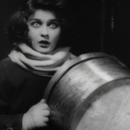
THE GIRL WITH THE HATBOX began as an inauspicious assignment: the film had to promote the new state lottery in some fashion. But Boris Barnet (making his solo directorial debut) and screenwriters Vadim Shershenevich and Valentin Turkin turned in something that exceeded expectations, as the film became a critical and commercial hit. It’s easy to see why it was so popular—it’s a funny, fast-paced comedy that contains enough surprises (in terms of both narrative developments and sight gags) to keep you on your toes for its hourlong run time. Natasha, the eponymous girl with the hat box, is a plucky young woman who lives with her grandfather on the outskirts of Moscow; they make hats for Madame Irène, who owns a boutique in the city proper. The film reveals early on that Madame Irène and her husband are scamming the state by claiming to rent a room in their apartment to Natasha but actually using it as a private study. They must pretend that Natasha lives with them whenever the state housing inspector pays a visit, which provides the grist for plenty of good farce. (The inspector’s visits also hint at the daily inconveniences of life under communism, something that American audiences aren’t generally used to seeing in Soviet films.) When Natasha meets Ilya, a young student living in the train station because he can’t find a place to live, the heroine decides to take advantage of her situation: she marries Ilya so he can use her spare room at Madame Irène’s. I won’t spoil what happens next, suffice to say that it involves a lottery ticket. Certain aspects of THE GIRL WITH THE HATBOX anticipate American screwball comedies of the 1930s, like Natasha’s flighty yet adorable behavior (star Anna Sten suggests at times a Soviet Carole Lombard), the speed at which the complications pile up, and the clashes, played for laughs, between the haves and have-nots of this world. Yet Barnet’s visual imagination, displayed in the frequent sight gags, distinguishes the film as unique, ditto his unflagging sympathy for his characters. Despite taking place in the wintertime, the film exudes an ingratiating warmth. Preceded by the surviving fragments of Barnet’s 1929 feature MOSCOW IN OCTOBER (Total approx. 33 min, Digital Projection). Both screening as part of the Boris Barnet: A Cinema Despite Life series. (1927, 65 min, 35mm) [Ben Sachs]
Tamara Jenkins’ SLUMS OF BEVERLY HILLS (US)
Doc Films (at the University of Chicago) – Thursday, 7pm
Tamara Jenkins has directed just three features to date, yet each one is a little masterpiece of comic filmmaking, rich in observational detail and exhibiting a distinctive perspective. That perspective—low-key, big-hearted, and unafraid of anything that falls under the category of human experience—is already evident in her first film, SLUMS OF BEVERLY HILLS. A concise yet unhurried movie, it takes place over the summer of 1976 and largely concerns the coming of age of a 14-year-old girl named Vivian (Natasha Lyonne). Jenkins establishes a wealth of information about this character within moments; the film practically opens with a scene of Vivian’s father (Alan Arkin, in a sublime performance) waking her up in the middle of the night so they can skip rent without waking the landlady. The family, which consists of Vivian, her single father and two brothers, has been rotating the outskirts of Beverly Hills for years, living in miserable apartments that happen to be “in the right zip codes” so the kids can attend good schools. Dad privileges education but has no sense of money beyond how not to spend it; in another delightful comic sequence that occurs early in the picture, he celebrates the family’s latest move by taking the kids out for steak and then leaving before the check arrives. When Vivian’s cousin Rita (Marisa Tomei) turns up in LA after escaping from a rehab facility, the family takes her in, since Dad knows his well-off brother will support them financially if Rita is living under their roof. She becomes an unlikely role model for Vivian, helping her navigate the physical changes of adolescence as well as her developing sexuality. The movie contains scenes about menstruation, masturbation, and loss of virginity, and the most striking thing about them is how genial they are. Jenkins presents these subjects as part of life and thus fodder for relatable humor—nothing here could be summarized as mere gross-out comedy or even highbrow shock humor à la Todd Solondz, whose HAPPINESS came out the same year as this and garnered far more attention. Yet time has proven SLUMS OF BEVERLY HILLS to be as good a film, if not better, not only for its humanity but for Jenkins’ astute class consciousness, which underscores her precise social portraiture. Screening as part of the Femalaise series. (1998, 91 min, 35mm) [Ben Sachs]
Jean-Pierre & Luc Dardenne’s YOUNG MOTHERS (Belgium/France)
Siskel Film Center – See Venue website for showtimes
Jean-Pierre and Luc Darenne have often depicted the plight of young women—see LORNA’S SILENCE (2008) or the Palme D’Or-winning ROSETTA (1999) for two of the best examples. Their latest follows five young women living in a shelter for young mothers and their newborns. The filmmaking duo spent time with actual shelter workers to forge a script rooted in authenticity and to check their own biases toward the subject matter; their collaboration with professionals earned them the prize for Best Screenplay at the 2025 Cannes Film Festival. Working with cinematographer Benoît Dervaux, the Dardennes move the camera freely through the space. While the use of verité style has been practically exhausted by modern filmmaking, the directors push it to its greatest potential, creating a subjective view of the faces of the mothers and their newborn children. This vision of universal sanctity juxtaposes with the struggles of drug abuse, rental deposits, co-parenting, and uncooperative fathers. Many characters remain trapped in a vicious cycle, with a number of them being unwanted by their mothers. Furthermore, many of these young women continue to search for their own identities within the limits of working-class Belgium. For many of the mothers—even those with economic security, supportive loved ones, and healthy coping skills—the postpartum period becomes one of the most difficult of their lives. If the same film were set in America, it would likely blur the lines between drama and horror. Yet every character does their best when confronted with manipulative parents, deadbeat boyfriends, addiction, or a society unwilling to assist its most vulnerable. The ensemble cast of young actors brings out the pathos of each storyline. Early in her career, Elsa Houben breathes full life to a young mother trying to maintain sobriety and her relationship with her boyfriend while trying to move out of the shelter. In a single shot, Janaina Halloy’s performance packs a blow to the audience as her character’s wish is fulfilled. Serving as the voices of reason, the social workers guide the mothers towards their best options. Their actions communicate to an audience that such situations do not need to end in tragedy. The film ends with hope as each mother finds what she was yearning for from a partner, a new family, or the fragments of their family: love and acceptance. (2025, 106 min, DCP Digital) [Ray Ebarb]
📽️ ALSO RECOMMENDED
Martin Scorsese's THE AGE OF INNOCENCE (US)
Siskel Film Center – Friday, 5:45pm; Sunday, 2:30pm; and Tuesday, 5:45pm
Depending on your point of view, this is either one of Martin Scorsese's grandest failures or one of his boldest triumphs. Certainly, it was unexpected for Scorsese to adapt Edith Wharton's Pulitzer Prize-winning novel, set among the high society of 1870s New York. Wharton's style is as reserved as the director's is visceral, and Scorsese approaches the discrepancy as a challenge: How to translate such a literary work, which derives its force from its describing unexpressed emotion, into a wholly cinematic one? Maintaining a placid tone in the performances, Scorsese pours himself into the dressing of the film: decor, positions of extras, music cues, verbose narration. One of the most obvious models here is Kubrick's BARRY LYNDON (1975), a film that Scorsese ranks among his favorites, and it shares with that movie a curiously inverted relationship between surface emotion and dramaturgy. (Indeed, this often seems as much a response to Kubrick as it does to Wharton.) The story is of an illicit affair between the complacent Newland Archer (Daniel Day-Lewis) and his wife's non-conformist cousin (Michelle Pfeiffer), a subject of barely hidden scorn since she walked out on a loveless marriage. Nearly all of the behavior we see is determined (hauntingly, tediously) by a rigid social order and the constant threat of excommunication; for this reason, Scorsese referred to AGE OF INNOCENCE as his most violent film. Screening as part of the Needle Drops series. (1993, 139 min, DCP Digital) [Ben Sachs]
Edoardo Mulargia & Giampaolo Lomi’s TROPIC OF CANCER (Italy)
Music Box Theatre – Monday, 6:30pm
TROPIC OF CANCER occupies a strange and revealing corner of early 1970s Italian cinema; it’s less a traditional giallo than a genre transplant made of two minds. Co-directed by Giampaolo Lomi and Edoardo Mulargia, the film reflects a collision of sensibilities rather than a unified vision. Mulargia, a reliable craftsman of Italian thrillers and westerns (including a few Django films) supplies the narrative scaffolding of intrigue, betrayal, and erotic menace. Lomi, whose background as an AD on GOODBYE UNCLE TOM (1971) reveals his interest in mondo documentaries, supplies the rest: the heat, the cruelty, and the impatience with plot whenever a filmable moment presents itself. The result is a film that frequently abandons mystery mechanics in favor of sensation. Fred and Grace arrive in Port-au-Prince as our potential protagonists. They are looking for Dr. Williams, an old acquaintance whose reputation as a humanitarian doctor suggests decency, or at least usefulness. The film wastes no time dismantling that comfort. From the first moments, events feel arranged rather than accidental. Near misses pile up. The camera often lingers just long enough to imply that someone is always watching. Williams himself is a collection of professional identities: he is a doctor, scientist, researcher, and possible entrepreneur who has discovered a valuable new drug while working in Haiti. The circumference of suspects increases with each scene. Enter Mr. Peacock—he’s wealthy, theatrical, and openly indulgent, lounging poolside with his nude male servants. Peacock bankrolls cockfights and exploits local labor. He is not subtle, and the film is not interested in making him symbolic. He is simply an expression of European excess transplanted into Caribbean heat, or he embodies colonialism in a western capitalism weight class. Motives and allegiances quickly blur. Grace is given hallucinogenic flowers and disappears into an extended delirium, one of the film’s most confident sequences. Narrative logic dissolves. What remains are bodies, red corridors, movement, and wind machines. Naked men bow before Grace, which feels like acknowledgment. Anita Strindberg’s Grace commands attention. The hallucinogenic scene shows Strindberg in all her giallo iconography. By the time she arrived in Haiti, Strindberg had become synonymous with psychological instability and erotic danger, particularly through her work with Umberto Lenzi. The film understands its assignment and gradually reorganizes itself around her. Strindberg does not need explanation. She needs space. When the mechanics of the mystery finally reveal themselves, the film treats the information as an obligation. Violence erupts near the end, briskly and with a celebration of fire. The solution matters less than the damage left behind. Lomi’s mondo instincts repeatedly override Mulargia’s genre discipline. Voodoo rituals, slaughterhouses, cockfights, and crowds of non-actors interrupt the narrative with documentary bluntness. Haiti is not imagined as a social world but as a series of sensory provocations. There’s an air of superiority that each Italian character exhibits when occupying scenes with the locals. Seeing them mistreat others allows us to fully indulge in their destruction. Explanations arrive late, if at all, and feel beside the point. TROPIC OF CANCER does not seek coherence so much as atmosphere. It is uneven, exploitative, occasionally crude, and intermittently hypnotic. What it captures, almost accidentally, is a moment when Italian genre cinema tested how far it could drift from structure without losing its grip. The answer, in this case, is messy, compromised, and strangely compelling. Screening as part of the January Giallo series. (1972, 95 min, DCP Digital) [Shaun Huhn]
Richard Linklater's DAZED AND CONFUSED (US)
Doc Films (at the University of Chicago) – Saturday, 9:30pm
Usually when a movie relishes its period detail this intensely it cuts corners elsewhere, but the rare feat of DAZED AND CONFUSED is its fully inhabited nostalgia. On the last day of school in the year of the bicentennial, incoming freshmen and seniors try on their respective roles for the first time through hazing rituals and the party to end all parties. Slapstick, sadism, stoner silliness, and sentiment all have their moments, but never overwhelm. Of course we can laugh at the pants and hair absurdities of high school in 1976; the aesthetic is not so far off from That 70's Show, but the difference is that while a cool guy is cracking a dirty joke at a freshman's expense, there's room onscreen for the pathos of the freshman's subtle facial reaction. Here the collar is wide, but the heart is true. Like all Linklater movies, DAZED AND CONFUSED is in no hurry to get anywhere, because it's all right there. This generous patience pays off; every character is worth spending time with, or they wouldn't be in the movie, right? Spanning from the last day of school until the following dawn, conversations get looser and more astral as the movie progresses, allowing even the squarest kids a chance to express some truly wonderful thinky-thoughts. Throughout the night the little triumphs and scores settled aren't inflated cinematically, they remain human-sized through Linklater's even-handedness, the large number of characters, and the skill of the young performers. It's an impressive cast of familiar faces, most at the very beginning of careers, and that wave of earnest effort floats the movie, giving it a very optimistic feeling. Screening as part of the Board Picks series. (1993, 103 min, DCP Digital) [Josephine Ferorelli]
Terry Gilliam's BRAZIL [Director’s Cut] (UK)
The Davis Theater – Tuesday, 6:45pm
Terry Gilliam and Sam Lowry—two impossible dreamers haplessly lashing out against the powers that be—are the twin heroes of BRAZIL, one behind the camera and the other before it. The behind-the-scenes narrative of this dystopian masterpiece has attained mythic status, with Gilliam locked in heated battle against Universal over their insistence on a more audience-friendly cut of the film, all while the fate of put-upon office drone Lowry (played with beleaguered bafflement by Jonathan Pryce) hangs in the balance. In fairness, it's not hard to see how a studio would look askance at the film before them. Gilliam takes his budget and constructs what is essentially just a child's blanket fort on the largest scale imaginable; a bureaucratic quagmire built of tubes and cardboard, at times dangerously close to coming apart at the seams. It's a world where instability is constantly threatening to undermine the tightly wound internal logic that governs everything, where loose cogs in the machine like Sam Lowry become threats simply because the system isn't wired to accommodate them. Under these conditions, there's a very thin line between getting imaginative and getting mad, so it's little wonder Gilliam followed a similar path to his protagonist. BRAZIL, among the most fantastically dark and detail-rich science fiction flicks ever, was—and remains—a visionary work worth fighting for. Screening as part of the Not Too Distant Future series. (1985, 143 min, New 4K DCP Digital Restoration) [Tristan Johnson]
Koji Shiraishi's NOROI: THE CURSE (Japan)
FACETS – Friday, 7pm
Each crafted sequence of Koji Shiraishi’s NOROI: THE CURSE is a jagged puzzle piece that fits into a portrait of doom. Released in 2005, NOROI emerged during a time when J-horror was slipping from the international spotlight. RINGU (1998) and JU-ON (2000) had been remade in Hollywood, soft and glossy for global consumption—replacing ambiguity with exposition and dread with Dolby. Shiraishi aimed for something different. After years working on projects within the J-horror cycle such as DARK TALES OF JAPAN (2004), JU-REI: GEKIJÔ-BAN - KURO-JU-REI (2004), and the REALLY? CURSED VIDEO (2003) films, it was Shiraishi’s deconstruction of the genre that became the most successful film of his career. It endures because it is utterly without hope—and in that hopelessness, it finds something terrifyingly honest. NOROI resembles a cultural x-ray: a grainy, flickering diagnosis of a Japan spiritually gutted by its own forward momentum. Shiraishi conjures a work that functions less like screaming in a forest and more akin to an autopsy. And we, as viewers, are sifting through its remains. Framed as a posthumous documentary stitched together from the now-vanished investigative footage shot by one Masafumi Kobayashi (Jin Muraki), NOROI is a Russian nesting doll of psychic breakdowns, media detritus, and old gods wanting to make a comeback. While American horror films of the time were preoccupied with torture and easy cash-in remakes, NOROI dives into the horror of cultural amnesia. The cursed deity, Kagutaba, isn’t a bargain bin boogeyman dug out of the mythological basement. The demon is a stand-in for everything Japan paved over in the name of progress: submerged villages, sealed shrines, dead languages, rituals lost to red tape and hydroelectric ambitions. The genius of Shiraishi’s method is that he never lets the metaphor announce itself. He opts for the cumulative dread of uncovering a terrible mystery via news clips, VHS artifacts, and fractured timelines. The aesthetic is pure anti-style: off-kilter angles, flat lighting, tape hiss. The style actively disorients you. By the time the climax occurs, the film has already collapsed the boundary between spectator and victim. The curse isn’t just in the plot; it’s in the format. The real horror isn’t Kagutaba, it’s the ontological collapse between document and fiction. The film’s schizophrenic effect comes from its refusal to honor chronology, coherence, or context. Shiraishi introduces his characters without explanation as to why they will be in Kobayashi’s documentary. Additional pieces of the puzzle that become pawns in a mythological spiral. The unhinged psychic, Mitsuo Hori (Satoru Jitsunashi)—imagine Crispin Glover playing Chuck McGill on Better Call Saul—rants about ectoplasmic worms while wearing a tin foil suit. Meanwhile, Kana Yano, a psychic child prodigy, vanishes like a fading echo while the film focuses more on the fact her parents died tragically after her disappearance. Marika Matsumoto plays herself (from 2001 to 2003, Marika acted as a spokesperson for Ministop, and was known as "Mini Stop-chan"). Each individual is cursed whether they are aware of it or not. While most horror traffics in catharsis—jump scares, last-minute reprieves, monster-versus-hero theatrics—NOROI offers no such comforts. There’s no final girl, no fight back, no tidy moral algebra. Only a tape mailed after a house fire. A postscript without survivors. A hero who vanishes into his own footage. It’s not a narrative; it’s an obituary. Which is precisely why NOROI endures. It wants to dismantle the idea that anything—history, ritual, even story structure—can protect you. And once that illusion breaks, what’s left isn’t fear, it’s a form of grief. (2005, 115 min, Digital Projection) [Shaun Huhn]
---
Screening as part of the Cold Sweat double feature with Joel Anderson’s 2008 film LAKE MUNGO (88 min, Digital Projection), which screens at 9:15pm.
Richard Fleischer's SOYLENT GREEN (US)
Northbrook Public Library (1201 Cedar Ln., Northbrook) – Wednesday, 2pm and 7pm
By now we all know what SOYLENT GREEN is made of: run-down, cheap-looking studio sets; sweaty, anonymous supporting actors; a hazy brown visual palette that seems to fog the celluloid; and an assortment of tightly-knotted scarves and other outdated fashions aggressively worn by Charlton Heston at his most macho. It may be the butt of jokes thanks to an SNL sketch, but its relentless claustrophobia holds up surprisingly well compared to other '70s dystopian visions (especially LOGAN'S RUN, which just seems campy now). The future will probably be more like the past than we usually care to admit. Its depiction of an overheated, overcrowded world populated by rigidly segregated classes (ranging from the sheltered rich to human "furniture") still holds a grungy, no-nonsense, 100% analog fascination that most recent dystopian films, with their slick and polished surfaces, can't match. What's often overlooked is Edward G. Robinson's performance, which was his last. It has a weary wistfulness that's distilled into a perfect poignancy in his last scene, when a genuine peace shines on his face for both the first and the last time. Screening as part of the Shades of Green film series. (1973, 97 min, Digital Projection) [Rob Christopher]
Mary Bronstein’s IF I HAD LEGS I’D KICK YOU (US)
FACETS – Saturday, 3pm; Sunday, 1pm; and Thursday, 9pm
It wouldn’t be too much of an exaggeration to say that at least a quarter of F I HAD LEGS I’D KICK YOU is composed of close-ups of Rose Byrne’s face, the very first shot of the film resting Byrne’s eyes, eventually pulling back to reveal her quizzical and frustrated reactions to the poking and prodding of the world around her. Byrne plays Linda, a psychotherapist whose world has become subsumed by two crises that threaten to swallow her whole. One is that Linda’s daughter suffers from an unnamed malady that has forced her to be hooked up to a feeding tube, leading to an extended absence from school and a strict dieting regimen with seemingly impossible recovery goals. This particular bump in the road of parenting might not be so bad were it not for the newly-emerging gigantic hole in the ceiling that has forced Linda and her daughter to vacate their Montauk apartment and shack up in a local motel (Linda’s husband is conveniently away on a work trip, avoiding this particular chaotic episode). Bronstein’s film exists, then, as its own gaping wound, festering and pulsating and begging to be picked at by whatever antsy force may be tempted to do so. Linda’s quest for peaceful stasis threatens to implode at any moment, her own elasticity (her daughter calls her “stretchy, like putty”) bending to the needs of whatever scenario has deemed itself most pressing. Her orbit additionally consists of her own psychotherapist, played by a tremendously droll Conan O’Brien, a patient (Danielle Macdonald) struggling with her postpartum maternal crisis, and the affable motel super (A$AP Rocky) inexplicably caught up in Linda’s web. One of the most fascinating stylistic turns Bronstein employs is the choice to never highlight Linda’s daughter’s face throughout the majority of the film, her presence captured only through brief physical glances and her constant, hilarious vocal intrusions. Linda’s own despair and suffering has caused her to barely even see her daughter as a presence to acknowledge; she’s just another problem to solve. Throughout her spiral through the drudgeries of parenthood, Linda is constantly being told “it’s not your fault,” a nails-on-a-chalkboard refrain that all but backfires in its intent. The grand truth is—and Bronstein’s film perfectly, hilariously, and artfully explores this—being a parent is an exhaustive role where you simultaneously are and are not responsible for the choices that lie before you. Parents are at the whims of the white noise of baby monitors, sleepless nights, the emotional irregularity of their offspring, and the loss of one’s self to become the guardian and caregiver for someone else. The sky is falling, the hole is expanding, and perhaps one day, it will all be better. (2025, 114 min, DCP Digital) [Ben Kaye]
Dan O’Bannon’s THE RETURN OF THE LIVING DEAD (US) and Sam Raimi’s ARMY OF DARKNESS
Metal Movie Night at Thalia Hall (1807 S. Allport St.) – Friday, 8pm
Do you wanna party?! It’s party time! What we have here is a cult film of impressive influence. Usually cult films find themselves an audience that clutches to them so tightly that they are nearly suffocated by the fandom and then never do much more than appeal to those diehards. Dan O’Bannon’s THE RETURN OF THE LIVING DEAD (1985, 91 min, Unconfirmed Format) has escaped this insularity; not only has it managed to reach legitimate cult status, but it has also helped create an entire new (sub)genre of film—the zombie comedy. Without THE RETURN OF THE LIVING DEAD there would be no MY BOYFRIEND’S BACK, no SHAUN OF THE DEAD, no ONE SHOT OF THE DEAD, no JUAN OF THE DEAD, etc. Just look at the worldwide influence in that short list alone; English, Japanese, and Cuban filmmakers all picking up where O’Bannon left off. Most famous for co-writing ALIEN and TOTAL RECALL, RETURN was the first of only two films he had the chance to direct. Based on his own screenplay, O’Bannon pits a crew of punk rockers against a graveyard full of zombies. A mysterious gas leaking from a U.S. government-marked canister infects employees and cadavers at a medical facility; the cremation of one of those newly undead contaminates the clouds overhead, creating a toxic rain that falls on a cemetery, bringing a host of zombies out of their graves. The plot is simple and direct, getting down to business right away. Played for laughs, THE RETURN OF THE LIVING DEAD mixes humor, horror, gore, and punksploitation into a film that once dominated the home video rental market, and still lends itself perfectly to revival screenings and midnight showings. The film is a love letter to underground culture as a whole; to weirdos, freaks, and the socially awkward looking for the same. RETURN augments its cult cred with a soundtrack of equally-cult bands: The Damned, Roky Erickson, 45 Grave, T.S.O.L., The Flesh Eaters, and of course, The Cramps. Unlike George A. Romero’s social-message zombie classics, RETURN is pure 20th-century American trash culture. And god bless O’Bannon for that. It’s a film of forever quotable lines, cheesy practical effects that you can laugh along with, and a Ramones-esque d-u-m-b nihilism that could have only been bred in the Cold War of Reagan’s ‘80s. This is a fun movie, plain and simple. I like it. It’s a statement. [Raphael Jose Martinez]
---
Also known as BRUCE CAMPBELL VERSUS ARMY OF DARKNESS, this is the third film in Raimi's saga following the moron Ash (Campbell) as he strives to save the world from the legions of the damned. Dripping with glee, ARMY OF DARKNESS (1992, 89 min, Unconfirmed Format) revels in its gore-splattered Deadite lunacy, featuring a plot that's little more than a series of contrivances for visual puns, hackneyed romantic clichés, and action set-pieces of virtuosic, if incoherent, energy. Every poke in the eye, every zombie glare, every threat upon one's edible soul is an opportunity for Raimi's teenage sense of humor to show itself, making this perhaps the most 3 Stooges-inflected action-horror film ever made. Certainly it's the lightest film Raimi's ever made, an effervescent dollop of self-mockery capping off a stage in his career of wild-eyed experiment and go-for-broke invention. This is filmmaking at its happiest, glorying in the bald capacities of cinema to shrink, duplicate, and transform its actors, to mold and mistreat space, to weirdly stutter and truncate time. Merely getting to move the camera is enough pretext for Raimi to set up an elaborate genre reference or visual gag, and the intricate stupidity of Ash, thrust back in time to Medieval England to fight the zombies he unleashed from the Necronomicon in the previous two (modern day) films is an elaborate counterpoint to his surprisingly badass versatility with a chainsaw and broomstick. In this lead role, Bruce Campbell, long-time muse to Raimi, demonstrates a self-effacing, deeply sensuous performance style that's long been under-recognized. One of the great physicalists of screen acting, Campbell's anti-naturalistic tics, too-careful gestures, and winking, self-aware line readings form a kind of over-saturated scaffold upon which the campy drapery of the narrative hangs. A scene-chewer in the best possible sense, Campbell steals every scene, dominates every shot, never missing an opportunity to deflate the film's artifices or turn his fellow actors' work against them. In the face of his mugging, defamiliarizing body, everyone else plays permanent catch-up. This is the last great Raimi film to date, and a milestone in Campbell's career. "Hail to the King, baby." [Kian Bergstrom]
---
The screening starts off with a DJ set by Metal Vinyl Weekend at 7pm and includes an intermission of metal videos and classic trailers.
Joe Dante's GREMLINS 2: THE NEW BATCH (US)
Alamo Drafthouse – Wednesday, 9:30pm
The etymologically mysterious "gremlin" is one of the most modern of myths, with its origin in WWII airmen's tales of technological sabotage; and while the 1984 film GREMLINS—set in a backlot-simulated small town—limited the mischievous animatronic-puppet destruction to consumerist sites of household goods and department stores, its sequel appropriately centers on a symbolic temple of managerial capital, a hyper-automated midtown office tower inspired simultaneously by Trump and Tati. As with the 21st-century horror film CABIN IN THE WOODS, an antiseptic and efficient surveillance bureaucracy is portrayed as a form of social organization whose continued survival is undeserved, and which must be duly and gleefully demolished by monsters of its own creation. This destruction is enacted through scene after scene of diverse genre parodies of camp cinema. Screening as part of the Weird Wednesday series. (1990, 106 min, DCP Digital) [Michael Castelle]
Jim Jarmusch's FATHER MOTHER SISTER BROTHER (US)
AMC River East 21 and the Music Box Theatre – See Venue website for showtimes
With FATHER MOTHER SISTER BROTHER, aging icon of sulky indie cool Jim Jarmusch may have reached the autumn of his career, that stage when some filmmakers, perhaps a little weary and with nothing left to prove, undergo a mellowing or paring-down of style. This is in many ways his straightest, simplest, and most sentimental feature, which is not to say it lacks his signature laconic wit or droll sense of existentialist detachment. The film is a tryptic of short stories of intergenerational distances, each bookended by a screen of dreamy flickering lights. In FATHER, well-off siblings Jeff (Adam Driver) and Emily (Mayim Bialik) check in on their widowed, financially and possibly mentally struggling recluse father (Tom Waits) in his New Jersey home. MOTHER focuses on a more dissimilar sibling pair, the materialistic pink-haired Lilith (Vicky Krieps) and the modest Timothea (Cate Blanchett), as they pay their annual visit to their posh writer mother (Charlotte Rampling) in Dublin. Finally, in SISTER BROTHER, fraternal twins Skye (Indya Moore) and Billy (Luka Sabbat) clean out their late parents’ flat in Paris. The first two stories unfold as dry comedies of manners, guarded encounters between estranged children and parents in which halting pleasantries conceal pains, insecurities, and resentments that are never spoken but are keenly felt. More sanguine, the third finds hope in how intergenerational gaps can be (belatedly) filled. All three stories include motifs that are mirrored or inverted across the others; as in Jarmusch’s PATERSON (2016), much of the pleasure here comes from picking up on the patterns. Some are obvious and quite funny—slow-motion skateboarders, Rolex watches, water and tea as questionable toasting beverages, a particular bit of British lingo—while others, like the use of eyeglasses or the repetition of certain camera angles, are more subtle. The latter helps spice up the flat digital images, mostly static closeup and medium shots that foreground the performers’ telling micro-expressions. Jarmusch hasn’t gone soft, exactly—these frosty relationships never do thaw out—but FATHER MOTHER SISTER BROTHER does tap a heartfelt universality in the familial(r) aches of its characters, reaffirming a maxim from Rynosuke Akatagawa once used by an idol of Jarmusch’s, Yasujiro Ozu: “Life’s tragedy begins with the bond between parent and child.” (2025, 110 min, DCP Digital) [Jonathan Leithold-Patt]
Park Chan-wook’s NO OTHER CHOICE (South Korea)
Alamo Drafthouse, AMC River East 21, Landmark’s Century Centre Cinema, Music Box Theatre, Regal City North and Regal Webster Place – See Venue website for showtimes
Neon, the distribution company handling the US release of NO OTHER CHOICE, put out an exquisite piece of PR: “On behalf of Director Park Chan-wook's new film, we are cordially inviting all Fortune 500 CEOs to a special screening of NO OTHER CHOICE. This is truly a film that speaks to our gracious executive leaders and the culture they have cultivated.” Whether any CEO accepted the invitation is beside the point—the provocation lands cleanly. NO OTHER CHOICE looks directly at the class that treats labor as an abstraction and asks them to sit with the human residue left behind. Audiences have embraced the film for its sharp wit and plainspoken clarity, recognizing themselves in its vision as the world lurches each day closer toward economic collapse. The film follows Man-su (Lee Byung-hun), a veteran paper-industry professional whose stable life implodes after an abrupt layoff during corporate restructuring. What unfolds is a slow erosion marked by repetitive job interviews leading nowhere, mounting debts, and quiet domestic compromises. Months stretch into a year. Man-su’s sense of dignity becomes increasingly bound to professional reinstatement, and his family home, formerly a symbol of personal history and stability, becomes a pressure cooker. Park shapes Man-su’s moral descent with procedural discipline. Routine governs the rhythm. Each decision emerges through deliberation, framed as practical problem-solving rather than impulse. Park’s labyrinthine tales of vengeance like LADY VENGEANCE (2005) are traded here for a straightforward logic. The tension at each moral quandary comes from recognition. Every step makes sense. And morality becomes another variable to manage. This framework traces back to Donald E. Westlake’s 1997 novel The Ax, a corporate satire that charts violence as career strategy. Park retains the architecture while reshaping the emotional terrain. Man-su is no longer alone inside his reasoning like the novel’s protagonist Burke Devore. The film places him within a family whose survival depends on shared silence and mutual implication. Responsibility spreads outward. Consequences echo inward. Glimpses of other laid-off workers provide a mirror for Man-su: men who have given up, workers who have been spit out and forgotten. Within Park’s body of work, NO OTHER CHOICE occupies a transitional space. His precision remains unmistakable: calibrated compositions, ironic musical cues, an enduring fascination with self-justifying ethics. Yet the film abandons the operatic violence of his other films like OLDBOY (2003), THIRST (2009), and THE HANDMAIDEN (2016). Violence here feels laborious and draining. Murder aligns with job hunting, interviews, and evaluations. It becomes another task to complete, another box to check. Dark humor, awkward missteps, and poorly executed plans brush against slapstick, an unexpected lightness that keeps Man-su recognizably human. By shifting focus away from revenge and obsession toward systemic design, NO OTHER CHOICE emerges as Park Chan-wook’s most direct examination of work as ideology. Employment defines dignity. Automation signals erasure. Survival demands compromise. The film offers no relief, only a clear-eyed portrait of a system accelerating toward collapse, guided by those insulated from its costs. Build identity around labor, strip it away, demand adaptation, and call it opportunity. Eventually, resistance becomes inevitable. There is no other choice. Unless, of course, a few CEOs attended the premiere and decided to reduce profits and expand their workforce. Cinema inspires miracles all the time; maybe that’s why the film was released on Christmas day. (2025, 139 min, DCP Digital) [Shaun Huhn]
Kelly Reichardt's THE MASTERMIND (US)
FACETS – Saturday, 5:30pm and Sunday, 3:30pm
THE MASTERMIND begins, like so many Kelly Reichardt films, obliquely and suggestively. A man moseys through an art museum, his gaze oddly intense. In another room, a woman, turned away from the camera, ignores her chatty boy; both then ignore another, similar-looking boy who sits down beside the other, nose in a comic book. As a security guard naps in the background, the man nicks a small figurine from a glass case and slips it unnoticed into the woman’s bag before they and the kids leave together. In this quietly observant opening, Reichardt succinctly sets the stage for a film about compromised attention and useless hubris, and how a person’s myopic self-interest ultimately effects a self-defeating estrangement from the world. The ubiquitous Josh O’Connor is smartly cast as James, bringing a soft-spoken affability to a character who is profoundly selfish and dishonest. Living a comfy, conservative middle-class life with his wife (Alana Haim, sadly underused) and two kids in suburban Massachusetts circa 1970, he puts it all on the line by plotting the heist of four Arthur Dove paintings from the museum he was scouting in the opening scene. Only, the unduly confident James doesn’t feel he’s risking anything at all, and after he’s able to successfully steal the paintings with his two accomplices, he thinks he’s in the clear. But things fall apart quickly, not with the frenzy of a traditional thriller but with the placid melancholy Reichardt has honed throughout a filmography populated with the most ordinary and hapless of outcasts and loners. James takes the inverse course to many of the filmmaker’s protagonists, starting from social privilege before becoming increasingly displaced and alienated. Surrounded by news broadcasts of the Vietnam War and the activism of protestors, he can do nothing but retreat ever-inward; his tragedy is not born from his criminal activity but his chronic failure to attend to the things that actually matter. Reichardt’s longtime DP Christopher Blauvelt shoots in glowing autumnal shades that gradually give way to the chilly light of late fall; Rob Mazurek’s lively jazz score is the only element not joining in the sense of regressive drift. By the deeply ironic denouement, thick with societal disillusionment, THE MASTERMIND has repeatedly and dolefully shown that its ostensible hero—perhaps America itself—has no clothes. (2025, 110 min, DCP Digital) [Jonathan Leithold-Patt]
📽️ ALSO SCREENING
⚫ Alamo Drafthouse
Jess Franco’s 1974 film LORNA, THE EXORCIST (99 min, Digital Projection) screens Tuesday, 9:30pm, as part of the Terror Tuesday series. More info on all screenings here.
⚫ Chicago Public Library
Celebrate the release of Nick Digilio’s new book, 40 Years, 40 Films, on Wednesday, 6pm, at the Rogers Park branch (6907 N. Clark St.).
View all screenings taking place at Chicago Public Library branches here.
⚫ Doc Films (at the University of Chicago)
Sarah Maldoror’s short documentaries ALBERTO CARLISKY (1980, 4 min, DCP Digital), MIRÓ (1979, 5 min, DCP Digital), WILFREDO LAM (1980, 4 min, DCP Digital), VLADY (1989, 24 min, DCP Digital), and MERCEDES HOYOS, PAINTER (2008, 13 min, DCP Digital) screen Saturday at 4pm; and Maldoror’s RENÉ DEPESTRE, HAITIAN POET (1981, 5 min, DCP Digital), LÉON G. DAMAS (1994, 28 min, DCP Digital), PÈRE LACHAISE CEMETERY (1978, 7 min, DCP Digital), LOUIS ARAGON: A MASK IN PARIS (1980, 19 min, DCP Digital), and MEMORY’S GAZE (2003, 24 min, DCP Digital) screen Tuesday at 7pm. Both programs are part of the Sarah Maldoror: To Make a Film Means to Take a Position series.
Joachim Trier’s 2025 film SENTIMENTAL VALUE (133 min, DCP Digital) screens Saturday, 7pm, and Sunday, 4pm, as part of the New Releases and Restorations series.
Todd Holland’s 1989 film THE WIZARD (100 min, DCP Digital) screens Thursday, 9:30pm, as part of the Screen Play: Cinematic Visions of Video Games and Sports series. More info on all screenings here.
⚫ FACETS
Ari Aster’s 2025 film EDDINGTON (149 min, DCP Digital) screens Saturday, 9pm.
Joachim Trier’s 2025 film SENTIMENTAL VALUE (133 min, DCP Digital) screens Sunday at 6pm and Thursday at 6:30pm. More info on all screenings here.
⚫ Mainstage Chicago (400 N. Racine Ave.)
Join the Mainstage team and Latine Film Gang Hangout for a night of networking on Thursday at 6pm. More info here.
⚫ Music Box Theatre
Mona Fastvold’s 2025 film THE TESTAMENT OF ANN LEE (137 min, 70mm) begins screening. See Venue website for showtimes. More info here.
⚫ Siskel Film Center
Kaouther Ben Hania’s 2025 film THE VOICE OF HIND RAJAB (89 min, DCP Digital) continues. See Venue website for showtimes.
The Chicago premiere of Abby Martin’s documentary EARTH’S GREAT ENEMY takes place Wednesday, 6pm, followed by a Q&A with Martin. More info on that event here and on all screenings here.
⚫ VDB TV (Virtual)
oliverio rodriguez and Victoria Stob's 2018 short film LYNDALE (24 min) and Sandi DuBowski's 1993 short film TOMBOYCHIK (15 min) stream for free on VDB-TV. Programmed by Cine-File contributor Elise Schierbeek. More info here.
CINE-LIST: January 16, 2026 - January 22, 2026
MANAGING EDITORS // Ben and Kat Sachs
CONTRIBUTORS // Kian Bergstrom, Michael Castelle, Rob Christopher, Maxwell Courtright, Ray Ebarb, Josephine Ferorelli, Shaun Huhn, Tristan Johnson, Jonathan Leithold-Patt, Raphael Jose Martinez, Michael Glover Smith
