
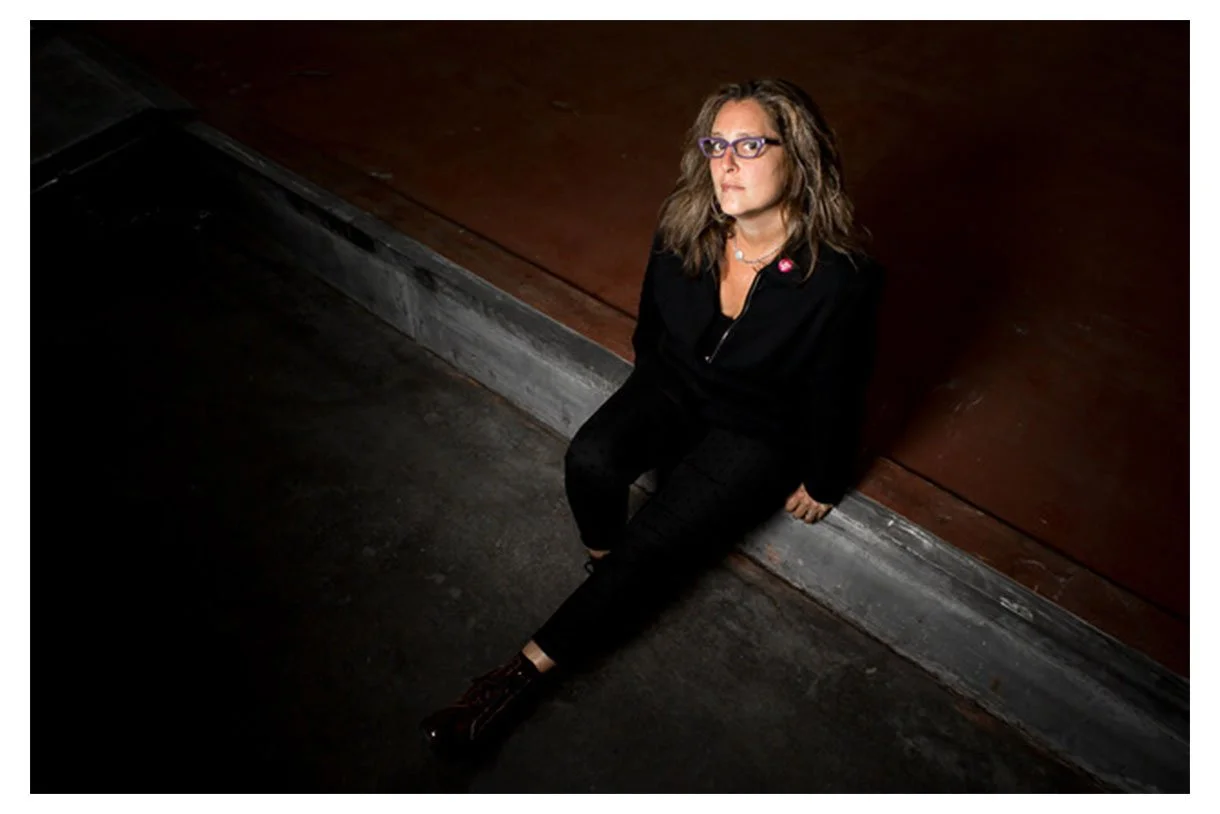
This interview has been edited for length and clarity. Photo source.
Cine-File: I'd like to start with the film's origins: your creative partnership with Carol Weaks Cassidy, and what drew the two of you to Wildwood in the first place. What was the impetus for the project?
Ruth Leitman: We actually knew each other as kids. We grew up together and went to high school together. We co-directed WILDWOOD, NJ, co-produced it. I shot it. Carol did a lot of the interviews; I did a lot of the interviews as well. I had been there shooting photography…. I started out as a photographer, so I was photographing there in about '90 and '91. We shot the film the summers of '92 and '93, did post in '94, finished it. We did the edit in '94 and went out on the festival circuit at that point. We were both living in Atlanta at the time when we made the film.
For me, it was about wanting to go to this working-class beach town that was actually, to be honest, the place my family didn't go to. My family went to Atlantic City and Longport and Ventnor. Carol's family went there. For me, it was really a forbidden place.
It was about about wanting to give a voice to these girls, mostly teenage girls, that I had been photographing. When I graduated from high school, I was reckoning with… I was in an abusive relationship when I was a teenager. And so this was really about going back and experiencing lots of things that I hadn't experienced myself. Wildwood was a place my friends from high school all went to after the prom, lost their virginity if they hadn't already. So it was about bringing a camera to this place and experiencing it maybe ten years later, and what that would have been like.
Carol and I both wanted to talk to young women and girls because so often they're not asked anything. They're not listened to. They're not valued in a certain way. We knew they had really incredible things to say, and they were uninhibited and really honest about their own lives. And it was at a time and a place where one didn't see independent filmmakers. It was funny, too, because they just automatically assumed we were the news. That's what they were used to. They weren't used to seeing cameras everywhere like they are today. So they were just really open and excited to talk about their lives.
CF: It's funny that they thought you were the news. I'm sure you explained that you were making a film. Did that change the context at all, or the response?
RL: The whole environment of how we were doing this was really foreign. We were an all-woman crew, there were four of us. In fact, one of the funny things that happened was Karen, who was the boom operator, had a giant boom with a giant zeppelin, because it's very windy there, and it's furry, right? So somebody came up to us and said, "Hey, where'd you win that?", thinking it was a stuffed animal.
We were a little bit of an anomaly and a novelty. And I think the fact that we were an all-woman crew made it very safe. It made these girls feel safe to talk about their lives with us. But yeah, they understood. We told them we were not the news. It's just that they didn't understand that there was anything else. And so it really made for a very comfortable situation.
Part of what happened on the boardwalk was we would approach groups of girls and ask if we could talk to them. Obviously not just young girls, not just teen girls, but a lot of different people. The film, as we edited and shaped it, certainly focused on that, and that was certainly the intent. We did these, what feels today, when you watch it, like these on-the-fly intimate moments, because we never knew when we were going to run into them again.
There were a couple of situations that were a departure from that, like Bonnie, the girl by the payphones who likes to fight. She's somebody I saw and approached, and I asked her if she'd be willing to be in the film. She thought about it, said yes, and then proceeded to blow me off for a week. I continued to try to find her by the payphones or the various places I had seen her hanging out. And eventually she was willing to allow me in with her, and I spent a lot of time with her on several different occasions.
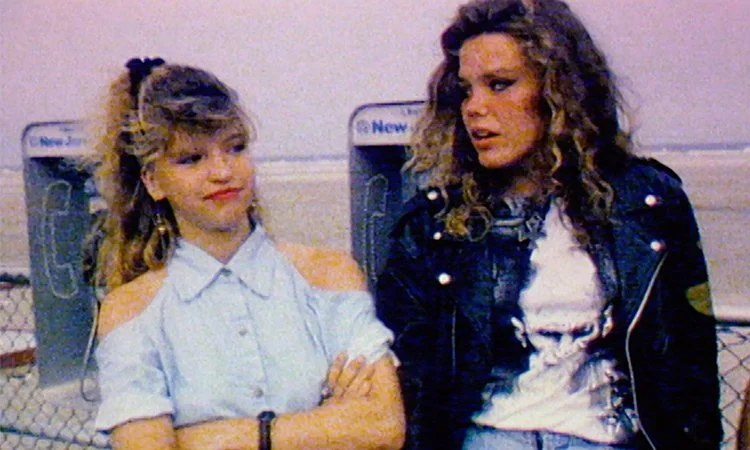
Bonnie and friend by the payphones. Photo source.
But these encounters were very spur of the moment, because we would connect with a group of girls, and then they were going to do something later. In the case of the group of girls where we go back to the apartment where they're staying and spend a lot of time with them there, we were their night's activities. They were into it enough that they could blow off the guys on the boardwalk and hang out with us.
CF: What does Wildwood represent to you beyond simply being a location? And are there aspects of its culture you consciously wanted to preserve on film?
RL: I think that for me, as well as for the women and girls who go there, Wildwood really represents a certain possibility of what's possible. That you might meet the boy of your dreams. Very heteronormative, for sure. Very white, for sure. And it's funny, when people write about it now, they'll talk about that, but that's what was happening there; that's what we were capturing. So I think that's a big part of it: that whole sense of possibility, what one can dream.
There were exchange students that came for a summer job from Ireland and Scotland and other places in Europe. Imagine being a high school student on a summer break, and you're going there and getting a job working at a hot dog stand or at the Skee-Ball, and this is the only thing you've seen of America. And couples got together from those summers. In fact, the film was invited to the Berlinale and screened this year in a retrospective, and there were couples there that had met in Wildwood on their summer vacation, or for their summer job, and then stayed together. That was really great.
But the one thing I think about a lot—and it's just been reconfirmed with these recent screenings—is that this film is really so much about the romance of female friendship. The good, the bad, and the mean. And it's been interesting, because I just showed the film in Atlantic City, and there were girlfriends who came together and they were taking selfies and snuggling in a way that felt really beautiful and safe, and was so much about this idea of, even with nostalgia, trying to recapture the kinds of friendships we had when we were really young. I think that's one of the things that draws people to it, and one of the things that helped give it its second, third, fourth life.
CF: Has revisiting the film through the restoration, and the process of taking it around, changed how you think about Wildwood today, or expanded it?
RL: This came up in Berlin as well. Someone asked me, “Do you think you could make this today?” It's just a really different time, and I don't think people are as forthcoming in the same way, because they're filming themselves all the time, because they're trying to present a certain way. Why is there a young woman in the film who tells me she likes to fight so much that she ended up taking someone's life? Why is that the thing she wanted to lead with? It's not the fodder of Instagram that we see right now at all.
I think Wildwood for decades was a place that remained the same, and that's one of the things people liked. They could go back in the '90s and it would still look very much like it did in the '60s. That lasted for a really long time. Recently, those things have changed a little bit. The beautiful signs of these old motels, many of them have been sold because they're worth a lot of money. It's become a lot more commercial. It was all mom-and-pop businesses for a while, and some of that has changed.
But I think the place was really a framework to talk about the greater things. Someone actually asked if this was a bit of a bait and switch. You say this film is about Wildwood, but it's really about these other things. And it is about these other things. It takes you to a place so that we can talk about the strength and resilience of young women who are never listened to.
CF: Was the assembling of the all-woman crew a conscious political or artistic decision, or the result of your creative community?
RL: I always felt comfortable working that way. I've pretty much worked that way ever since. I certainly work with men on other productions and have before, but a lot of the crews I've worked with have been all-female. It was definitely about what we knew: that we wanted to talk to teen girls about things they might not want to talk about as frankly with a male crew.
There was a lot of experimentation in this, including how I shot the film in the first place: the camera, and modifying the camera, and setting up first a Nagra and then a DAT recorder. Also, there was sound on the film—there was a magnetic stripe on some of that Super 8 film—so there was a lot of room for experimentation and error. It was really about talking through that to come up with a system that would be really agile, and also fun and experimental. I'd say there was a lot of learning along the way in terms of how we did it. The people who came with us were just really interested in the sociological experiment of being in this environment, in this very rich landscape, to tell the story.
CF: Speaking of Super 8, was that again a conscious decision, or born out of necessity? Can you talk about the origin of the Super 8 format as it connects to the work?
RL: I love film. I continue to shoot on film. I've made a lot of films since WILDWOOD, and I was a photographer before WILDWOOD, so I've always shot on film. The conscious decision to shoot on Super 8 rather than 16 at the time had to do with an aesthetic I was really interested in, which was a very dreamlike look of a home movie.
I also shot a lot of it from a wheelchair, a very cheap dolly. We killed that wheelchair over those two summers. And I loved the grain. We went to Brodsky & Treadway in Massachusetts to transfer it and do color grading, and they were the best. They literally wrote the book on color grading and transfer of Super 8 film.
The thing that's so interesting is that by shooting Super 8 in the '90s in a place that doesn't really change, often people think the film is from the '80s or the '70s, or it's unclear. And I think that was a very conscious decision on my part, the aesthetic about how I wanted the film to look and feel. Very grainy, and some of it's push-processed. Obviously, when you see it on the big screen, it's really grainy. You never forget that it's film when you watch it.
CF: What is it like watching your work about these real working-class women get absorbed into someone else's nostalgia aesthetic, like Lana Del Rey using shots from the film in her music video for “Diet Mountain Dew”?
RL: Well, it's funny. When the film first resurfaced, it was a perfect storm. In 2009, Rich Juzwiak, of Gawker and Jezebel, wrote me and said, hey, I want to write really thoughtful things about what you were able to capture in the stories of these young women and girls in New Jersey. And I proceeded to not write him back. I was working on something else, and I didn't know. Then he did it anyway, and it really blew up. And then Jersey Shore premiered. One of the girls on the boardwalk was then a 15-year-old Dina and is now Dina from Real Housewives of New Jersey. And Lana Del Rey used 25 shots in her first music video, for “Diet Mountain Dew,” unfortunately, with the juxtaposition of shots of JonBenét Ramsey, which was not my intent ever. But these things happen.
I'm probably, by necessity, as interested in the distribution and sharing of work as I am in making the work, because it's all about how people consume it and use it and relate to it. At the beginning I was like, “I don't understand why this is happening, this is crazy.” At the time I thought, okay, let's just make it available, and then other people were making it available themselves.
I like that it has resonated with people so much that it's become a part of their look, a part of their aesthetic. There was a series of designers in Milan who put together a whole runway show and a photo spread emulating the "fashions"—I'm air-quoting right now—of the girls in the film. To me, that was unbelievable. Other people were using it in fashion spreads. Vogue talked about it; a lot of different fashion magazines talked about it. That was certainly something I never expected, and something I feel was a testament to the authenticity of the film we made, and certainly the authenticity in how these girls let us into their lives in a way that was so real.
I think that's what I take away from it now. In 2009, when it had its first next life, I didn't really understand. I was like, "Why don't they want to talk to me about the film I'm making now?" And then I got it. Now it's a lot of how people find me. And I can really see the through line in what I gravitated towards for years in all of my other films: that everything does go back to our adolescent years, and finding the meaning of what we're trying to do with our lives, and who we want to be with, and who our friends are. It connects to my film LIPSTICK & DYNAMITE, about women wrestlers; it connects because it's all about the truths that we want to tell. Not necessarily what the truth or the greater truth is, but what is our truth. I don't know if that's an unwieldy way of saying it, but I really embrace that we were young and trying to do something that was real, that would resonate so many years later with so many different ages of people, and people who are certainly not just from New Jersey, but everywhere.
CF: What was the process of finding the subjects? They are very frank, but how did you earn that frankness they show on camera about sex, violence, family, all of these things? Or did it come about organically without needing to be cultivated?
RL: It was a little bit of both. We would observe people. That's the thing I mentioned with Bonnie—observing her, observing how she would hold court. Groups of girls that seemed pretty uninhibited, able to talk. Some people would come up to us and say, “Hey, what are you doing?” That happened a lot, actually, because they saw us with our gear: “Hey, what's that?” The microphone, the boom. “What could you possibly be doing?” And we'd say, “We're making a film about Wildwood; we've been coming here for a while.” And if they started to talk to us, we'd say, “Hey, can we film with you?” It was really that organic.
And then, yes, there were things we were talking to them about: their friendships, the relationships they were in, the fighting. Because that was a big thing. Where we grew up, girls liked to fight, and I've always been really interested in that. There's this thing about how many of us became friends with our best friends: first we were in a fight, and then we became friends, and then we stayed friends. I don't know if that's really specific to that area, but it was very much a part of how we grew up.
CF: Was there anything too raw, or too sad, or too violent to include?
RL: Well, the whole thing with Bonnie, meeting her, chasing her down, having her finally agree to be in the film. I think I ended up finding her in the middle of the night and getting her to finally say yes, and it was like, “Okay, film me now.” And it was a reduced crew of the already-reduced crew that we were. Having her tell me that she took someone's life… I think about that every day of my life. She taught me so much. Number one, she taught me that people really want to tell you what it is they want to tell you because of some other thing that's going on with them that will hopefully make them feel important. The fact that that's something she wanted me to know has always plagued me. And I don't believe that that's what happened. I don't know. It's funny, because the other night at a Q&A in Milwaukee, we were talking about that, where the truth lies in there, and why people want to tell an audience something. What would make her stand out, what would make her sound important. I think that was pretty harrowing.
Something else that I think a lot about when I watch it now—and this got brought up the other night as well—is there's a lot of abortion- and slut-shaming going on in there. Which is rather anti-feminist, for sure. Something else I learned very early on with that film, that continued on: I may not share political views with my subjects at all, but it is my job as a filmmaker to allow them to say what they need to say, because that's their truth. That's their autonomy, their agency over their own lives. That was very eye-opening for me. So I think that's the thing I squirm at the most—in fact, she's dating her best friend's uncle in part of the film—the slut-shaming, and that she's had a lot of abortions. Because when I say the warts-and-all part of the friendship: the whole weaponization of young women doing that to one another is something we are all coming to terms with right now, in the America we live in, right? Like, please don't say those things to other women. But I'm not going to censor you. If you say that, then we're going to talk about it.
CF: Have you stayed in touch with any of them?
RL: Yeah. I stayed in touch with Bonnie for a while and visited with her. And the mother of the “Somewhere Over the Rainbow” twins reached out to me when the film had its resurgence, so I've been in touch with her. I've been in touch with Betty—the “check to cash” girl. There was a shock-jock morning show that was quoting her over and over again in the mornings, and she went to a wedding, and all of these people were saying, “Hey, I saw you. This film is coming out again. What's going on?” She reached out to me because everybody's lives are so different now, and we talked through some of that. She was like, “Oh my God, my life is so much different. That's not who I am anymore.” And I said, “Yes, but people gain a lot of strength from you. You're really funny, you're no-bullshit, and I think women feel empowered by that.” So we had a really interesting conversation about that.
And just recently, somebody reached out to me about the Chicago show and said, “Oh, I really want to come, but I can't be there. I'm in it.” And I said, “You are? Who?” And she sent me a picture of herself. She's actually going to be at a screening in New Jersey. So that's starting to happen a lot more, people reaching out.
We obviously never expected the film would have this bizarre life. When I taught, I said to my students, “Be careful what you make first, because you never know what's going to happen with it. It's going to come out, and people are going to share it and talk about it.” And I'm not going to say judge you for it, but people will perpetuate its life. And I do think that's a gift. I think that's a really fun part of all of this. It definitely feeds
my interest in serving an audience in a really personal way.
There was a guy who came up to me at a screening a couple of weeks ago in Philadelphia… this was crazy. He brought a giant hunk of the boardwalk for me to sign. And he brought his whole entire family, like eight people. That's the kind of thing where, if we go back to the reason we make films in the first place, that's what we really want. But how do you attain that?
You asked about Carol and me. We made this one film together, and then we went different ways and did different things. I really connected with what was happening with the film because I liked the idea that I had no control over it—that we had no control over it—and that people were connecting to it in a way that didn't have to do with a distributor or anything. It had to do with people sharing it. It's still on YouTube. It doesn't look as great as what AGFA did; AGFA did a really nice job restoring it.
CF: I was going to ask how the restoration came about. And if I'm misrepresenting this, I apologize, but it was preserved from the DigiBeta tape master rather than the Super 8 elements?
RL: Yes. And there's definitely a part of me… I love film; I would have loved to have gone back to the original film. But I also really loved the color grading and the color session that happened with Brodsky & Treadway, and so that was the reason to preserve that. Also, it would have been really cost-prohibitive to go back to all of the original elements. I have all of the original elements, and that was a conversation. But when we looked at the restoration from the best digital masters, it made sense to do that. And then we did some sound work too.
CF: And lastly, I wanted to ask: is there a shot or sequence that still feels magical to you? Or maybe something that seemed crazy during production and became a favorite part of the finished film?
RL: I love Bonnie by the payphone, when the phone rings and she's yelling out to Dave, and then she mouths “motherfucker” to the audience. I love that, because the payphone became… it's funny, in a lot of the Letterboxd pieces, people are talking about the payphone, and at the screenings, people were talking about the payphone, because that's such a novelty for people now. Like, “here's a payphone sighting,” but it was actually in use. It's just one of those moments in documentary where you're capturing something happening that's unexpected, that tells you a lot about who you are watching it, but also what's happening with that character and everyone around them, that they kind of own that space. That tells me a lot more about who she is.
I love a lot of the music sequences in the film, where I'm in the wheelchair and I'm really low, and it's a little bit of a dance. I'm being driven through a bunch of teenagers wearing their best, hottest clothes, moving through people connecting in a way that feels kind of magical. I think those are the two things I really love the most. And I also love Betty and Chrissy with the whole “check to cash” thing, them really standing up for who they are, and sort of understanding that this is really temporary and everything will change. I think those things capture a moment that happened that will never happen again.
