


We will list/highlight physical screenings at the top of the list for theaters and venues that have reopened, and list streaming/online screenings below.
Check the venues’ websites for information on safety protocols and other procedures put in place.
🎟️ THIS WEEKEND!
Cine-File and the Front Row present the Chicago premieres of new restorations of Arthur J. Bressan, Jr’s PASSING STRANGERS (1974) and FORBIDDEN LETTERS (1979) at the Music Box Theatre on Sunday, July 25 at 7:30pm and 9:30pm, respectively. Tickets can be purchased here for $12 each or $15 for the double feature using discount code cinefile.
See our reviews of the films below. Each will be preceded by introductions from filmmakers and queer film historians Jenni Olson (co-initiator of The Bressan Project with Bressan’s sister, Roe Bressan) and Elizabeth Purchell (director of ASK ANY BUDDY and founder of the eponymous podcast), with a conversation between Olson, Purchell and Cine-File associate editor Kathleen Sachs.
---
Get your tickets here!
🔊CINE-CAST: The Cine-File Podcast
EPISODE #18
Episode #18 of the Cine-Cast opens with associate editors Ben and Kathleen Sachs and contributors Megan Fariello and Josh B. Mabe discussing all things VHS, from the democratization of cinephilia to TikTok filters. Next, contributors Mabe and Raphael Martinez chat with filmmaker Joe Swanberg about his new VHS rental pop-up operating out of Borelli's Pizza on Lawrence Ave. Finally, in a "Friends of Cine-File" segment, contributor Marilyn Ferdinand interviews her longtime partner Shane Truax about his experience working in a video story and his reminiscences of the medium. The introductory theme is by local film composer Ben Van Vlissingen. Find out more about his work here.
---
Listen to the Cine-Cast here!
📽️ PHYSICAL SCREENINGS
Arthur J. Bressan, Jr.’s PASSING STRANGERS and FORBIDDEN LETTERS (US/Adult)
Music Box Theater – Sunday, 7:30 and 9:30pm, respectively
🎟️ Get tickets to individual screenings or double feature here
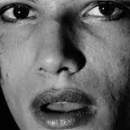
Arthur J. Bressan, Jr. had a fondness for Frank Capra—he wrote his thesis on the director and even spoke with him for a 1971 issue of Interview magazine. I’d say this penchant comes through in the way his films evoke dual senses of idealism and melancholy with regards to queer love and the gay liberation movement. Among his better-known films is the landmark GAY USA (1978), the first feature-length documentary made by and about persons from the LBGTQIA+ community, which embodies that duality more straightforwardly but no less intriguingly; later, in 1985, he wrote and directed BUDDIES, a strikingly sensitive endeavor and the first film to address the burgeoning AIDS crisis. Around these touchstones of independent queer cinema, he made his debut feature, PASSING STRANGERS (1974, 75 min), and, several years later, FORBIDDEN LETTERS (1979, 70 min), two hardcore films that have recently been restored by Vinegar Syndrome in collaboration with The Bressan Project. Having previously seen and admired GAY USA and BUDDIES, these newly available works account for two of my choice film discoveries of the past year, each exhibiting a distinct cinematic sensibility that complements the requisite intercourse. PASSING STRANGERS tells the story—yes, an actual story—of 28-year-old Tom (Robert Carnagey), who posts a personal in the Berkeley Barb that quotes Walt Whitman’s “To a Stranger” and 18-year-old Robert (Robert Adams), who responds. (Bressan himself features as a projectionist at a porn theater who’s friends with Tom.) One might hear ‘Walt Whitman’ and assume pretension, but that’s the beauty of the Bressan films I’ve seen: they’re wonderfully earnest, and he incorporates urbane references with heartfelt aplomb. Both PASSING STRANGERS and FORBIDDEN LETTERS utilize an epistolary approach; in the former, the two men exchange letters, which are read in voiceover and accompanied by various sexual scenarios onscreen. Some are near avant-garde in nature, as evidenced by one sequence where young Robert goes to a sex store and enters a single-occupancy viewing booth; images of Robert watching are superimposed onto images of the pornography he’s viewing. In the next scene, he masturbates while watching D.W. Griffith’s BROKEN BLOSSOMS (a first—maybe only—in porn?). In a later scene, Robert examines himself in a mirror, prodding at a few spots on his face, which then turns into that of a clown and then back into his own—it’s simple enough, but the almost Bergman-esque close-ups are breathtaking. This moment leads to a dream sequence in which Robert masturbates again while several naked men, including himself, jump up and down, blowing bubbles. Despite the joyous nature of the sex scenes, melancholy comes into play with Robert’s final letter to Tom before they meet; he expresses anxiety, writing, “You know more about me than anybody else, and we’ve never really met. I don’t understand you too well. You wrote that you have friends and that you’ve had lovers, and yet you said you’re not at all that happy. That blows my mind.” When the two come together in the second half of the film, Bressan switches from black and white to color, an obvious reference to THE WIZARD OF OZ. The men fly kites, have sex, and, toward the end of the film, attend a pride march in San Francisco, scenes that contain footage from Bressan’s 1972 documentary short, COMING OUT. Bressan seems to have wanted to make an artful film, a sexy film, and a political film, and he succeeds on all counts. FORBIDDEN LETTERS is a more worn-in romance, this time between the younger Larry (Robert Adams, who played Robert in the previous film) and the older Richard (Richard Locke), who's been arrested for mugging. It follows Richard’s imminent release from prison and consists of flashbacks to sexual encounters between the two or between Larry and others, ruminations on Richard’s time in prison—they have to sanitize their letters, lest anyone discover Richard is gay—and scenes with their friend, Iris (Victoria Young), a female sex worker whose long-winded assessment of their relationship is some of the most extraordinary acting I’ve seen in porn. Another of the more affecting sequences in this film merges Bressan’s desire to reflect gay life as well as the tantalizing aspects of gay sex. In voiceover, Larry talks about the first time he saw Richard, at a Halloween party in the Castro district, with glitter in his beard and a stunningly outfitted drag queen as his date. The footage is shot like a documentary, which imbues the scenario with a sense of realism that recalls a moment where someone might see another person and be instantly attracted to them. Like the preceding film, there are shifts in tone and style, some of the scenes shot in black and white and others in color, though here Bressan interweaves the two. He specifically uses black and white for intense sequences taking place in prison that serve as metaphors for the men’s constrained sexuality and their physical distance from one another, while flashbacks to the men at home and at play are often in color. Many of the latter sequences occur as Larry, in voiceover, reads a letter he wishes he could send to Richard, one full of love, gratefulness, and trepidation. I was as moved as I am by, say, Capra’s films, so do both auteurs’ films teem with the beautiful complexities of life in all its tricky splendor. Humorously, the end credits riff on the credits sequence from Orson Welles’ THE MAGNIFICENT AMBERSONS—likewise, they’re an apt assertion of Bressan’s personal mode of filmmaking: “My name is Arthur J. Bressan, Jr.,” he concludes, “and I made this motion picture.” [Kathleen Sachs]
Michael Sarnoski’s PIG (US)
Music Box Theater – See Venue website for showtimes
As Rob—a disheveled man living off the grid with his truffle pig— Nicholas Cage delivers a performance that overrides most of his 21st-century filmography. PIG is a reminder of Cage’s talent and commitment, transcending both the expectations and limits that audiences have placed on him since his Academy Award win for LEAVING LAS VEGAS. Making his directorial debut, Michael Sarnoski fashions a story about the death of dreams as brought about by the deaths of people we know and by other people taking over our stories. Rob goes on a journey to find his pig after she’s kidnapped; he’s accompanied by Amir (Alex Wolff), a young supplier in Portland’s high-end restaurant industry who exhibits little concern for his son. Shifting between the cutthroat supplier business and the culinary scene, PIG never falters in its twisted vision, considering how loss can force us to change, how food can trigger memories, and how a single man can impact an entire community. Sarnoski gives some fine actors (Cage, Wolff, Adam Arkin) nuanced moments to marinate in; the film’s emotions feel earned, not forced. An ode to food, memory, and mourning, PIG is also a welcome reminder that Cage can command a film when paired with the right director. (2021, 92 min, DCP Digital) [Michael Frank]
Morgan Neville’s ROADRUNNER: A FILM ABOUT ANTHONY BOURDAIN (US/Documentary)
Music Box Theatre — See Venue website for showtimes
As Anthony Bourdain, the subject of ROADRUNNER, says in a non-spoiler, the story of this film does not have a happy ending. It came as a shock when the charismatic celebrity chef, writer, traveler, and TV personality committed suicide in 2018. But to readers of Kitchen Confidential, the memoir that first catapulted him to fame, his one-time heroin addiction and marginal life in the restaurant industry suggested struggles under the glittering markers of success. Morgan Neville, an Oscar-winning documentarian whose films often focus on famous people (WON’T YOU BE MY NEIGHBOR [2018], KEITH RICHARDS: UNDER THE INFLUENCE [2015], BEST OF ENEMIES: BUCKLEY VS. VIDAL [2015]), lets Bourdain speak for himself through clips and outtakes from his TV shows and other archival footage. The film goes through Bourdain’s life in chronological order, highlighting his first meeting with Eric Ripert, the French chef who became one of his best friends, as well as the origins of his partnership with Lydia Tenaglia and Christopher Collins, the married couple who produced his first show, A Cook’s Tour, and its spinoffs, No Reservations, The Layover, and Parts Unknown. Interviews with Tenaglia, Collins, and other people in Bourdain’s life—including chef David Chang, producer/director Helen Cho, artist David Choe, and Bourdain’s second wife, Ottavia Busia-Bourdain—illuminate and expand on stories told in the various clips. Fans of Bourdain’s TV shows will recognize a lot of the footage; indeed, the film feels like a two-hour episode of Parts Unknown rather than a fully fleshed-out documentary, as it doesn’t go beyond its subject to consult other sources or consider the subject’s larger influence. If you don’t know anything about Bourdain, ROADRUNNER is a reasonably good introduction. If you do, you’ll recognize the film as an elaborate, if belated, celebration of his life that should have arrived shortly after his death. Letting Bourdain’s still-grieving friends dump all over actor Asia Argento (his last girlfriend) without offering her a chance to appear onscreen is a pretty low blow. Ultimately, the observations and speculations about Bourdain do not uncover the reasons for his suicide, which is an unfathomable act no matter who does it. (2021, 119 min, DCP Projection) [Marilyn Ferdinand]
---
Also showing at the Music Box Theatre is Jörg Adolph’s 2021 documentary THE HIDDEN LIFE OF TREES (81 min, DCP Projection). Check Venue website for showtimes and the Music Box Garden Series line-up.
Free Screening of "Signature Move" #TCSG
Comfort Film at Comfort Station (2579 N. Milwaukee Ave. – Outdoor Screening) – Friday, 7:30pm
From Comfort Station’s website: “Join us for our kickoff event to the Chicago Screenwriter's Getaway! We are so excited to partner with Full Spectrum Features and Comfort Station to bring a free screening of Chicago film "Signature Move" to you! Join us for a brief mixer at the beginning and an introduction to Mezcla Media Collective, then a showing of the film.”
---
Jennifer Reeder’s debut feature is a charming rumination on modern relationships and identity. Zaynab (Fawzia Mirza) is a proud Pakistani, Muslim lesbian who takes up luchador-style wrestling when she’s not working at her day job, but she finds herself compartmentalizing the many facets of her identity when her recently widowed conservative mother moves in—and tries to search for a suitable husband for her only daughter. But when Zaynab falls for Alma (Sari Sanchez), her worlds collide in unexpected ways—and she realizes she can’t keep who she is away from the people she loves. As with the rest of Reeder’s work—including KNIVES AND SKIN and a wide array of intimate short films—SIGNATURE MOVE is most interested in peeling back the layers of how we communicate with one another and the relationships that mold us. The relationships you have with your partner, your family, and your own sense of self are all interwoven, even if you spend so much of your life trying to separate them or hide them from others. SIGNATURE MOVE uses the glitz and performance of wrestling to initiate thoughtful conversations on the masks we all wear, especially as queer people. It’s full of heart, introspection, and endearing humor—all while being wholly Chicago. (2017, 80 min, Digital Projection) [Cody Corrall]
---
Also taking place at Comfort Station is Codes of Radical Persistence, a film series inspired by the life and work of Greek painter, Yannis Tsarouchis, whose work is currently on display at Wrightwood 659. Screening on Saturday is Paola Revenioti’s 2015 documentary KALIARDA (Digital Projection); per Comfort Station’s website, “[t]he program also includes archival footage and premieres a new virtual performance, Affect Alien, by Athens-based artist Antigoni Tsagkaropoulou Bunny which intertwines the experience of the famous activist and rebetiko singer Sotiria Bellou with her close friend Yannis Tsarouchis.” Check Venue website for more details; the films in this program will be on view virtually here for a week following the Friday premiere.
Abel Ferrara’s MS .45 (US) and Andrew Bujalski’s SUPPORT THE GIRLS (US)
Analog Rooftop Cinema at Borelli's Pizzeria (2124 W. Lawrence Ave.) – Friday and Saturday, 9pm
Ferrara (1981, 80 min, Digital Projection) and Bujalski (2018, 91 min, Digital Projection)—need we say more?
---
Tickets cost $20 cash, which includes a drink.
🎞️ LOCAL ONLINE SCREENINGS – New Reviews
Rosalynde LeBlanc and Tom Hurwitz’s CAN YOU BRING IT: BILL T. JONES AND D-MAN IN THE WATERS (US/Documentary)
Available to rent through the Gene Siskel Film Center here and the Music Box Theatre here
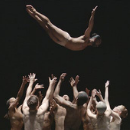
From out of the tragedy of the 1980s AIDS crisis in the United States were issued some incredible works of art. One of them, a dance called D-Man in the Waters (1989), emerged from the Bill T. Jones/Arnie Zane Company, less than a year after Zane’s death from AIDS in 1988. The piece, composed of the company’s improvisations to Felix Mendelssohn’s buoyant Octet for Strings as artfully edited and arranged by Jones, was seen by the dance world as a test of Jones’ abilities. Not only had he lost the love of his life, but he had also lost the main choreographer of the company they ran together. Could Jones make it as a choreographer on his own? Some 150 pieces later, the answer is a resounding yes, and it was obvious from the first performance of D-Man, a kinetic work that channeled the company’s sorrow, rage, and youthful resilience in the face of sickness and death in a way that transcended its moment. Or did it? With the film’s very title, co-director Rosalynde LeBlanc (an original member of the Jones/Zane company) prepares us for the challenge she issued to her dance students at Loyola Marymount University in Los Angeles. Could D-Man move a bunch of teenagers who have heard little or nothing about the AIDS era? Does the dance still have meaning? CAN YOU BRING IT provides a history of Jones and Zane, the exhilaration of sexual liberation experienced by the gay community during the 1970s, and the viral hurricane that swept so many away during the plague years. Several surviving members of the company talk movingly about those times as the film shifts focus to LeBlanc’s casting and rehearsals for the student performances of D-Man, with Jones coming in to work with the dancers and request a cast change that requires LeBlanc to work one-on-one with a freshman who entered the class without formal dance training. As we watch several iterations of portions of the dance, as performed by the original company, the current company, and the student dancers, suspense builds. What is it that the students care enough about to help them infuse their movements with meaning? I’m not sure how he did it, but award-winning co-director and cinematographer Tom Hurwitz (who has made several dance-related films) manages to get in among the dancers to an astonishing degree. The film reminded me of Michelangelo’s Four Prisoners as it mirrors the young dancers' struggle to connect with each other, trust each other, and emerge from the prison of their individuality to become a community with an urgent message to deliver to the world. (2020, 94 min) [Marilyn Ferdinand]
Nobuhiko Obayashi’s War Trilogy (Japan)
Available to rent through the Gene Siskel Film Center here
CASTING BLOSSOMS TO THE SKY
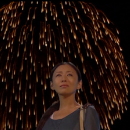
The first film in Japanese writer-director Nobuhiko Obayashi’s war trilogy is a dizzying bend of fact and fiction—to watch it is to get sucked into a whirlwind of narrative and historical information. An opening title card modestly introduces CASTING BLOSSOMS TO THE SKY as “a movie essay,” but it’s much more than that, as Obayashi integrates made-up stories so fluidly into historical accounts that the film is ultimately unclassifiable. It centers on a female reporter named Reiko (Yasuko Matsuyuki), who travels to the town of Nagaoka in central Japan at the invitation of an ex-boyfriend she hasn’t seen in almost two decades. He wants her to report on the production of a historical drama written by one of his high school students, but Reiko’s curiosity leads her—and, by extension, the filmmakers—to investigate myriad aspects of Nagaoka’s past. Principally, Reiko learns how the town became the site of a famous annual fireworks display and how Nagaoka suffered through numerous wars. Few people outside of Japan know that the U.S. Army dropped nearly 1,000 tons of bombs on Nagaoka shortly before the atomic bombings of Hiroshima and Nagasaki; while the latter events quickly overshadowed the former, the destruction of Nagaoka was so sweeping that the reconstruction of the town took years. CASTING BLOSSOMS argues that Nagaoka (and possibly all of Japan) still hasn’t recovered from the spiritual damage wrecked by WWII and the events leading up to it, but that art can serve as a palliative for lasting historical trauma. The film practically opens with a quote from the artist Kiyoshi Yamashita: “If people made pretty fireworks instead of bombs, there wouldn’t have been any wars.” This line serves as the organizing center for the centrifugal structure, which moves unpredictably between interpersonal drama, history lessons, and documentary segments. (Even the title is a play on the Japanese word for fireworks, hana-bi, which literally means “sky flowers.”) Many of the film's insights don’t become evident until after the it ends, however; Obayashi’s editing—rooted in his beginnings as an experimental filmmaker and avid fan of Jean-Luc Godard—is so rapid and at times disorienting that it’s almost hard to believe the filmmaker was in his 70s when he made this. (2012, 160 min) [Ben Sachs]
---
SEVEN WEEKS
I’d seen only one of Nobuhiko Obayashi’s films before embarking on the three, two-hour-plus tomes that comprise his war trilogy. HOUSE (1977), the film I’d seen prior, is nearly a surrealist horror classic at this point; one watches it and is struck by the utter singularity of Obayashi’s kaleidoscopic vision. It’s no wonder, then, that a comparable sensibility demarcates the awe-inspiringly ambitious triptych, of which SEVEN WEEKS is the second entry. A series of disparate-yet-connected, narrative-based annals, the films mimic the complicated history of Japan during and after WWII through a mosaic-like approach that resembles the harshly assembled tessellations of an indomitable nation’s long-since and no-so-distant past. SEVEN WEEKS does so through the death of an elderly doctor with a penchant for painting; after his death, his family gathers to partake in a Buddhist ceremony that involves memorializing the dead every seven days over a period of 49 days in total. The surviving family members run the gamut from the doctor’s sister to several grandchildren and even a great-grandchild, a feisty young girl who imbues the film with the childlike awe that distinguishes Obayashi’s work. Also present is a beautiful, mysterious woman who is—or is at least thought to be—the doctor’s nurse. She lingers around the family as they likewise reminisce over their dearly departed’s life, the history of the region they’re in—Ashibetsu, in the Hokkaido Prefecture, a seemingly unremarkable town pervaded by tentatively recalled dreams and nightmares, as well as a now-defunct amusement park called Canadian World—and their own modest narratives. The nurse, a ghost-like figure who gently haunts the film as she does the deceased’s family, may be the young woman whom the doctor had known during the war or, more likely, the young woman’s specter; she apparently died under traumatic circumstances many years before, during an attack by the Russians. Mystifying flashbacks suggest the doctor as well as his friend were in love with the young woman. In his essay on HOUSE for the Criterion Collection, critic Chuck Stephens writes that Obayashi’s “sensibility [was] steeped in a romanticism far more Truffaut than Godard,” the latter of whom Obayashi especially admired but whose political fervor Obayashi eschewed for something more romantic. The suggestion of a love triangle and the presence of an almost sphinx-like object of attraction (though here conferred more sentimentally) recall Truffaut’s classic JULES AND JIM. The influence of the French New Wave is also felt, as in the other entries in the trilogy, through the film’s vigorous editing and the utilization of childhood and young adulthood as a metaphor for both existential growth and, ultimately, spiritual and even physical death. Obayashi examines a country beleaguered by intense ground warfare (including the use of nuclear bombs, which cloak the trilogy as the bomb’s plume does its target) and more recent ecological catastrophes as if reflecting on a traumatic childhood, the scars of which are constantly felt even if healed on the surface. The director, however, doesn’t hold back in bringing such trauma to the forefront; with a background rooted in experimental cinema and advertising, it’s what’s being seen—which in these three films is everything, as each is filled to the brim with myriad threads and throughlines—that matters. In taking one man’s life and looking back on it, Obayashi conveys not just literal history but the sense of history, which itself is a lifetime of places and their people and with which reckoning is needed for its ghosts to finally be at peace. (2014, 171 min) [Kathleen Sachs]
---
HANAGATAMI
HANAGATAMI pulses with the color red. It runs from images of lipstick stains to rose petals to toy fish, but two related forms dominate this film: blood and the Japanese flag. The final part of Obayashi’s war trilogy, it takes place in the seaside town of Karatsu in the spring of 1941, as Japan prepares to amp up its military operations. Although it's based on a 1937 novella by Kazuo Don, the film describes a generation that was sacrificed to World War II. The teenage Toshihiko (Shunsuke Kobuza) moves to Karatsu, where his aunt takes care of a cousin, Kira (Keishi Nagatsuka), who suffers from tuberculosis. He quickly befriends other students as well as a few adults and becomes involved in the community; unfortunately, he's arrived at the moment when boys and men were expected to serve in the army. Even his long-haired, communist school teacher shaves his head and joins up. Obayahsi marshals an exciting array of filmmaking techniques: horizontal wipes, hand-drawn animation, obvious green-screen backdrops. From HOUSE on, his work consistently identified with youth and took delight in fantasy, generally without recourse to expensive special effects. By the time he made HANAGATAMI, Obayahi had long since given up any lingering naturalism, using colors saturated to the point of distortion to create an uncanny sterility. Drawing on Japanese theater, his films luxuriated in artificiality. But Obayashi never used style to distance the spectator from his characters, instead advancing an eccentric identification with their struggles. HANAGATAMI was the first film he made after he received a diagnosis of terminal lung cancer, and he expected it to be his last one. (He lived long enough to end his body of work with LABYRINTH OF CINEMA [2019], an anguished, idealistic meditation on the same theme of Japan at war.) His presentation of characters as phantoms revived temporarily feels tempered by the director’s own impending mortality, turning this into the testament of an elderly man who outlived almost all of his peers. (2017, 169 min) [Steve Erickson]
🎞️ LOCAL ONLINE SCREENINGS – Held Over/Still Screening/Return Engagements (Selected)
Roy Andersson’s ABOUT ENDLESSNESS (Sweden)
Available to rent through Facets Cinémathèque here and the Music Box Theatre here
Swedish writer-director Roy Andersson trades almost exclusively in tableau-like shots that suggest the offscreen space goes on forever—in this regard, all of his features beginning with SONGS FROM THE SECOND FLOOR (2000) could be called ABOUT ENDLESSNESS. Andersson’s style is by now immediately recognizable; as Nick Pinkerton summed it up in a November 2020 article for Sight & Sound: “It comprises a string of vignettes, almost all playing out in a single take, viewed by a locked-down camera with a static frame that holds its human subjects in the philosophical distance of a deep-focus long shot… The skies in his Stockholm are overcast or pale; the light in the city is weak and milky; and the walls are bare in the city’s seedy cafés and offices and flats. Grays and off-whites proliferate, and the palette is desaturated, as though colors have lost their will to live in this cold climate.” For those who appreciate his aesthetic or his dry, Scandinavian wit, Andersson’s approach is endlessly compelling. Each shot feels like a little world unto itself (too bad Chicagoans can’t see this on a big screen); the director strews details all around the frames, creates expansive backgrounds, and brings each scene to a pointed observation reminiscent of a fable or parable. ABOUT ENDLESSNESS (for which Andersson won the Best Director prize at the Venice Film Festival) feels especially parable-like in its focus on big philosophical questions. The movie runs just 76 minutes but has the air of an epic, since Andersson seldom strays from considerations of what it means to live, love, believe, act morally, kill, grieve, and die. Most of the scenes are narrated by an omniscient figure who flatly delivers pithy descriptions of the onscreen action (e.g., “I once saw a man who wanted to surprise his wife with a nice dinner…”), which renders them, alternately, universal and almost comically simple. Indeed, the straight-ahead, presentational style is a reliable source of deadpan humor; even the recurring character of the preacher who’s lost his faith comes across as a little funny when seen from such an exaggerated distance. Andersson’s style can be devastating too, as in the scene of a man who instantly regrets carrying out an honor killing; and it can be majestic, as in a scene occurring roughly halfway into ABOUT ENDLESSNESS that finds three young women improvising a dance in front of an outdoor cafe in late afternoon. A director prone to using miniatures to create the illusion of outsize spaces, Andersson is very good at reminding us how small—which is to say, precious—humanity is in light of eternity. (2019, 76 min) [Ben Sachs]
Courtney Stephens and Pacho Velez’s THE AMERICAN SECTOR (US/Documentary)
Available to rent through the Music Box Theatre here
For those of us who witnessed it, the fall of the Berlin Wall in 1989 was a surprise and the beginning of a sea change in the world order as we knew it. In the ensuing years, sections of the Wall were sold to interested buyers all over the world as historical artifacts and, in some cases, works of graffiti art. Co-directors Courtney Stephens and Pacho Velez spent more than a year crisscrossing the United States to places where one can view pieces of the Wall. The often-random distribution of Wall sections is quite interesting. The film opens with one concrete monolith sitting isolated in the middle of a forest. Two others show up at the side of an interstate highway, apparently not even near a rest stop. Southern California has more Wall segments than any other part of the country, though no one seems to know why. More expected are the museums and other institutions that house segments and chunks, including the George H.W. Bush Presidential Library, where a rather beautiful sculpture shows bronze horses in active motion trampling the Wall underfoot. I was excited to learn that a part of the wall lives inside the Brown Line’s Western ‘L’ station, which I went in and out of for years when I lived in Lincoln Square, an ethnic German neighborhood. Perhaps most fascinating is an audio recording of Stephens speaking with someone at CIA headquarters, who explains that many clearances would be needed for Stephens and Velez to film the section at Langley. The spokeswoman says that people working for the CIA wondered whether the end of the Cold War meant that the agency would be disbanded—how naïvely quaint. I’m not sure that THE AMERICAN SECTOR makes any grand statements, despite its closing words of how we are back to building walls again, but it sure is a fun ride. (2020, 69 min) [Marilyn Ferdinand]
Agnieszka Holland’s CHARLATAN (Czech Republic)
Available to rent through the Music Box Theatre here
Handsomely wrought, Agnieszka Holland’s biopic of Czech herbalist and faith healer Jan Mikolášek continues the director’s ongoing exploration of people operating within oppressive political regimes. The renowned Mikolášek (played by lauded Czech actor Ivan Trojan), whose career spanned the mid-20th century, is a curious subject for biopic treatment; his practice of healing patients through herbal remedies, prescribed after examining their urine, doesn’t lend itself to one’s idea of compelling cinema. But because of Marek Epstein’s curious script and Holland’s disquisitive direction, the film becomes a wry study of loyalty, passion, orthodoxy, and dissent. The story is framed by Mikolášek’s arrest in the late 50s, when he was accused by the Czech communist government of deliberately poisoning two high-ranking party members. Through flashbacks, we see Mikolášek as a brusque young soldier-cum-gardener, played by Trojan’s son Josef; he becomes an herbalist after he cures his sister’s gangrenous leg using plants. The story then follows him as an older man as he sets up practice in a dilapidated mansion and helps (per his count) millions of people over the course of his career, his patients ranging from peasants to Nazis to communist party officials. It’s been speculated that Mikolášek was gay; his marriage was an unhappy one, and his assistant (here called František, played by Juraj Loj) lived with him for decades. The filmmakers indulge that idea, using the fraught relationship between Mikolášek and František to emphasize the complexity of the faith healer and his unusual engrossment with a largely unsubstantiated practice. He treated basically whomever, even if he did not agree with their politics, though he also rejected their systems (his practice, for example, was privately held, and he made a lot of money doing it, both contrary to communist ideals) and was subjected to admonishment by both the Nazis and the communists despite having treated officials in each group. Naturally, some people believed that since Mikolášek wasn’t a licensed doctor, he was in fact a charlatan, yet another reason he was targeted by the authorities. As in many of her films, most famously the 1990 tour de force EUROPA EUROPA, Holland probes the narrative convolutions with stunning aplomb, likely influenced by the circumstances under which she grew up and started making films in post-war and communist Poland. The story sometimes lags, focusing too much on the speculative relationship between Mikolášek and his assistant, but Holland makes up for it with compelling visuals that add a sense of profundity. Mikolášek was a complicated man with natural gifts; whether they were for healing or deception (of himself as well as others) is left for us to decide. (2020, 118 min) [Kathleen Sachs]
Jafar Panahi’s CRIMSON GOLD (Iran)
Available to rent through the Gene Siskel Film Center here and the Music Box Theatre here
Abbas Kiarostami receives screenplay credit on Jafar Panahi’s fourth feature, CRIMSON GOLD, and one of the many compelling things about the film is how it plays like an inversion of Kiarostami’s TASTE OF CHERRY. That film told the story of one man’s efforts to find someone to bury him after he commits suicide; the hero’s quest, which confirms his connection to other people, is ultimately life-affirming in spite of its morbid nature. CRIMSON GOLD opens with a botched robbery that ends with the hero’s suicide, then flashes back to show the days leading up to that event; it’s a despairing journey that builds upon Panahi’s depiction of modern-day Tehran as an unforgiving hellhole that he introduced in THE CIRCLE. As in TASTE OF CHERRY, the hero’s progress is marked by three encounters, though here, the hero doesn’t initiate them. Hossain is a pizza delivery man, and the people he meets on his deliveries tend to regard him from the start as a social inferior. (Compare this with the gratitude with which the strangers regard Mr. Badii when he offers them rides in his SUV.) Each encounter reminds Hossain of his powerlessness within Iranian society, though, ironically, each one hinges on a moment of camaraderie. In the first, Hossain recognizes his customer as a military buddy from the Iran-Iraq War; the old acquaintance, embarrassed to see Hossain reduced to delivering pizzas, leaves Hossain with kind words and a handsome tip. The delivery man is unable to complete his second delivery, as the apartment building he’s supposed to enter has been surrounded by a police tactical unit, which waits in ambush for people leaving a party with illegal drinking and dancing on the second floor. The officer in charge of the unit berates Hossain for trying to enter the building, but forbids him from leaving the scene, since he could find a phone somewhere and warn the partygoers about their impending arrest. Hossain has a poignant conversation with a teenage soldier before deciding to share his undelivered pizzas with policemen lying in wait. The third key encounter of CRIMSON GOLD takes place in the high-rise condo of a rich man whose apartment has just been vacated by two female guests. Feeling spurned and lonely, the rich man invites Hossain in for dinner. He’s much nicer to Hossain than the wealthy jewelry store owner who’d condescended to him in an earlier scene; still, the apparent randomness of the rich man’s kindness—which Hossain clearly recognizes—speaks to the great, and likely insurmountable, social divide between him and Hossain. Like Kiarostami’s decision to place the hero’s death at the start of the movie, the scene in the high-rise makes Hossain’s act of desperation seem inevitable. Heightening the film’s morbid air is the ghostlike lead performance by Hossain Emadeddin, an actual pizza delivery man and an actual paranoid schizophrenic. Emaddedin’s deadpan under-reaction to practically everything borders on comical, yet it also reflects the inability of isolated, working-poor individuals to impact the system that degrades them. (2003, 96 min) [Ben Sachs]
Teona Strugar Mitevska’s GOD EXISTS, HER NAME IS PETRUNYA (North Macedonia)
Available to rent through the Music Box Theatre here
“It’s 2018, but it still feels like the Dark Ages in Macedonia,” says TV reporter Slavica (Labina Mitevska, sister of the film’s director). Slavica and her cameraman, Bojkan (Xhevdet Jashari), are in the small town of Štip to cover an unusual story—a woman named Petrunya (Zorica Nusheva) joined in a religious competition meant only for men and recovered the sought-after lucky cross tossed in the river by the town priest (Suad Begovski-Suhi). The townspeople, especially the young men who believe that Petrunya stole the cross from them, are scandalized and demand that she give it back or face dire consequences. But Petrunya broke no civil law, and the police who hold her for questioning aren’t quite sure what to do with her. The situation set up by Mitevska, who co-wrote the intelligent and perceptive screenplay with Elma Tataragic, examines the persistence of patriarchy in the modern world. Petrunya is a 32-year-old, overweight woman who lives with her supportive, but ineffectual father (Petar Mircevski) and her mother (Violeta Sapkovska), who seems to both hate Petrunya and want to keep her tied to her apron strings. A college graduate with a degree in history who has never had a job, Petrunya is humiliated when she applies for work with the manager of a garment factory (Mario Knezović). The entire set-up, with the manager sitting in a glass-walled office in the middle of a room full of women working at sewing machines, is masculine control writ large. Nusheva brings to life all of Petrunya’s frustration with her dead-end circumstances, her anger at her belittling mother, and her confusion about how to change her life—a confusion that impelled her to jump into the water to find the cross without even thinking. I had flashbacks to Jan. 6 watching the angry young men of the village mass at the police station and break through the glass door to visit their displeasure on Petrunya. They are the cross she and the other women in the film have had to bear their whole lives—one Petrunya finally realizes she doesn’t have to shoulder anymore. Inventively shot by DP Virginie Saint-Martin, the film tips into humor during the interview segments, with Slavica answering her own questions and airing her feminist viewpoint. It is during one of these interviews that we come to understand the film’s title. One of the townsmen says he doesn’t understand what the fuss is about. “What if god is a woman?” he says. What if, indeed. (2019, 100 min) [Marilyn Ferdinand]
Jeanne Leblanc’s LES NÔTRES (Canada)
Available to rent through Facets Cinématheque here
Ripping the lid off a small town to reveal its depraved underbelly has long been a strategy for social criticism, but this had lost its sting around the time AMERICAN BEAUTY won the Best Picture Oscar. Yet Jeanne Leblanc’s film goes much deeper, generating a bleak tone that presents sexual abuse as horrible but banal. The streets of Sainte-Adeline, Quebec, are almost parodically broad, green and sunny. But the town is haunted by an industrial accident which killed 13-year-old Magalie’s (Emilie Bierre) father. After she passes out during a dance rehearsal at school, a doctor’s examination reveals that she’s in her second trimester of pregnancy. Her mother (Marianne Farley) and much of the town suspect that Magalie’s best friend Manu (Leon Diasco Pellettier) is the father. She receives harassing texts on her phone. But she has actually been groomed to believe she can consent to sex with Manu’s father Jean-Marc (Paul Doucet), the town’s mayor. Leblanc’s direction keeps its distance from the actors, framing them in medium shot. LES NÔTRES runs on barely suppressed tension, giving the audience more information than the characters. For a narrative which could have set out to shock or turn into melodrama, it’s actually fairly hushed. (On the soundtrack, crickets constantly chirp, melting into Marie-Heléne L. Delorme’s dark score.) Some images would fit perfectly in IT FOLLOWS, and LES NÔTRES suggests a horror film about a girl’s coming of age with all the metaphor and allegory stripped away. Bierre brings the character to life while preserving her inner mystery. The final shot, in which Magalie stares blankly at the camera, suggests the difficult life ahead of her while retaining the film’s reticence to speak too loudly. (2020, 103 min) [Steve Erickson]
Beth B.’s LYDIA LUNCH: THE WAR IS NEVER OVER (US/Documentary)
Available to rent through the Music Box Theatre here
For those unfamiliar with Lydia Lunch, a short primer: Lunch is a prolific multidisciplanary artist and shit-stirrer who began her career in late-1970s New York. Initially known for her work in such (in)famous No Wave bands as Teenage Jesus and The Jerks, Beirut Slump, and 8-Eyed Spy and for her collaborations with filmmakers Richard Kern, Nick Zedd, Vivienne Dick, and Beth B., Lunch has gone on to work with artists ranging from Nick Cave to Hubert Selby Jr. to Weasel Walter over the ensuing decades. LYDIA LUNCH: THE WAR IS NEVER OVER, a new collaboration with Beth B., is a film essay of sorts. It isn’t a traditional biography showcasing art from Lunch’s past; rather, the film explores the overarching themes of her work. Placing as much attention on the work she’s doing now as on her heroic years as a teenager/twentysomething, THE WAR IS NEVER OVER explores how the motivations behind Lunch’s art—her unique takes on feminist, sexual, and artistic politics—have never wavered and how they may be more relevant today than ever. The film is still filled with absolutely blistering archival footage, not to mention equally jaw-dropping contemporary performances. For fans of Lydia Lunch, this is absolutely essential; for those who have only heard her name in passing, this is the perfect overview. Like Lunch’s work, the film is direct, running barely over an hour. And every minute is worth it. (2019, 75 mins) [Raphael Jose Martinez]
---
Read an interview with filmmaker Beth B. and the film’s subject, Lydia Lunch, on the blog here.
Jean-Paul Salomé’s MAMA WEED (France)
Available to rent through the Music Box Theatre here
Patience Portefeux (Isabelle Huppert), a translator of Arabic who works for the Paris police, is having a difficult time making ends meet. She owes money to the Chinese manager of her apartment building as well as to the nursing facility where her mother lives. When an opportunity arises to solve her financial problems and repay the kindness of her mother’s caregiver, she unhesitatingly masquerades as Mama Weed, a Muslim drug dealer. The crime thriller films of director Jean-Paul Salomé frequently feature female protagonists and at least a few A-list actors who elevate the material. MAMA WEED, which Salomé adapted from a novel by Hannelore Cayre, benefits greatly from the presence of Huppert, who adds to her distinguished and storied career with an amusing but complex portrayal of an enigmatic woman for whom personal loyalty, even to a long-dead husband, overrides virtually all other considerations. This energetic crime film thankfully eschews violence to focus on character dynamics, but stereotyping Arabs and Chinese as criminals is a sloppy, offensive genre attitude Salomé should have avoided. (2020, 104 min, DCP Digital) [Marilyn Ferdinand]
Seth McClellan’s OTHERS BEFORE SELF: VOICES FROM THE TIBETAN CHILDREN’S VILLAGE (US/Documentary)
Available to rent through the Gene Siskel Film Center here
Due to the outreach efforts and charisma of His Holiness the Dalai Lama of Tibet, the world has learned of and largely sympathized with the plight of the Tibetan people, whose land was seized some 60 years ago by the People’s Republic of China. The Chinese outlawed the country’s language, culture, and religion, and continue to oppress, torture, and kill Tibetans. To keep Tibetan traditions and hope alive, the Dalai Lama established the Tibetan Children’s Village (TCV) in the Himalayan mountains of India. OTHERS BEFORE SELF offers a brief, but complete portrait of the TCV, where teachers act like parents for the children separated from their families in Tibet and the children learn English and take classes in Tibetan language and culture. Most importantly, the teachings of Tibetan Buddhism—compassion, love, others before self—are passed on to them in the hope that they will eschew bitterness as they grow up and move out into the world. The residents of the TCV, even some of the youngest, speak for themselves and their feelings about the Chinese government (not the people), which they see as greedy and selfish. They give voice to their hope, or lack thereof, of being able to see Tibet, most for the first time, and reclaim it for the Tibetan people. In showing a group of children working together and developing their minds and hearts, McClellan has painted an effective portrait of how we could create a more peaceful, pleasant world community. The cynic/realist in me thinks we’re doomed, but the dreamer in me was inspired by this moving, beautifully filmed documentary. (2021, 55 min) [Marilyn Ferdinand]
Suzanne Lindon’s SPRING BLOSSOM (France)
Available to rent through the Music Box Theatre here
Suzanne Lindon was just 20 years old when SPRING BLOSSOM (which she wrote, directed, and starred in) received its virtual premiere at the 2020 Cannes Film Festival, making her one of the youngest filmmakers—if not the youngest—to have a film in competition there. It is very much a young person’s movie, for better and for worse. On the one hand, Lindon conveys youthful feelings of vulnerability, restlessness, and self-involvement with striking accuracy; on the other, the film sometimes comes off as simple and naive, and Lindon’s tendency to place herself at the front and center of the scene makes the film’s self-regarding perspective indistinguishable from the one it depicts. SPRING BLOSSOM doesn’t approach the level of narcissism that Vincent Gallo reached with THE BROWN BUNNY, but it seems to come from a similar place, as Lindon demands viewers watch herself as she watches herself. Underscoring the personal nature of the project, Lindon plays a character named Suzanne. A seemingly well-adjusted 16-year-old Paris high school student, Suzanne is tired of her routine: she’s introduced surrounded by friends, their conversation muffled into background noise, as she finds herself unable to engage with them with much interest. One afternoon, Suzanne notices an actor outside a theater where the play he’s in is being performed. She becomes smitten with the older man (whom, we later learn, is 35), and gradually works her way into an acquaintance with him, setting up “accidental” meetings until he decides to invite her to a cafe on his own. Viewers dreading the story of an illicit sexual relationship will be pleasantly surprised to find that Lindon keeps the budding romance chaste, focusing on Suzanne’s growing confidence rather than her sexual awakening. Raphael, the actor, may come off as something of a cipher (the film never establishes convincingly why he’d welcome the romantic attention of a high school student), but Arnaud Valois at least succeeds in making him not seem like a creep. Lindon parts with realism in a few unexpected sequences where the characters break out in choreographed movements (it would be an overstatement to call it dancing), putting their ineffable feelings into moving images. The technique, like most of SPRING BLOSSOM, walks such a thin line between charm and preciousness that it will probably take another few films before Lindon falls decisively on one side or the other. That’s just fine—she certainly has time. (2020, 74 min) [Ben Sachs]
Melvin Van Peebles’ THE STORY OF A THREE-DAY PASS (France)
Available to rent through the Music Box Theatre here
THE STORY OF A THREE-DAY PASS, the first feature by influential independent Melvin Van Peebles, inspires comparisons with Jean-Luc Godard’s BREATHLESS with its intercontinental romance and jazzy montage, but a more fitting point-of-reference may be the films of William Klein, another American expatriate working in France when this was made. Like Klein, Van Peebles shifts frequently between naturalism and cartoonish exaggeration, and he exhibits a chic visual sensibility throughout. (The black-and-white cinematography is by Michel Kelber, whose long filmography includes Jean Renoir’s FRENCH CANCAN and Nicholas Ray’s BITTER VICTORY.) The three-day pass in question belongs to Turner, a Black American soldier who’s stationed in France. The white superior officer who grants the leave makes clear that he’s doing so to reward Turner for his obsequious behavior; in fact, he promises Turner a promotion when he gets back. The protagonist has mixed feelings about all this, and Van Peebles dramatizes the character’s ambivalence through scenes where he talks to another version of himself in the bathroom mirror, the mirror-image raising doubts and even calling his double an Uncle Tom. Turner manages to put his concerns aside when he leaves his base for Paris, enjoying himself first as a tourist and then as a paramour, entering into a romance with a white Frenchwoman named Miriam. Van Peebles presents their relationship in a freewheeling, Nouvelle Vague-like style, though the aesthetic doesn’t distract from the obstacles they face in finding happiness. Everywhere the couple goes, they’re met with dirty looks, insidious questions, and even physical confrontations; things reach their worst when Turner runs into some suspicious fellow (white) soldiers when he and Miriam are on the beach. The impediments to interracial romance are portrayed, alternately, as scary and comic. In one of the more inspired visuals, Van Peebles cuts from the couple’s first time in bed to a shot of Miriam being surrounded by a group of Africans in traditional tribal garb. This sort of bold imagery points ahead to Van Peebles’ incendiary classic SWEET SWEETBACK’S BAADASSSSS SONG (1971), the film with which the writer-director would cement his reputation. (1967, 88 min) [Ben Sachs]
Zaida Bergroth’s TOVE (Finland)
Available to rent through the Music Box Theatre here
Coming-of-age stories are normally thought of as involving teenagers who learn the realities of adult life. In fact, we all come of age again and again as we pass through new phases of our lives. The unique coming-of-age tale director Zaida Bergroth tells in the biopic TOVE covers roughly 10 years in the life of Tove Jansson, a Finnish artist best known for her fanciful Moomin children’s books. Tove (Alma Pöysti) is 30 years old when the narrative begins in 1944. She is living at her parents’ home in Helsinki, trying to emerge as a serious artist from the long shadow of her censorious father, sculptor Viktor Jansson (Robert Enckell). When she fails to win a competitive grant to study abroad, she moves out on her own and begins her journey of self-discovery. The troll illustrations that eventually become the Moomins are introduced as mere doodles to help Tove unblock her more serious artistic impulses. It takes the encouragement of Vivica Bandler (Krista Kosonen), an upper-class theatre director with whom Tove falls deeply in love, to recognize their worth. Pöysti is engaging as the high-spirited Tove, infusing a fairly conventional biopic with energy and complexity. She is well supported by her fellow actors, particularly Kosonen. Linda Wassberg’s cinematography is warm and lush, befitting a story of creative and romantic passion. The costumes, art direction, and soundtrack laced with 1940s swing music evoke the exuberance of the post-WWII era and a certain go-for-broke attitude that Pöysti grows into. I particularly like a scene inside a lesbian club in Paris that is a riot of liberated women enjoying being themselves. TOVE offers a sumptuous and fully fleshed world that is a pleasure to visit. (2020, 103 min) [Marilyn Ferdinand]
Hong Sang-soo's THE WOMAN WHO RAN (South Korea)
Available to rent through the Gene Siskel Film Center here
The films of prolific South Korean auteur Hong Sang-soo have become steadily more oriented around their female protagonists since he began working with Kim Min-hee in 2015’s RIGHT NOW, WRONG THEN. This mighty director/actress combo has reached a kind of apotheosis in their seventh and latest collaboration, THE WOMAN WHO RAN, a charming dramedy about three days in the life of a woman, Gam-hee (Kim), who spends time apart from her spouse for the first time after five years of marriage. When her husband goes on a trip, Gam-hee uses the occasion to visit three of her female friends—one of whom is single, one of whom is married, and one of whom is recently divorced—and Hong subtly implies that Gam-hee’s extended dialogue with each causes her to take stock of her own marriage and life. Gam-hee also comes into contact with three annoying men—a nosy neighbor, a stalker, and a mansplainer—while visiting each friend, situations that allow Hong to create clever internal rhymes across his triptych narrative structure. Hong’s inimitable cinematographical style has long favored long takes punctuated by sudden zooms and pans, but rarely have the devices felt as purposeful as they dohere. Notice how his camera zooms, with the precision of a microscope, into a close-up of a woman’s face immediately after she issues an apology to Gam-hee during the film's final act, and how the tears in this woman's eyes would not have been visible without the zoom. This is masterful stuff. (2020, 77 min) [Michael Glover Smith]
🎞️ LOCAL ONLINE SCREENINGS – Also Screening/Streaming
⚫Chicago International Film Festival Summer Screenings
Summer Screenings is a free weekly film series that celebrates sports and games from around the world. This week’s selection is Anwar Safa’s 2018 Mexican film YOU ARE MY PASSION (105 min), featuring a livestream Q&A with Safa on the streaming platform at 8:30pm following the film. More info here.
⚫Facets Cinémathèque
Paul Sattler’s 2021 film BROKEN DIAMONDS (90 min) is available to rent beginning this week through August 19.
Paul Felten and Joe DeNardo’s 2020 screwball thriller SLOW MACHINE (72 min) and Sahar Mosayebi’s 2019 Iranian film PLATFORM (87 min) are available to rent through July 22 and August 5, respectively. More info here.
⚫Gene Siskel Film Center
LOST AND FOUND: THE ECSTASY OF WORDPLAY, presented in conjunction with the Low-Res MFA Show at the School of the Art Institute of Chicago (SAIC) Galleries, is available to view through July 31. Viewers can visit the Low Res MFA Show website and schedule an appointment to view the exhibition if so desired.
Óskar Páll Sveinsson’s 2020 Icelandic adventure documentary AGAINST THE CURRENT (87 min) and Max Basch and Malia Scharf’s 2020 documentary KENNY SCHARF: WHEN WORLDS COLLIDE (77 min), about the East Village artist, are available to rent through July 29.
Nancy Buirsk’s 2021 documentary A CRIME ON THE BAYOU (89 min) is available to rent through August 5.
Ursula Liang’s 2021 documentary DOWN A DARK STAIRWELL (83 min) and Lisa Immordino Vreeland’s 2021 documentary TRUMAN & TENNESSEE: AN INTIMATE CONVERSATION (81 min) are available to rent through August 12.
⚫Music Box Theatre
Carlos López Estrada’s 2021 film SUMMERTIME (90 min) is available to rent beginning this week. Check the Music Box website for hold-over titles and the Music Box Garden Series line-up.
⚫Video Data Bank
VDB presents the online program I Wanna Be Well: Gregg Bordowitz, with two video works by the artist, activist, writer, and teacher, FAST TRIP, LONG DROP (1993, 54 min) and ONLY IDIOTS SMILE (2017, 22 min). View them here.
🎞️ ADDITIONAL ONLINE SCREENINGS
Poetry of the Everyday (Experimental)
Streaming through July 31 for free on the Memorial Art Gallery of the University of Rochester website here
Programmed in conjunction with an in-person cinematic performance by Tara Merenda Nelson at the University of Rochester, this online screening is centered on several of Nelson's highly-personal Super 8 pieces and other films from masters of the miniature format. These small-gauge films command big emotions and themes of death, mental illness, and radical upheavals both personal and political. Jonas Mekas' oft-quoted ideological little ditty is sung in the heart of each of these films: "I live—therefore I make films. / I make films—therefore I live. / Light. Movement. / I make home movies—therefore I live. / I live—therefore I make home movies." Rose Lowder's BEIJING is a bit different from her venerated dynamic nature films. This one is more diaristic in nature, showing the everyday occurrences of the capital city shortly before the 1989 protests. Some of her single-frame dances still appear, but she takes a much more observational tone rather than her regular intensely investigative. Nelson's FLYING FISH is a tender domestic portrait of her pregnant sister with gorgeous colors and sun dappled bodies and poetic editing rhyming birds in the sky and children's toys. Nelson's 43 STREET TREELAPSE is a simple and clever black-and-white, triple-screen cataloging of the homes on her block as a way of orienting herself in her new home. For those unfamiliar, Helga Fanderl is an absolute master of the Super 8 form. Since the 80s she has been making very brief Super 8 films of beguiling, gentle mystery and rattling power and rhythm. Fittingly for the theme of the program, the four films shown here (LEOPARD; MÄDCHEN/GIRLS; THE COLOR RUN 3’18; and IM SCHNEE/IN THE SNOW) are of the former harmonious variety. Nelson's SNOW is film documenting time the filmmaker spent under painkillers resting in the hospital after a surgery. The film is blurred in vision by the effect of the drugs, blurred in content by the frosty outside weather, and blurred in form by the hand-processing and scratched text. All those hazy layers add up to an oddly incisive film about disorientation and healing. Anne Charlotte Robertson's FIVE YEAR DIARY, REEL 31: NIAGARA FALLS, AUGUST 19–28 is a chunk of her massive diary project that most deeply echos Mekas' previously mentioned lines about the unwaveringly intertwined activities of art and life. Robertson lived with mental health issues for most of her adult life and died in her early sixties from cancer. For her, creating film and living were indistinguishable and her films are ravishing testaments to both. Ending the program on an elegiac note, Nelson's LAST DAY OF CAPRICORN is a reflective and mournful film made in tribute to Robertson shortly after her death. (1983-2014; approx. 71 min) [Josh B Mabe]
CINE-LIST: July 23 - July 29, 2021
MANAGING EDITOR // Patrick Friel
ASSOCIATE EDITORS // Ben Sachs, Kathleen Sachs
CONTRIBUTORS // Cody Corrall, Steve Erickson, Marilyn Ferdinand, Michael Frank, Raphael Jose Martinez, Michael Glover Smith
Quisque iaculis facilisis lacinia. Mauris euismod pellentesque tellus sit amet mollis.